Author: Al Ngu, MDiv
Why is Westminster confessions so important?
Without the one and only true God, society, the nation, descent into violence and evil
The subject of polygamy and divorce in Old Testament and New Testament
The future lies in the Lords Way, not ours
Inheriting the promises of God
How do you struggle to take delight in the Lord’s Day?
How do you struggle to take delight in the Lord’s Day? How could the WCF’s teaching on the Lord’s Day be applied to your life, or the lives of those in your church to help in seeing the beauty of the Sabbath?
I will admit that it is a challenging and difficult process to take delight in the Lord’s day in the sense of what Westminster confession talking about keeping the Sabbath holy unto God By making preparation of our heart and ordering our common affairs beforehand, and observe a holy rest all the day from our works, words, thoughts and our worldly employments and recreations. But also, to be taken up the whole time in the public and private exercise of his worship in the duties of necessity and mercy.
This is a very strong dedication and setting aside the Lord’s day as a Sabbath day holy unto God that require essentially almost a complete holy rest from all our works so as to be taken up in worship on the Lord’s day. This practically is almost impossible because of the heavy schedule of bi-vocational seminary student and a full-time job so as to catch up all the assignments and paper and preparation on the weekend is crucial just to barely stay on top of it.
I would say Isaiah 58:13-14 helps me a lot in the perspective in terms of the word “delight”. Isaiah writes that if we turn back our foot from the Sabbath, from doing our pleasure on God’s holy day, and call the sabbath a delight, and the holy day of the Lord honorable, if we honor it, not going our own ways or seeking our own pleasures then we will take delight in the Lord, then God will make us ride on the heights of the earth.
To me this is insanely motivating and powerful to make us ride on the height of the earth just by putting pleasure on God’s Sabbath as a day of the Lord. I see this as God wanting our heart for a day that He sets apart every week instead of taking our own ways, this surely bring much pleasure to the heart of God. It’s like my way of God’s ways and if I submit to God’s way on the day of holiness called Sabbath day, He promised that we will take delight in him. I think it is more than just honoring the Sabbath day, makes us delight in the Lord, but it is the process of setting our time for God weekly is in in itself taking delight in God!
I believe we will grow overtime in it. Now the question of how we do that practically on the Lord’s Day i.e. Sunday is that I quite agree with Dr Duncan’s lecture saying that a great way of spending Sabbath day is have two worship services on Sunday morning and Sunday evening, that pretty much fill up and dedicate the day of the Lord and keep it holy to the Lord.
I look forward to writing on the height of the earth in the Lord. Amen.
Isaiah 58:13–14 (ESV)
13 “If you turn back your foot from the Sabbath,
from doing your pleasure on my holy day,
and call the Sabbath a delight
and the holy day of the Lord honorable;
if you honor it, not going your own ways,
or seeking your own pleasure, or talking idly;
14 then you shall take delight in the Lord,
and I will make you ride on the heights of the earth;
I will feed you with the heritage of Jacob your father,
for the mouth of the Lord has spoken.”
I have plan to prosper you , give you hope & future
How to explain and actually use “Election & Predestination” in our thinkings and ministry
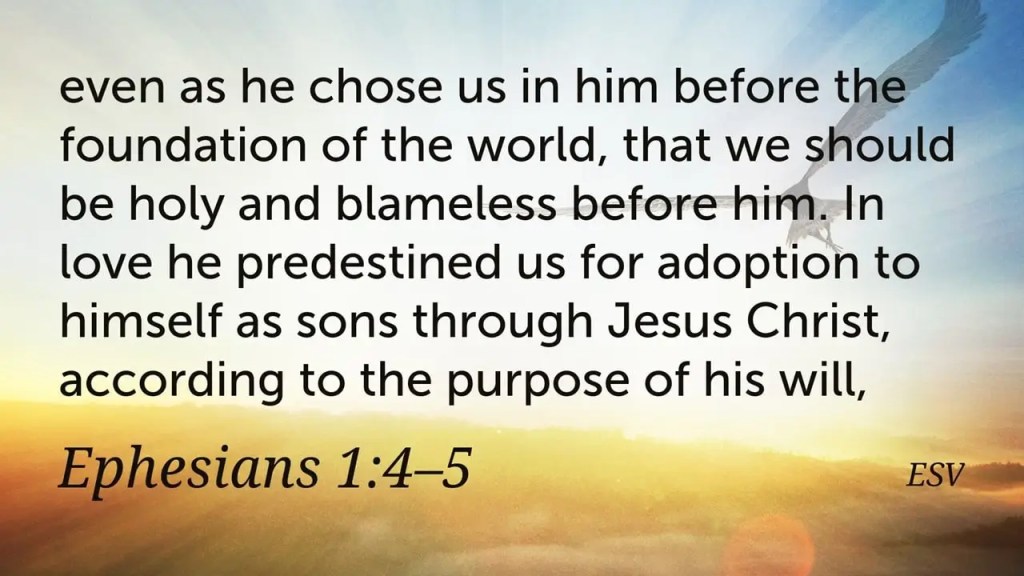
Some have argued that the topics of election and predestination should be avoided in preaching due to their complex and difficult nature, and even that they are a hindrance to evangelism. Do you agree or disagree? Provide rationale for your position.
I would say that it is not easy to talk about election and predestination in our evangelism correct, however there are some phenomenal truths that can be very appealing to the non-believers in evangelism. For instance God from all eternity by His most wise and holy council of his own will, freely and unchangeably ordained whatsoever comes to pass and yet he is not the author of saying, and also he does not violate the free will of the creatures, neither is the liberty and contingency of secondary courses being taken away but rather established. That to me is a very appealing voice of the attribute and the character of God. Because he’s totally in charge in control and yet he gives us the free will to respond he doesn’t control his creation robotically. And also the liberty or contingency of the secondary causes are not taken away but rather established. That means what we do matter and we are not going towards fatalism.
JI Packer also expounded that the whole Bible is the outworking of God’s sovereign purpose for his world, the purpose that led him to create, the sin that disrupted, and his work of redemption is currently restoring. I think that’s a really appealing message that in this broken world which non believers will acknowledge, to know that God is currently restoring the world, it is a real message of comfort and encouragement and relevance of God. And the purpose of all this restoration is the endless expression and enjoyment of love between God and his rational creatures- love shown in their worship, praise, thanks, honor, glory, and service given to him, ending the fellowship, privileges, jaws, and gifts they give to them. Bible tells us that what God has done to advance God’s redemptive plan for sin damaged planet earth, and they look ahead to the day of its completion, when planet earth will be recreated in unimaginable glory. They proclaim God as the almighty creator Redeemer and do all constantly of the multifaceted works of grace that God performs in history to secure for himself a people, a great company of individuals together, with whom his original purpose of giving and receiving love can be fulfilled. God has shown himself absolutely in control in bringing his plan to the point and working out everything according to his own will and completing his redemptive project.
Considering the area of pastoral care alongside of preaching/evangelism (you hint at an answer, but aim it toward this question): How might you discuss election & predestination with someone faithfully attending your church, who did not grow up in a Reformed church, but who wants to talk to you about how they believe “election and predestination don’t have any practical use,” instead, they say: “these doctrines just seem to make people complacent in their faith”?
Topics of election and predestination should be avoided in preaching due to their complex and difficult nature?
I would say that while election and predestination is highly mysterious, and we cannot deny it as its plainly written in the Bible. And WCF has really articulated it beautifully, though, hard to swallow sometimes, because, the reality is its still hard to understand fully, but we have to remember that we are his creature, and He is God. And He reserves the right to mystery that He hasn’t revealed, and He has the perfect right to reveal what He chooses to His creatures, as in: Deuteronomy 29: 29 “The secret things belong to the Lord our God, but the things that are revealed belong to us and to our children forever, that we may do all the words of this law.
An important point is that God doesn’t violate our free will. WCF: “God does not violate the free will of the creatures, neither is the liberty and contingency of secondary courses being taken away but rather established.”
That settled, I would then focus on the restoration of this broken world, as JI Packer puts it, “The whole Bible is the outworking of God’s sovereign purpose for his world, the purpose that led him to create, the sin that disrupted, and his work of redemption is currently restoring.”
God’s sovereign purpose and work now is the work of redemption that’s currently restoring what’s been destroyed by sin, and it’s that restoration, we believers in Christ, we are honored and called, to take part in. And it’s the highest calling for all of us all.
Why is it important for God to feel with us ?
Jesus expressed his emotion frequently like he wept for Lazarus on his death with his sister, Mary and Mariam. I think it is incredibly important for God to feel our emotions and actually identify with us emotionally and not a detached stoic God that would’ve been like pantheism or Greek gods.
Jesus cried out for the lost sheep of Israel that he longs to gather them as little chicks.
I guess the argument against that will be Jesus expressed his emotion as a man the incarnate God, but if we want to draw a connection to the emotional heartbeat of God, the only expression of that on earth will be the heart beat of Christ walking on earth as he is also the perfect image of God. He is God. I will find it astonishing for God to incarnate into this world and expressed his emotions, scholars would explain that as an anthropomorphic expression of God. But Christ is also God walking on earth in a strange way. That dichotomy is therefore almost like a social construct to delineate it quite unnecessarily.
To argue for the unchangeability of God, the immutability of God, that is easy that even Gen 6 God was grieved and he regretted making mankind because they were evil sinners. But he never changed because he is still a loving God and compassionate and a righteous holy God. His purpose never change. Is just a on the spot manifestation of his emotion on individual cases that does not contradict impassibility and immutability.
As for the sources of research, I will look into Augustine in his confession , which is really a powerful book that book in itself consolidate humans emotions with God and in fact, it will be impossible for Augustine to write that on an emotionless God. Augustine will never agree with the God that does not grieve inside or rejoice over us.
Other sources like the Institute by John Calvin and some patristic literature and the historical theology I’m sure.
So my conclusion, the incarnate God came as a man to express the heartbeat of God, and if we take that away, defeats part of this incarnation expression or manifestation of his majesty, and the reality of who God is.
 Al Ngu sermons & devotion