Introduction
CS Lewis believed that myths, despite originating from various cultures and religions, often contain elements of truth and longing that resonate with humanities innate spiritual yearnings. He saw myth as a natural language through which deep root spiritual realities could be communicated. Lewis draws upon with the logical motif and narrative to illustrate and reinforce Christian concepts and themes. For example, in the Chronicles of Narnia, he uses the mythical realm of Chronicles of Narnia to explore fundamental Christian ideas such as redemption, sacrificial love, and the battle between good and evil. By weaving Christian themes into familiar mythic landscapes, Lewis invites readers to engage with profound truths in a captivating and relatable way.
Myth, Imagination & Supernatural & Aesthetic Experience
In that essay, Lewis analyzed two types of faith viz, the intellectual faith, and the religious or faith or trust in God which experiences the numinous (supernatural). He equates that the intellectual faith is the precondition for numinous faith. He calls it the feelings aroused by numinous is awe, very much like the awe of God in the OT.[1]
He finds the seed of religious experience in our experience of the numinous. In our age like our own such experience does occur and but, until religion comes and retrospectively transforms it, it usually appears to the subject to be a special form of aesthetic experience. [2]
By that he means if we don’t have religion in our life, what’s really the works of the transcendent God would simply be labelled as something beautiful without God. He argues that faith does not come from the experience of the philosophical arguments alone, numinous experience alone, but from historical events that transcends the moral category, which demand their presupposition the existence of God.
The Apologetic Value of Myth
CS Lewis writes, “Taking the point in particular the old myth of the dying God, without ceasing to be myth, comes down from the heaven of legend and imagination to the earth of history and happened on a particular date, particular place, and definable historical consequence. We passed from history to a historical person crucified by Pontius Pilot, so that myth became fact.” [3]
All that’s like the transcendent God coming down to earth, is just to too good to be true, and yet it is really myth became fact. And if that happened, that will energize the whole base of humanity to move closer to knowing and experiencing transcendent God. It’s also part of the curiosity and inquisitiveness of human nature to be drawn with something fascinating, something beyond us.
I think the beauty and power of mythical thinking in apologetics is to open and provide a way for us to connect to the mysterious and mythical element of the transcendent God. Too often, case in point, Easter just becomes a commercial social celebration gathering with Easter bunnies etcetera because people lost touch with the mythical and the mysterious aspect of the dying God on the cross. We must communicate that to the unbelievers in the world so that they can appreciate Good Friday and Easter that it is not just a ceremonial process in the good old Christian customs but rather it is part of the greatest mystery and myth of Christianity that a God-Man was crucified in time and space. This is not only good for apologetics for non-believers but this is hugely beneficial and essential for Christian flourishing too.
Wonder & Delight because of the mythical radiance from God
We are also telling unbelievers and the Christians that if and when they choose to believe in Christ, they need to understand that it is not a mere assent to the intellectual story of Christ death on the cross, but it is essential to embrace the mythical and mysterious aspect of such crucifixion of a God man. To be convinced the supernatural that is that even possible naturally.
The mythical aspect of the gospel as Lewis puts it, “claims not only our love and our obedience but also our wonder and delight because of the mythical radiance resting on theology as God chooses to be mythopoeic and myth pathetic, therefore we want to respond in light manner.” [4]
And that is to respond not only with obedience and with love but also with the wonder and delight. So the apologetics to the non-believers and even believers is the aspect of wonder and delight in the God who speaks to us in such intensity and passion.
Christianity likened to modern English Monarch with the form, but the reality abandoned
CS Lewis writes on his friend, “ Corineus advanced that…Modern Christianity basically just believes a modern system of thought which retains the vocabulary of Christianity and exploits the emotions inherited from it while quietly dropping its essential doctrines. He compared modern Christianity with the modern English monarch, the forms of kingship have been retained, but the reality has been abandoned. [5]
This is conceivably the saddest that has happened and is happening in reality in our culture in our days today and for millennia. That’s because people adopted the tradition of Christianity the forms and the shapes and all this but abandoned the orthodoxy the essential doctrines. And this is all happening towards churches that have gone liberal jettisoned core doctrines of the holy scripture that in inerrant word of God. That becomes an inherent problem why many unbelievers are confused because they don’t see any real difference between the church and the world.
Lewis’s friend is contending that why would educate it enlighten pseudo-Christians insist on expressing their deepest thoughts in items of the arcade mythology which must hamper and embarrass them at every turn? [6]
What he’s called is mythology are the so-called historical essential doctrines of the church from the Bible come if you call them as such, you have not read the bible. And these Christians they are absolutely precious and the fundamental core of the entire Christianity let alone cutting them off. I take it that people feel the historical essential doctrines of the Bible are outdated somehow and they want to jump on the modern or postmodernism bandwagon, but that’s exactly and Antichrist book as described in the Bible.
The scariest thing and upsetting thing is what CS Lewis called the “clergyman becoming intellectual prostitutes or preach for pay”- and thereby created what he called as the darkening of conscience among thousands of men. [7]
The biggest problem what I see from the here is that the misconception of the modernity calling historical orthodoxy doctrines of the word of God as myths. I get that more souls removed from the historical orthodoxy in church and with the postmodernism and modernism pounding on our philosophy and the culture on a daily basis, it won’t be hard to imagine that there is a disdain from the culture towards anything historical orthodoxy push appears to be binding to them. So Lewis sort of rides along with them taking on what they call as myth and expound what is really important on ‘myths’, those doctrines.
To combat that criticism of Christianity holding on to the old historical doctrines, Lewis warned of dropping to a darkening of conscience of men and women who don’t know real Christianity anymore.
He, therefore, in a very radical way, creatively asked the question, “If they want to cut off from this what is called vestigial mythology, would not be would it be, “Much easier for the mother of invalid child if she put it into an institution and adopt someone else healthy baby instead. Life would be far easier to many a man if he abandoned the woman he has actually fall in love with and marry someone else because she’s more suitable.[8]
So if the nonbelieving world think that our Christian orthodoxy doctrines are like myth, Lewis argues, “Even assuming (which I almost certainly deny) the doctrines of historic Christianity are nearly mythical, it is the myth which is the vital and nourishing element in the whole concern. ” So Lewis arguing that his friend once us to move with the times, very much like today. society wants us to move with the time and not wanting to stay with historical orthodoxy of Bible. Lewis right the time actually move away. But in religion, we find something that does not move away. It is the myth that abide, it is what he caused the modern and living thought that moves away. I think that is absolutely correct to say that I will modern thoughts and modernity and philosophy keeps moving and changing and moving. The only thing that is absolute is the historical orthodoxy word of God. For example he quoted the pagan revival of Julian apostate, the Nix, the monism of Aus, the deem of, the dogmatic materialism of the great vans. They have all moved with the times. And the thing that were all attacking remains. The myth has outlived the thoughts of all its defenders and all its adversaries. It is the myth that gives life. This apologetics is powerful because Lewis is arguing that the very thing that modernity all the idioms and religions they have been attacking Christianity orthodoxy scripture all moving, they all moved along with times. In other words, position on religion and believe kit, moving there is no certainty or concreteness about it. In comparison, it is the religion, so-called myth of the historical orthodox doctrines they stay and never change very much like the Lord God never changes. The meet is outlived of thoughts of its defenders and all its adversaries. It’s the myth that gives life.
Lewis talked about we are not knowing the abstract meaning at all, but tasting it. But We were testing turns out to be universal principal. The moment we state this principle, we are admittedly back in the world of abstraction. It is only wow receiving the myth as a story that you experience the principal concrete.
So he is saying that the idea of me as an abstraction as an abstraction, and it is only when we take the myth as a story that we can experience the principal concrete. Another words, the so-called myth of Christianity must be received as a story so that we can experience the principle of the story concrete.
He wrote that myth consents thought, incarnation transcend Smith. The heart of Christianity is a myth, which is also a fact. The all myth of the dying guard without seizing to be miss, comes down from the heaven of legend and imagination to the Earth of histories. It happens – at a particular date, in a particular place, forward by definable historical consequences. We passed from Boulder, die. Nobody knows when away, to a historical person, crucified, and punished by pilot. By becoming fact, it does not seize to be a myth, that’s the miracle.
So Lewis is arguing that the heart of Christianity is a myth which is also a fact. I would agree that truly Christianity is a myth because to have the God of the universe Hung on the cross and bleeding 2000 years ago for redemption of mankind, does sound very much like a myth to many, who have not believed in the gospel. I love that. He said the myth of the dying guard on the cross does not seize to be myth, and it comes down from the heaven of legend and imagination to the Earth of history. I definitely agree that it is a mess because, Jesus, came down from heaven of legend and imagination to the Earth of history. He actually happens a particular time and place and a date. To combine as a fact for the crucifixion of the dying guard on the cross is a powerful testimony of the incarnation of God and the suffering of Christ for humanity. Luis calls the crucifixion national seize to be made: that is the miracle. I hundred percent agree that the myth is the miracle.
Lewis wrote that he suspects men have sometimes derived more spiritual sustenance from myths. They do not believe then from the religion, the profession. There is so much truth in it and shame on many, who profess some kind of believe in Christ in the religion of Christianity have been changed in transformed in the lives because there is no personal conviction. It is what is called the Christianity or Christian by name or cultural Christian. It is fascinating for him to write that, actually more spiritual sustenance for Smith, and I think that is relatable because myth is fascinating supernatural thing of people that you don’t even know whether it’s true or not but certainly it sounds pretty profound. So Luis wrote that to be truly sent to historical fact of the dying on the cross, and also receive the, with the same imagination, imaginative embrace which we accord to all myths. For myth and fact merges on the cross.
Myth: a traditional story, especially one concerning the early history of a people or explaining some natural or social phenomenon, and typically involving supernatural beings or events.
The definition of myth. It’s a story of. The early history of people that involves supernatural beings. This is a really important take because. The whole of redemptive narrative of God in Christ Jesus is supernatural and therefore in the eyes of the world, in many ways, it’s a myth. Just to clarify myth has been sort of misconceived commonly that it is something that is not true, but the definition of myth is something supernatural which can be true or. Not true. So when Louise talks about the dying God on the cross does not cease to be myth, comes down from the heaven of legend and imagination to the earth of history, is a profound statement. He’s able to connect something that is most profound in the world which is the death of the transcendent God on the cross and that is definitely supernatural because the death of God is impossible but that is the death of a human in Christ Jesus who is both God and man. Baloise brilliantly connects the myth nature crucifixion of Christ on the cross 2 an actual event in space and time in history. He’s contrasting the myth legend of boulder die nobody knows when or where, to a historical person crucified under Pontius pilot. That myth became fact on the cross. However that myth does not cease to be myth and that is the miracle. The word miracle is the exact word needed to describe the event because of what happened on the cross it’s nothing less than miraculous and definitely myth became fact. The problem with the very materially wired world today is not able to see the myth the mythical aspect of the cross, but merely seeing the human dying on the cross. Besides frankly even many who believed Christ died on the cross for humans sins and received Christ as believers, have no head much lively spirit spirituality in this earthly world. Louis rightly said a man who disbelieved the Christian story is fact but continually fed on it as Smith would come up perhaps, be more spiritually alive than one who ascended and did not think much about it. The key problem is those Christians or supposedly born again Christians who believed the story of crucifixion but didn’t think much about it, has not brought much transformation to their lives. On the other hand, however, those who did not believe in the Christian crucifixion as fact but just believed it as a myth, Lewis argued, are perhaps more spiritually alive. There’s a real danger of just assent to it as intellectual knowledge but without absorbing and soaking in the mythical aspect of the Christian narrative redemption story.
I would argue that the word myth in in the Christ redemption narrative story it’s really equivalent to supernatural or miracle. It is indeed without a shadow of doubt Christianity without supernatural is a human story devoid of the divinity, taking the two most potent events in Christianity which is the incarnation of God into this world Christmas, and the son of God offered as a sacrifice to redeem mankind on the cross. Both prominent events are profoundly supernatural and hence mythical. So for us to communicate this to the non believers, we have to convey the mythical aspect of the entire redemption story.
Lewis writes, we must not be ashamed of the mythical radiance resting in our theology. We must not be nervous about parallels and pagan idols: they ought to be there dash you’d be a stumbling block if they weren’t. We must not, enforce spirituality, withhold our imagination welcome. If God chooses to be a mythopoeic dash and is not the sky itself a myth dash shall we refuse to be Mr. pathic? For this is the marriage of heaven and earth: perfect myth and perfect fact: claiming not only our love and our obedience, but also I will wonder and delight, address to the savage, the child, and the poet in each one of us no less than to the moralist, the scholar, and the philosopher.
I would agree that God has revealed himself in a very mythical manner or what he called his mythopoeic call mom by us examining the incarnation and crucifixion and resurrection. And the fact that Christianity is so mythical and supernatural, louis is right to say that we must not withhold our imaginative welcome. If God chooses to be mythopoeic and is not the sky itself a myth, shall we refuse to myopathic? So he’s right that we are only paint attention to myth or call myopathic because God chooses to be mythopoeic, by even just looking at the sky itself it’s a mystery and myth, the entire creation of the world it’s in such amazingly profound complexity that beyond any human engineering imagination. Therefore it is actually a myth that became fact. For anyone to approach Christianity without touching the supernatural or the myth it’s not can you to know the real faith and religion in Christ Jesus the transcendent God who created the world.
I love the fact that Lewis brought in the sense of imagination to cross the bridge from what is natural in the material world to the supernatural world which he calls it as myth. I would only critique do is in the sense that he did not bring the word supernatural in his apologetics discourse, although he’s alluding to it big time through the word myth. The entire Bible is a myth in a sense because it is totally supernatural starting from Genesis all the way to Revelations. We can’t even pass the first chapter of Genesis without believing in and acknowledging the supernatural work and power of God as he called out the different creation and speak them into being and create them actually ex-Nihilo. In other words he created everything out of nothing. That is supernatural and therefore isn’t that a myth?
I would argue that bringing mythical imagination into the apologetics of believing in Christ the Son of God the savior of the world, we will enrich and still with the mind of the folks whether they believe in Christ or not. For Christians it will be a challenge and stirring of hearts and challenging them to stretch themselves into the supernatural by faith. There are plenty of Christians today who do not quite believe in the supernatural and the whole aspect of faith has not really been exercised or taught much. So this paper is to help the unbelievers to cross the bridge from the natural to the supernatural. Lewis said that a mere intellectual assent to the doctrine of Christ crucifixion and resurrection will not sufficiently build a complete born again story.
I think it is particularly powerful when Lewis described that the heart of Christianity is a myth which is also a fact referring specifically to the old myth of the dying God without ceasing to be myth, comes down from heaven of legend and imagination to the earth of history. It happens at a particular date, particular place ,followed by definable historical consequences. We pass from time, nobody knows when or where, to a historical person crucified under Pontius pilot. To me this is particularly powerful when Lewis described the entire incarnation of the Son of God from the heaven, the legend, in imagination to the earth of history is a supreme myth and that is nothing short of the miracle. And also to see a God the dying God on the cross is another supreme myth that became miracle. The power of myth is so powerful that it transcends even a pure intellectual assent to a religion people professed. Like he said man have sometimes derive more spiritual sustenance from myths they did not believe then from the religion they professed.
That shows how much power is contained in the very sustenance of myth even though they don’t really believe in it, because the very myth contains so much supernaturally charged mystery and power that overwhelms the mere intellectual assent to a religion. And that to me is very powerful in apologetics in driving people to search for the supernatural and not being content with the natural full of intellectual discussion and apologetics. That’s why I believe that intellectual apologetics does not cut it, although I believe the transcendental approach of apologetics by Vantil is in the route of supernatural or myth and that’s why it cuts it as well.
Lewis writes, “It is not reason that is taking away my faith: on the contrary, my faith is based on reason. It is my imagination and emotions. The battle is between faith and reason on one side and emotion and imagination on the other”.[9]
Lewis writes, “I start thinking I am going to choke, and I am afraid they will start cutting me up before I am properly under. In other words, I lose my faith in anesthetics. It is not reason that is taking away my faith: on the contrary, my faith is based on reason. It is my imagination and emotions. The battle is between faith and reason on one side and emotion and imagination on the other.[10]
Lewis writes, “Christians need to be reminded that what became fact was a myth, that it carries with it into the world of fact all the properties of a myth. God is more than a god, not less; Christ is more than Balder, not less. We must not be ashamed of the mythical radiance resting on our theology. We must not, in false spirituality, withhold our imaginative welcome. If God chooses to be mythopoeic- and it’s not the sky itself a myth- shall we refuse to be myopathic? For this is the marriage of heaven and earth; Perfect myth and perfect fact; Claiming not only our love and our obedience, but also our wonder in delight, addressed to the savage, the child, and the poet in each one of us no less than to the moralist, the scholar, and the philosopher”.
-I think Lewis just made Christianity so much more alive and personal, something not only to be obeyed and followed in obedience, and with love, but indeed with wonder and delight. That’s a huge contribution to humanity understanding of Christianity because no one, even though rejecting Christianity or just being ignorant, will reject delight and wonder in a religion. To deprive Christianity of wonder and delight is to make the God of miracles and love and passion into a stoic idle that doesn’t speak or move.
The Myth of Incarnation, Predestination & Election
“The central miracle asserted by Christians is the Incarnation. They say that God became Man. Every other miracle prepares for this, or exhibits this, or results from this.” – C.S. Lewis, Miracles, 173.
Lewis calls Incarnation as the “Grand Miracle”. All the miracles in OT prepare for the Grand miracle—Incarnation. Incarnation of God into a human is mind blowing to any sane educated folks, unless you reach into the dimension of faith. There is no way for anyone to understand and hence believe that without being supernaturally touched by the Spirit of God, and what’s called regeneration of our soul/spirit by the Spirit. And that’s why it’s the biggest stumbling block to the Jews, and foolishness to the Greeks who seek wisdom (1 Cor 1:22-25). It is something humanly impossible and outrageously scandalous in the minds of all civilizations, and that’s why Jesus took the Roman world, the Jewish nation by storm, when he finally resurrected from death. It is such outlandishly extravagant that, God precisely demonstrated his love and grace beyond even the best poets can conjure up a love story of such magnitude and power. That’s all in the eyes of many unbelievers a myth. And if we can tap into it, and explain with conviction, it will be apologetically powerful. Not only that, when one gets into, he deep reflection of such act of God, there is nothing but just sheer deepening of our souls, and understanding and affection for Christ. And that’s transformative.
God chose Israel not because of something in Israel (Deut 7:6–8), but He refers to his promise to Israel’s ancestor, Abraham. So, we have to go to Abraham:
Genesis 12:1–2 Now the Lord said to Abram, “Go from your country and your kindred and your father’s house to the land that I will show you. 2 And I will make of you a great nation, and I will bless you and make your name great, so that you will be a blessing.
Why did God choose Abraham? It’s a mystery, and myth. Because no one really understands. I concur what Dr Hoffecker said that God sees something in a man’s heart that we don’t. Like God told Samuel that man looks at the outside, but God looks at the inside. (1 Sam 16:7).
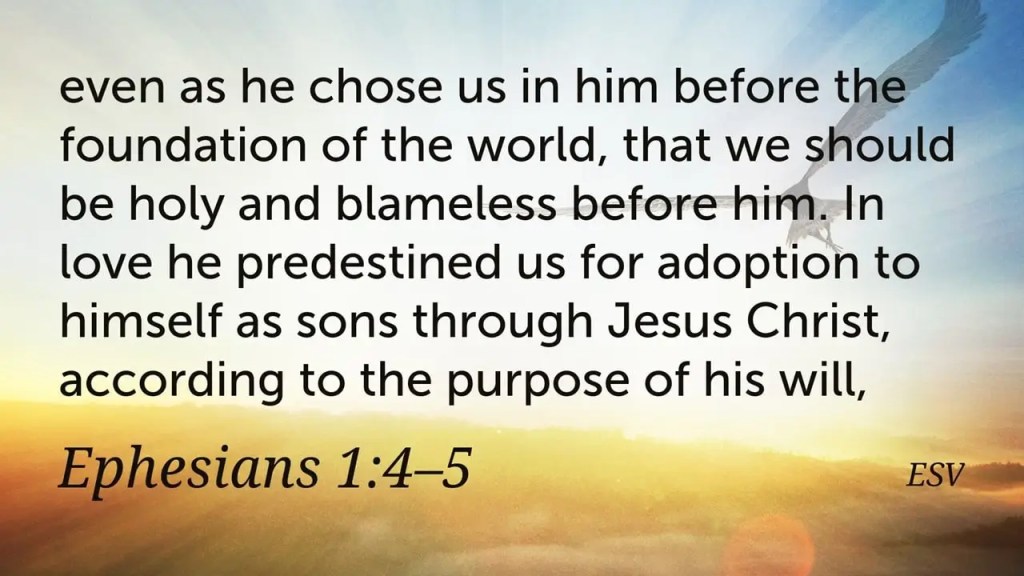
Therefore things that we don’t know, and hence tend to speculate, best left to the transcendent God who knows it all even before the foundation of the earth (Eph 1:4), He has destined us to before saved. Paul wrote that he was chosen and called by the Lord even before he was born (Gal 1:15-17).
So, all these to speak of the mystery of God and an important verse to explain this all is:
Deuteronomy 29:29 (ESV)
29 “The secret things belong to the Lord our God, but the things that are revealed belong to us and to our children forever, that we may do all the words of this law.
We must settle in not knowing and understanding the predestination which is. Major pillar doctrine of Christianity, and that belongs to the category of mystery, and in the sight of artists, unbelievers, they become myth. So, there is enormous untapped power and potential in the mythical thinking and projection like Lewis has so elegantly and powerfully captured them. Of course, there are also many ungodly myths from of old, but that doesn’t cancel the good myths that Christian can take hold of, and develop them to enrich our own spiritual life and also connect with the non-believers mind set apologetically.
Conclusion
I think the apologetic value of myth is tremendous as per CS Lewis, taking the point in particular the old myth of the dying God, without ceasing to be myth, comes down from the heaven of legend and imagination to the earth of history and happened on a particular date, particular place, and definable historical consequence. We passed from history to a historical person crucified by Pontius Pilot, so that myth became fact. All that like the transcendent God coming down to earth, is just to too good to be true, and yet it is really myth became fact. And if that happened, that would energize the whole base of humanity to move closer to knowing and experiencing transcendent God. It’s also part of the curiosity and inquisitiveness of human nature to be drawn with something fascinating, something beyond us.
I think the beauty and power of mythical thinking in apologetics is to open and provide a way for us to connect to the mysterious and mythical element of the transcendent God. Too often, case in point, Easter just becomes a commercial social celebration gathering with Easter bunnies etcetera because people lost touch with the mythical and the mysterious aspect of the dying God on the cross. We must communicate that to the unbelievers in the world so that they can appreciate Good Friday and Easter that it is not just a ceremonial process in the good old Christian customs but rather it is part of the greatest mystery and myth of Christianity that a God man was crucified in time and space. This is not only good for apologetics for non-believers, but this is hugely beneficial and essential for Christian flourishing too.
We are also telling unbelievers and the Christians that if and when they choose to believe in Christ, they need to understand that it is not a mere assent to the intellectual story of Christ death on the cross, but it is essential to embrace the mythical and mysterious aspect of such crucifixion of a God man. To be convinced the supernatural that is that even possible naturally.
The mythical aspect of the gospel as Lewis puts it, claims not only our love and our obedience but also our wonder and delight because of the mythical radiance resting on theology as God chooses to be mythopoeic and myth pathetic, therefore we want to respond in light manner. And that is to respond not only with obedience and with love but also with the wonder and delight. So, the apologetics to the non-believers and even believers is the aspect of wonder and delight in the God who speaks to us in such intensity and passion.
[1] CS Lewis, Is Theism Important? –God in the Dock, ( Zondervan: ) 187
[2] Ibid, 187
[3] CS Lewis, God in the Dock (Zondervan: )
[4] Ibid
[5] CS Lewis, God in the Dock, (Wm. B. Eerdmans: Grand Rapids) 54
[6] Ibid, 54
[7] Ibid, 54
[8] Ibid, 55
[9] CS Lewis, Mere Christianity, (Harper Collins: New York, 2001) 138
[10] Ibid, 140

 Al Ngu sermons & devotion