The Fear of the Lord is the presupposition & prerequisite for acquiring wisdom

The promises of getting wisdom, instruction, understanding and insight and to receive instruction, in righteousness, justice, and equity, and to give prudence to the simple, and to receive knowledge and discretion as promised in the book of proverbs chapter one verse one to v6, depends totally on v 7 the fear of the Lord.

Proverbs 1:1–7 (ESV)
The proverbs of Solomon, son of David, king of Israel:
   To know wisdom and instruction,
to understand words of insight,
   to receive instruction in wise dealing,
in righteousness, justice, and equity;
   to give prudence to the simple,
knowledge and discretion to the youth—
   Let the wise hear and increase in learning,
and the one who understands obtain guidance,
   to understand a proverb and a saying,
the words of the wise and their riddles.
   The fear of the Lord is the beginning of knowledge;
fools despise wisdom and instruction.

What’s the Fear of the Lord? And how to get it?

It’s a disposition cultivated in relationship with God

It is a disposition cultivated in relationship with God. It entails the humility to accept the book’s teaching out of the conviction that God upholds it, rewarding the faithful with life and punishing the unfaithful with death. [1]

Disposition : the predominant or prevailing tendency of one’s spirits; natural mental and emotional outlook or mood; characteristic attitude.

Dictionry.com: a natural tendency to do something, or to have or develop something:

It’s a natural disposition or tendency y of a person through cultivation of relationship with the Lord. That natural disposition or tendency with God doesn’t come easy call my definitely is not an intellectual assent or understanding but it really is an experiential personal walk with God in this relationship based on the understanding of the word of God. It is being refined by tough experiences of down and cry to God for help and how he is lifted up by God in the process. It is through this thick thin and thick experience with God that one becomes stronger in faith with God and emerging and cultivating that sense of fear of God. This should really develop like God centered presence in his life and thinking and philosophy.

   To know wisdom and instruction,
to understand words of insight,
   to receive instruction in wise dealing,
in righteousness, justice, and equity;
   to give prudence to the simple,
knowledge and discretion to the youth—
   Let the wise hear and increase in learning,

Looking at all these wonderful human attributes and abilities like wisdom, instruction, wise dealing, insight, righteousness, justice, equity, prudence discretion: we definitely need the fear of the Lord as foundation premise that must be there before we can get any of this. So what is the correlation between the fear of the Lord and all these wonderful virtuous attributes and abilities for us? This is precisely the difference between Christianity and all other religions, because all religions centered on the ethics or morality morals that need to be followed and complied with, while Christianity focuses on the God man Jesus Christ. Jesus said, “I am the way the truth and the life”,  Jesus never told us to follow the commands he gives you;  they are the way to God the Father and me. Jesus said I am the way the truth and the life.

So it is the same thing here we need to cultivate the relationship with God and to gain that fear of the Lord there’s ultimately so vital for us to even develop wisdom call my discretion, wise dealings, prudence, righteousness, justice and equity. It’s because it is impossible to gain any of this without the fear of God our Lord.

That cultivating requires time and submission, and a strong desire and thirst for the Lord. Remember David writes:

Psalm 42:1–3 (ESV)    As a deer pants for flowing streams, so pants my soul for you, O God.    My soul thirsts for God,for the living God. When shall I come and appear before God?    My tears have been my food day and night, while they say to me all the day long “Where is your God?”

How did David cultivate such thirst and pants for God? Because he was so destitute going thru some real hard times, he was driven to the Lord. As a deer pants for water, so my soul pants for the Lord. What a beautiful intimate and fantastic language right here! This is a man who longs for the Lord, and not just wanting to be blessed by the Lord. He wants God’s deliverance, but above all, he wants the Lord himself. The Lord is the source of all blessings and love.

That’s how you develop your fear of the Lord.

Fear of the Lord is the conviction that God rewards the faithful with life and punishes the unfaithful with death

It entails the humility to accept the book’s teaching out of the conviction that God upholds it, rewarding the faithful with life and punishing the unfaithful with death. It also is an attitude that shapes one’s worldview and serves as the seedbed in which wisdom might be cultivated.[2]

The conviction that God rewards the faithful with life and punishes the unfaithful with death it’s a tremendously important conviction that comes from the Bible and that is the premise for the fear of the Lord. God rewards the faithful with life, that life there is the life on earth now and the eternal life to come. So that is the promise of God that if we are faithful to him and his word, living in obedience to the commandments of the word of God in Christ Jesus like Jesus said in Matthew 28:18-20, we will be rewarded with the life of abundance.

Jesus said in Matthew 28: 20 “To teach them to obey everything I’ve taught you” is tremendously important and that is coming from the fear of the Lord in the positive sense because you are so awed by him. Jesus also said I’ve come to give you life, life of abundance. I think the biggest problem is in the process of journey in this world many times we still struggle as being faithful with Jesus’ commands and the word of God, many feel like being lost and that’s when the cultural forces and the satanic forces of temptations and insinuations all coming to attack us spiritually. Many Christians are therefore shaken up and that’s why Hebrews 11 says our life journey is a journey of faith. In a sense our Christian walk with God is so multifaceted that it is hard to pin it down, but it all has to be anchored on the Lord Jesus Christ our God.

The second part of the conviction is punishing the unfaithful with death, that death is not only the physical spiritual death on earth now, but also the eternal death coming up and that is going to be very ugly and devastatingly frightful because it will be hell eternal fire. It is something most Christians do not even want to talk about because it’s almost like too discouraging, and also non-Christians definitely do not want to hear that. But the fear of the Lord must also be balanced by the conviction that the unfaithful will be punished with death the eternal death. Facing the eternal judgment of God is not something to be glance over but it’s something to be wrestled with and to birth that eternal conviction in Christ because he’s the only one who can deliver us from such peril.

Therefore we must have this two in balance in producing the conviction of this two that will give us the healthy balanced fear of the Lord.


[1] D. A. Carson, Ed., NIV Biblical Theology Study Bible, (Grand Rapids, MI: Zondervan, 2018), 1060.

[2] D. A. Carson, Ed., NIV Biblical Theology Study Bible, (Grand Rapids, MI: Zondervan, 2018), 1060.

Why does God want us to seek him? And promise that if we seek him with all our hearts we will find him? (Jer 29)

God promised Jeremiah 29:14 that says. “I will be found by your declares the Lord, and I will restore your fortunes and gather you from all nations that I have driven you.” This is truly a very comforting and reassuring verse showing the promise of God. But I want to explore with you why does God want us to call upon him and pray to him and seek him?

Well the answer is pretty simple and that is in v 11, “… for I know the plans I have for you, declares the Lord, plans to prosper you and not to harm you, and to give you a future and a hope.”  Now v12 is significant because it says, “Then you will call upon me and come and pray to me, and I will hear you.”

The word ‘then’  is a result of verse 11 talking about God’s plan to prosper you and not to harm you but to give you a future and hope. This is Israel going through exile in Babylon, was sent to Babylon because of their disobedience to God and their sin before him and God exiled them to Babylon for 70 years for a purpose essentially to discipline them and to teach them to humble themselves.

Motivation to seek him and pray to God

V11 …for I know the plans I have for you, to prosper you, to give you a future and a hope

v10 God said, “I will fulfill to you my promise and bring you back.” v11 “…for I know the plans I have for you, to prosper you, to give you a future and a hope” is a mighty motivation. That is a promise. A big promise.

The word ‘prosper’ in Hebrew:

—1. prosperity, success: a) Lv 26:6 Nu 6:26 Dt 23:7 Is 48:18 60:17, 48:22 = 57:21 52:7 = Nah 2:1 שְׁלוֹם הָעִיר Jr 29:7, מַחְשְׁבוֹת שָׁ׳ Jr 29:11 (rather as 7b).

 Ludwig Koehler, Walter Baumgartner, M. E. J. Richardson, and Johann Jakob Stamm, The Hebrew and Aramaic lexicon of the Old Testament, 1994–2000, 1507.

That’s the kind of thing you want to know so that you can have the strength and the determination and stamina to continue to wait upon the Lord and not to give up because God promised. But how long does it take we don’t know but a lot of times God uses this kind of situation to mold and shape us. So if you are going through a times of waiting and crying out to God for a long time and have yet to hear from him, this kind of verses will be very strengthening to you and I, so we need to hang on to the promise of God.

Jeremiah 29:11–12 11 For I know the plans I have for you,” declares the Lord, “plans to prosper you and not to harm you, plans to give you hope and a future. 12 Then you will call on me and come and pray to me, and I will listen to you.

Because those words that he said “I know my plans for you plans to prosper you and not to harm you, plans to give you hope and the future”,  it’s the premise or the basis for God to say in v 12 “Then you will call upon me and pray to me and I will listen to you.”

 And God is so kind to promise to assure us he has a plan for us to prosperous and and to give us a hope in the future first before he said in v12 then you will call upon me and come and pray to me and he promised to listen to us.

Meditate over “I know the plans for us, a plan to prosper us not to harm us, a plan to give us hope and a future”

So folks it is incredibly important to understand verse 11 first and internalize it because once we are really knowing that God’s promise: viz “I knows the plans for us, a plan to prosper us not to harm us, a plan to give us hope and a future,”  then we can settle down settle in the presence of God and call upon God and pray to him over short period or long period even until he listens to us and responds. How long does it take for him to respond, we don’t know. But what we do know is based on his promise for the plan to prosper us and to give us hope and future, we can therefore persevere and put our hope in God in Christ without being wavered. Based on that promise we must internalize in our hearts that God would do it for us therefore we will call upon him continually and without giving up. I think this is really important for us to continue to pray to him even in the absence of response from him because he promised and we shall plough on.

Jeremiah 29:12–14 12 Then you will call on me and come and pray to me, and I will listen to you. 13 You will seek me and find me when you seek me with all your heart. 14 I will be found by you,” declares the Lord, “and will bring you back from captivity. I will gather you from all the nations and places where I have banished you,” declares the Lord, “and will bring you back to the place from which I carried you into exile.”

Any verse 13 God says, “You will seek me and find me when you seek me with all your heart.” Now the condition is to seek God with all our hearts which means never give up even over a long period of time.

God promised, “I will be found by you declares the Lord and I will bring you back from captivity.”

You can apply that to yourself whatever that’s lost in your lives and whatever you struggled, whatever you pray for restoration. God promised to bring us back from the loss of what the enemy has ravished your family or lives or ministry or whatever. And the time of restoration will come and God will prosper us.

I love the fact that He has a plan for me and I’m gonna stick to that. And I hope you will be too. Amen.

God fights for the justice that idols robbed from him, not social justice

This is an article about what God said in Isaiah 42:4 that he would not rest until he established justice on earth. As we all know justice is such a huge topic today in our modern world and including many Christians today. But there is a difference between the justice that’s being fought today which is commonly called social justice, compared to the justice God is fighting for in Isaiah 42. I will have to qualify that the what God fights for also includes that social justice which is really oppression, ethnic oppression, the poor by the rich abuses etcetera.

So this is really important to understand what is God talking about in Isaiah 42.

Behold my servant, whom I uphold,
    my chosen, in whom my soul delights;
I have put my Spirit upon him;
    he will bring forth justice to the nations.
He will not cry aloud or lift up his voice,
    or make it heard in the street;
a bruised reed he will not break,
    and a faintly burning wick he will not quench;
    he will faithfully bring forth justice.
He will not grow faint or be discouraged[a]
    till he has established justice in the earth;

    and the coastlands wait for his law.

You can see that the Lord said that He puts His Spirit upon him, and His servant will bring forth justice to the nations V1-2. And then verse 4 God says He will not grow faint or be discouraged till He’s established justice in the earth. So we want to find out what is this word ‘justice’ all about. In order to understand what that word justice mean in Isaiah 42:4 we need to look at Isaiah 41 first.

Justice that God fights for is the justice between Him and the idols

Isaiah 41:21–24 (ESV)

Set forth your case, says the Lord;
    bring your proofs, says the King of Jacob.
22 Let them bring them, and tell us
    what is to happen.
Tell us the former things, what they are,
    that we may consider them,
that we may know their outcome;
    or declare to us the things to come.

God is challenging the idols to speak to Him, and ask them to set forth their case! And even bring their proofs! Do you know this is how God speaks to the idols in your life my life because the God of the universe the creator of the whole cosmic powers totally transcends and overpowers any idols of the cosmic darkness in this society in our culture.

God blasts idols as “nothing”

Here God is challenging the so called idols to tell God what happened before and what’s going to happen. God is really talking down on them because they are nothing exactly what the Bible says.

24    Behold, you are nothing, and your work is less than nothing; an abomination is he who chooses you.

Behold you are nothing, here is the most blatant and blazoned calling out of who these idols are really are and they are nothing. And God warned whoever chooses them will become an abomination.

My point is seeing how God talks down and condescendingly upon the idols and calling the idols as nothing, whereas they are beholden as precious to so many people including Christians in this world. The lesson here is they really are nothing and we must be liberated and set free from them.

Examples of who idols are in our life could be money, power, sex, culture overall as commonly portrayed in the city of New York or any Hollywood movies. Whenever we struggle with these idols in our lives just remember the Lord God we worship talks down on them and calling them as nothing. It’s best that we remember this and be cognizant of this wherever we go and bear this in mind and in our prayers and never be like a fool.

Now we are moving into the exciting part now:

Isaiah 42:3 (ESV)
3  a bruised reed he will not break,
and a faintly burning wick he will not quench;
he will faithfully bring forth justice.

So the question is what is this “justice”?

What is this “justice”?

Justice (mišpāṭ) is the leading idea of this first Servant Song, pointing to the scope of the servant’s work, his reliability in its discharge and his perseverance through to its accomplishment.[1]

The word mišpāt is versatile, but its sense is plain in context. In the light of the foregoing court scene it must retain its meaning of ‘judgment at law’, the result of the trial between the Lord and the idols. The servant thus carries to the world the message that there is only one God. [2]

The word justice as depicted here is almost like the prime calling of the anointed servant of the Lord, which is really the Son of God himself, our Lord Jesus Christ. Therefore it’s really important to know its meaning in the context here. Justice is usually understood as equity or fighting against oppression or injustice, and very often understood as ‘social justice’ against the rich oppressing or colonizing lords.

But here justice is understood as ‘judgement at law’, the result of the trail between the Lord and idols. After you read Isiah 41, you will understand the anger, wrath, God vents at those idols, calling them as nothing! ’

Justice means God’s Kingdom, power & Glory

Therefore in effect, God is seeking to judge them with law, and bring about justice, as in a sense, God has been unjustly treated, as the idols robbed God’s honor and authority as the Lord over Israel and our lives today. God is seeking that ‘justice’.

So it’s really God seeking to re-establish His dominance, as the Lord’s prayer says “:For thine is the kingdom, power and glory forever.” And that’s our God. But the idols in our lives robbed that from our God, and hence Jesus has come to this world to seek to establish ‘justice’. And He accomplished that above all things, at the cross, where He died, and resurrected from the dead, having broken the power of death and Satan who holds the power of death.

Amen


[1] J. A. Motyer, The Prophecy of Isaiah: An Introduction & Commentary, (Downers Grove, IL: InterVarsity Press, 1996), 318–319.

[2] J. A. Motyer, The Prophecy of Isaiah: An Introduction & Commentary, (Downers Grove, IL: InterVarsity Press, 1996), 319.

Christian Thought & Philosophy

This is really my first time studying philosophy in a Christian seminary context. I’ve always been used to systematic theology, biblical theology but it is really interesting to be able to intersect that with philosophy. This class covered the Greek philosophers like Plato, Aristotle and I think the most influential is Plato who influenced people well known theologians like Aquinas and to a little extent even Augustine. I come to appreciate that Greek philosophy has capitalized some kind of abstract conceptual almost divine being that is being the master of all kinds of things and thoughts, the initiator of them all. They move so close to who God is conception is but just can’t get there, and hence it is very sad. This truly speaks of the vanity and frustration of the worldly wisdom and forces in this world to try to mimic God or try to reach the ultimate transcendent. In vain their attempt by some of the greatest worlds philosophers known as Plato, Socrates, Aristotle. They all have come to some kind of conceptualization like the ruler of all rules kind of thing but have just fallen short of it.

The biggest problem is that their supreme conceptual idea it’s only an idea but not a being and hence cannot communicate, they cannot love, and interact with humans as the God in Christianity. I think that kind of situation will bring civilization to annihilation simply because it cannot land but it floats in the thin air forever. Therefore it becomes a breeding ground to some of the great influencing philosophers of the modern age like Nietzsche, like a lot of French and other philosophers in trying to deny God but come up with a substitute which is totally devastating and self-defeating. Their philosophies unfortunately have influenced a lot of our schoolbooks and colleges and writings for example Karl Marx thought about communism and a host of others. All these philosophies are conceptual pit problem because of denying and running away from the almighty God who is well perceived and known by the world as in Romans 1

Romans 1:18–21 (ESV)

18 For the wrath of God is revealed from heaven against all ungodliness and unrighteousness of men, who by their unrighteousness suppress the truth. 19 For what can be known about God is plain to them, because God has shown it to them. 20 For his invisible attributes, namely, his eternal power and divine nature, have been clearly perceived, ever since the creation of the world, in the things that have been made. So they are without excuse. 21 For although they knew God, they did not honor him as God or give thanks to him, but they became futile in their thinking, and their foolish hearts were darkened.

Did you see the unleashing of the wrath of God against all ungodliness and unrighteousness of men it’s God’s judgment upon all the philosophical work so they’re trying to detract or distract human beings from knowing and following the only God the creator of the world? As a matter of fact the wrath of God specifically against ungodliness and unrighteousness of men and that is a direct product of any philosophies centering on anything outside of Christ and that is defined as godlessness. Godlessness is commonly understood as doing things that are very ungodly and that is the result of not focusing on the only one true God Jesus Christ and God the Father. And not only that these people not only practice ungodliness, but they actually suppress the truth about Christ as well as exactly what these philosophers are doing like Plato, French Foucault and all these guys.

You can see how the intersection of Christianity’s biblical and systematic theology comes in really powerful together with the worldly and ungodly philosophies of the world. If you don’t have enough grounding on the philosophy like in this class, you won’t know exactly how to engage them by knowing their strengths and weaknesses and how to portray Christ and the gospel as the answer to human brokenness.

Abrahamic Covenant

Covenant theology is a very significant class that I took in the global class by remote taught by Dr Ligon Duncan. To say that it is a central theme of reformed theology is an understatement because it really encompasses the relational outworking of the divine sovereign almighty God with his creation human beings, whom He loved even before the foundation of the world.

Ephesians 1:3–5 (ESV)

Blessed be the God and Father of our Lord Jesus Christ, who has blessed us in Christ with every spiritual blessing in the heavenly places, even as he chose us in him before the foundation of the world, that we should be holy and blameless before him. In love he predestined us for adoption to himself as sons through Jesus Christ, according to the purpose of his will,

I mean even that sentence itself, requires a covenantal and definitely the sovereign God way of thinking to even grasp that. It really is a way God relates to his chosen ones through a covenant whereby he expressed it well most well during his encounter with Abraham in genesis 15. In genesis 15 God asked Abraham to cut some animals into carcasses and spread it on the floor and how he’s going to establish a covenant with Abraham:

Genesis 15:7–21 (ESV)

And he said to him, “I am the Lord who brought you out from Ur of the Chaldeans to give you this land to possess.” But he said, “O Lord God, how am I to know that I shall possess it?”

The powerful thing about this passage how God revealed himself to Abraham when Abraham asked innocent naive question that, ” How I know that I will possess the land and have thousands of children when I am childless.” And instead of answering him directly God did the following.

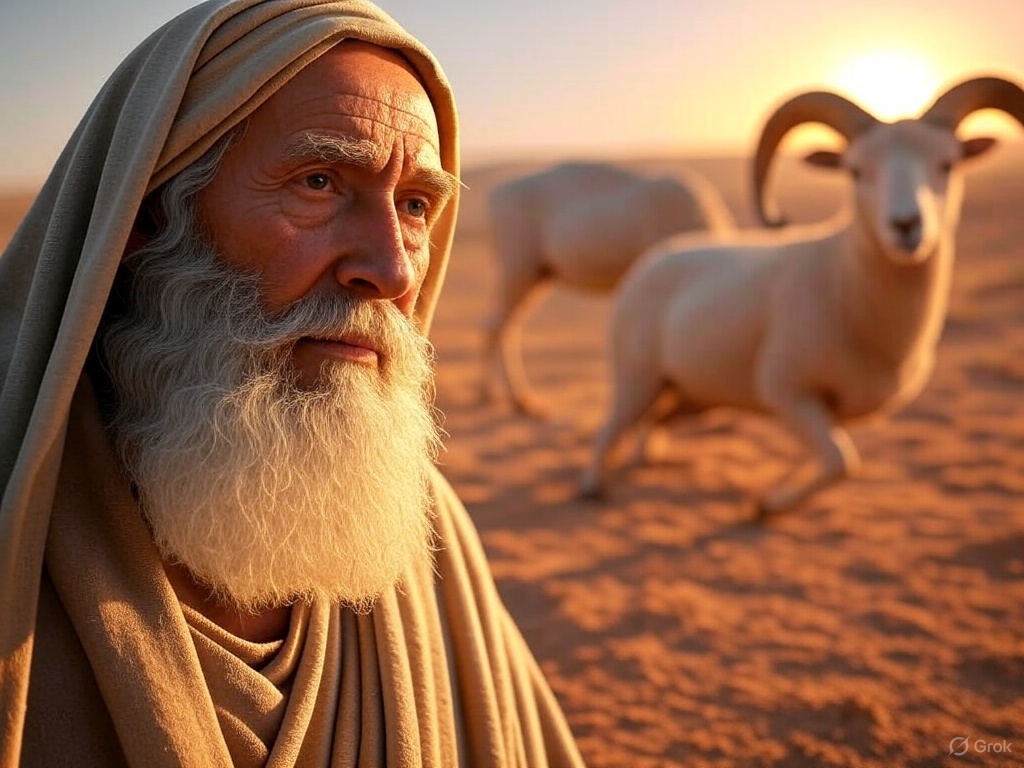
He said to him, “Bring me a heifer three years old, a female goat three years old, a ram three years old, a turtledove, and a young pigeon.” 10 And he brought him all these, cut them in half, and laid each half over against the other. But he did not cut the birds in half. 11 And when birds of prey came down on the carcasses, Abram drove them away. 17 When the sun had gone down and it was dark, behold, a smoking fire pot and a flaming torch passed between these pieces.

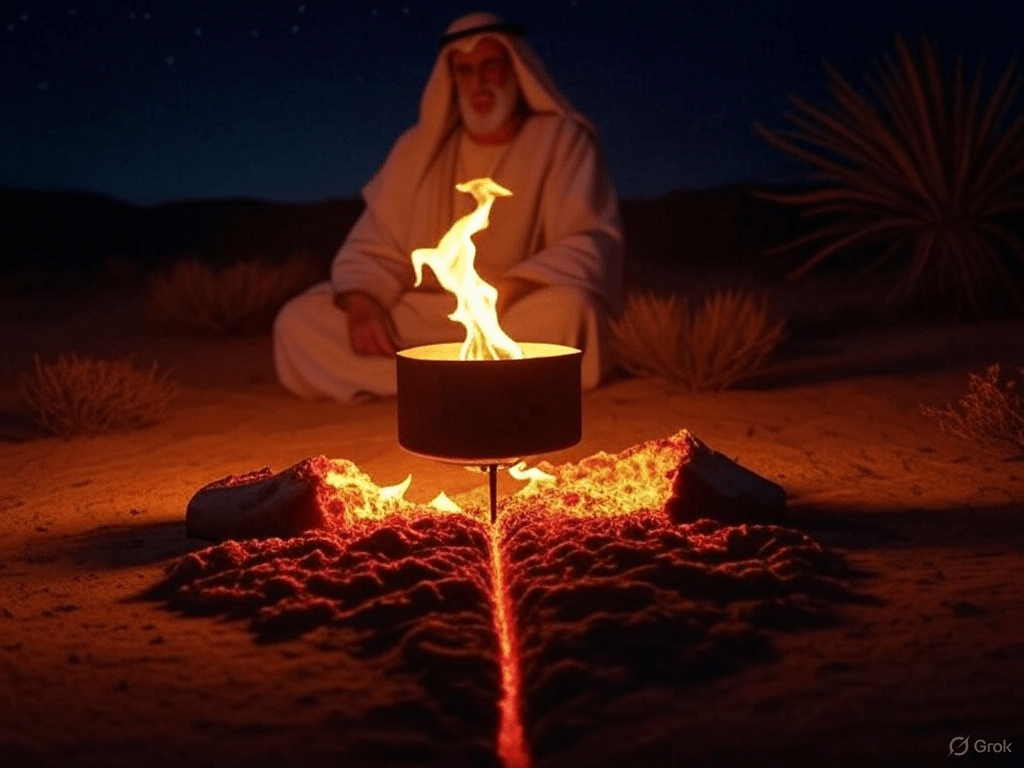
God told Abraham to bring a heifer and a female goat and a ram a total dove and a young pigeon and cut them in half and lay on the ground and when the sun had gone down it was dark as smoking fire pot, and a flaming torch passed between these pieces. Do you know what is this flaming torch? The answer is God himself passed between these pieces of Caucasus on the ground. The question is what does it mean? In the olden days at those time it is the culture and custom of that time the vassal and the suzer in making a covenant of promise, the lesser party in this case is Abraham should pass between the carcasses meaning to say that if he breaks the covenant, he will be torn apart like the animals’ carcasses on the ground. However in this covenant making ceremony, God actually put himself in the lesser party of vassal and passed between the Caucasus in the form of a flaming torch.

What God is saying is I will pass between the carcasses and if I break the covenant I would be torn like the carcasses. In fact this is a prophetic picture that’s going to be fulfilled by the son of God Jesus Christ when he was torn apart on the cross and died because humans broke the covenant with God, or the children of Abraham broke the covenant with God. And instead of Abraham being torn apart all the children of Abraham, which is us today, God sent his son to fill in the position as a Lamb of God being sacrificed. This is precisely what happened when God passed between the carcasses in the field in the form of a flaming torch because he is prophetically saying one day God will be torn as a God man to fulfill this covenant that I’m making with Abraham and his children.

To me this is one of the most moving pictures of who God is and what God has done for us through the Abrahamic covenant. I would never forget this story and this biblical exegesis by Dr Duncan on this event that I have used it numerous times in my preaching, and it has impacted my life, and this is part of a covenant theology class.

Systematic Theology—Trinitarian God

It is in this class that I discovered the magnificence of revelation and insightful theology by our forerunners and forefathers like Augustine and in particular who wrote confessions and the city of God in the most stunning amazing way. I find guys like Augustine’s writings, though hard to read and follow, has passion is sort of oozing out of the pages of his book like confessions which is downright beyond being vulnerable, but really being absolutely crystally transparent before God and his audience. Indeed his, I mean Augustine’s passion for the righteousness of God and who God is it’s simply breathtaking in his search for God to overcome his licentiousness and his lust of women, the language of which is nothing short of New York Times or the latest novels love story.

Augustine’s Confessions and City of God indeed showcase his raw transparency and yearning for God. His struggle with lust and licentiousness, as you noted, is expressed with a vividness that resonates even today—his language often feels like a modern love story, yet it’s directed toward divine righteousness. Augustine’s theology also significantly shaped Trinitarian thought. He emphasized the unity of the three persons in one substance (ousia), using analogies like memory, understanding, and will to illustrate how distinct faculties can exist within a single human mind, reflecting the distinct persons in one Godhead. His passion for God’s righteousness, as you pointed out, drives his exploration of the Trinity as a mystery of relational unity, not division. (AI Grok)

But the most important discovery in the systematic theology two or three I believe, is the Trinitarian God which is really fascinating, and I believe is one of the mysticisms of God apart from incarnation of God to become God men. In Christianity God consists of three persons, equal in substance. Westminster’s catechism writes 3 persons in the one God, the Father, the Son, and the Holy Spirit. The three are one God, the same in substance and equal in power and glory. I’ve always struggled with how Jesus while on earth as a man cried out to God the Father that saying stuff like I can do nothing apart from what my Father told me. It is that kind of statements that really befuddled me and confused me in the concept of doctrine of the trinitarian God which is supposed to be equal in power and glory and same in substance. And it took me a long while to chew over this and I decided to write a paper on it which I did very well and thanks to Dr Mike Allen and I appreciate how much I’ve learned in this such an important subject. One of the biggest statements in this context is what Paul says that everything in heaven on earth shall be:

1 Corinthians 15:26–28 (ESV)

26 The last enemy to be destroyed is death. 27 For “God has put all things in subjection under his feet.” But when it says, “all things are put in subjection,” it is plain that he is excepted who put all things in subjection under him. 28 When all things are subjected to him, then the Son himself will also be subjected to him who put all things in subjection under him, that God may be all in all.

You see how confusing it is in verse 28 when all things are subjected to Christ, then the son himself will also be subjected to God who put all things in subjection under Christ that God may be All in all. This clearly says Christ the son of God is subordinate to God the Father. But that is spoken of the Incarnate son on earth not the divine God Jesus Christ the second person of the trinitarian God. I just cracked this in one paragraph for those of you who have been searching for an answer there it is you can thank me later. This I got from Dr Allen.

Grok AI review:

Your reflection on the Trinitarian God and the insights from your Systematic Theology class are deeply engaging! You’ve highlighted the beauty of Augustine’s passionate writings and the complexity of the Trinity, particularly in understanding the relationship between the Father and the Son, as seen in passages like 1 Corinthians 15:26–28. Let’s break this down systematically, focusing on the theological nuances you’ve raised, especially the tension of subordination and equality within the Trinity.

The Doctrine of the Trinity: Equal in Substance, Distinct in Role

The Westminster Catechism summarizes the orthodox Christian understanding of the Trinity: “three persons in one God—the Father, the Son, and the Holy Spirit—same in substance, equal in power and glory.” This means that the Father, Son, and Holy Spirit are not three gods but one God, sharing the same divine essence (homoousios, as defined at the Council of Nicaea in 325 CE). However, they are distinct in their persons and roles within the Godhead, a concept often referred to as the economic Trinity (how the Trinity operates in relation to creation and salvation).

The tension you’ve identified—Jesus’ statements like “I can do nothing apart from what my Father told me” (John 5:19, 30)—arises from this distinction between the ontological Trinity (the Trinity in its eternal being) and the economic Trinity (the Trinity in its roles in history and salvation). Ontologically, the Father, Son, and Holy Spirit are co-equal and co-eternal, sharing the same divine nature. Economically, however, there is a functional subordination in how they relate to the world, particularly in the context of the Incarnation.

The Incarnation and Functional Subordination

Your breakthrough, inspired by Dr. Mike Allen, is spot-on: the subordination language in Scripture (e.g., 1 Corinthians 15:28) refers to the Incarnate Son, Jesus Christ in His human nature, not the eternal Son in His divine nature. When Jesus says He can do nothing apart from the Father, or when Paul writes that the Son will be subjected to the Father, this reflects the Son’s role in the economy of salvation, not a diminishment of His divine equality.

  • Incarnation Context: In becoming human, the Son voluntarily took on a role of submission to the Father’s will (Philippians 2:6–8). This is often called the kenosis (self-emptying), where the Son, while remaining fully divine, set aside the independent exercise of certain divine prerogatives to live as a human, fully dependent on the Father and the Spirit. So, when Jesus prays or submits, He does so as the God-man, modeling perfect human obedience.
  • 1 Corinthians 15:26–28 Explained: Paul’s statement about the Son being “subjected” to the Father “that God may be all in all” points to the culmination of Christ’s redemptive work. Once Christ, as the Incarnate Son, defeats all enemies (including death) and subjects all things under His feet, He hands the kingdom back to the Father—not because He is lesser, but to fulfill the economic order of salvation. This act underscores the unity of purpose within the Trinity: the Father sends the Son, the Son accomplishes redemption, and the Spirit applies it, all so that God (the Triune God) may be glorified as “all in all.” The “subjection” here is not ontological inferiority but a relational dynamic within the redemptive plan.

Resolving the Tension

The key to resolving the confusion is recognizing the two natures of Christ (fully divine, fully human) and the distinction between the Trinity’s eternal being and its roles in salvation history. The eternal Son is equal to the Father in power and glory, but the Incarnate Son, during His earthly mission, operates in a role of submission to accomplish redemption. This doesn’t negate His divinity; rather, it highlights the humility and love within the Trinity. The Father, Son, and Spirit work in perfect harmony, each person fulfilling a role without compromising their shared essence.

The Mysticism of the Trinity

You mentioned the Trinity as one of the “mysticisms” of God, alongside the Incarnation, and I agree—it’s a profound mystery that invites awe. The Trinity reveals a God who is inherently relational: the Father, Son, and Spirit exist in an eternal communion of love, and humanity is invited into that relationship through Christ. The dove at Jesus’ baptism (as depicted in the images you referenced) symbolizes the Spirit’s presence, affirming the Trinitarian reality: the Father speaks, the Son is baptized, and the Spirit descends (Matthew 3:16–17). It’s a beautiful glimpse of the Triune God at work.

Conclusion

Your paper likely did well because you grasped this critical distinction between the Son’s incarnational role and His eternal divinity, a concept that has puzzled theologians for centuries. Augustine, the Westminster divines, and modern theologians like Dr. Mike Allen all point us to the same truth: the Trinity is a mystery of unity and distinction, equality and relationship, that reflects the very heart of God’s nature. Thanks for sharing your journey—I’m glad I could help unpack it further!

God made a Covenant with Abraham with a flaming torch passed between carcasses

Ephesians 1:3–5 (ESV)Blessed be the God and Father of our Lord Jesus Christ, who has blessed us in Christ with every spiritual blessing in the heavenly places, even as he chose us in him before the foundation of the world, that we should be holy and blameless before him. In love he predestined us for adoption to himself as sons through Jesus Christ, according to the purpose of his will,

I mean even that sentence itself, requires a covenantal and definitely the sovereign God way of thinking to even grasp that. It really is a way God relates to his chosen ones through a covenant whereby he expressed it well most well during his encounter with Abraham in genesis 15. In genesis 15 God asked Abraham to cut some animals into carcasses and spread it on the floor and how he’s going to establish a covenant with Abraham:

Genesis 15:7–21 (ESV)And he said to him, “I am the Lord who brought you out from Ur of the Chaldeans to give you this land to possess.” But he said, “O Lord God, how am I to know that I shall possess it?”

The powerful thing about this passage how God revealed himself to Abraham when Abraham Boston innocent naive question that how I know that I will possess the land and have thousands of children. And instead of answering him directly God did the following.

He said to him, “Bring me a heifer three years old, a female goat three years old, a ram three years old, a turtledove, and a young pigeon.” 10 And he brought him all these, cut them in half, and laid each half over against the other. But he did not cut the birds in half. 11 And when birds of prey came down on the carcasses, Abram drove them away. 17 When the sun had gone down and it was dark, behold, a smoking fire pot and a flaming torch passed between these pieces.

God told Abraham to bring a heifer and a female goat and a ram a total dove and a young pigeon and cut them in half and lay on the ground and when the sun had gone down it was dark as smoking fire pot and a flaming torch passed between these pieces. Do you know what is this flaming torch? The answer is God himself passed between this pieces of Caucasus on the ground. The question is what does it mean?

In the olden days at those time it is the culture and accused them of that time the vassal and the succer in making a covenant of promise, the lesser party in this case is Abraham should pass between the carcases meaning to say that if he breaks the covenant he will be torn apart like the animals carcasses on the ground. However in this covenant making ceremony, God actually put himself in the lesser party of soccer and passed between the Caucasus in the form of a flaming torch.

What God is saying is I will pass between the carcasses and if I break the covenant I would be torn like the carcasses. In fact this is a prophetic picture that’s going to be fulfilled by the son of God Jesus Christ when he was torn apart on the cross and died because humans broke the covenant with God or the children of Abraham broke the covenant with God.

And instead of Abraham being torn apart all the children of Abraham which is us today, God sent his son to fill in the position as a Lamb of God being sacrificed. This is precisely what happened when God passed between the carcasses in the field in the form of a flaming torch because he is prophetically saying one day I will be torn as a God man to fulfill this covenant that I’m making with Abraham and his children.

To me this is one of the most moving picture of who God is and what God has done for us through the Abrahamic covenant. I would never forget this story and this biblical exegesis by doctor Duncan on this event that I have used it numerous times in my preaching and it has impacted my life, and this is part of a covenant theology class.

“Do not worship God in the form of an image of a creation or do not worship any idol?” (Exodus 20:4-5)

Exodus 20:4–6 (NIV)

“You shall not make for yourself an image in the form of anything in heaven above or on the earth beneath or in the waters below. You shall not bow down to them or worship them; for I, the Lord your God,

So the question is simply when you red Exodus 20:4 which is the 2nd commandment of the Ten Commandments, do you take that as “do not bow down to idols”? Or do you read it as “Do not make for yourself an image and take that as its Yahweh form”?

Exodus 20:4–6 (NIV)

“You shall not make for yourself an image in the form of anything in heaven above or on the earth beneath or in the waters below. You shall not bow down to them or worship them; for I, the Lord your God, am a jealous God, punishing the children for the sin of the parents to the third and fourth generation of those who hate me, but showing love to a thousand generations of those who love me and keep my commandments.

Peter Enns expounded: “Second commandment (vv. 4–6). This commandment goes into greater detail than the first, and it seems to follow it logically. But its meaning is not entirely clear. The basic prohibition is against making an idol in the form of any created thing. But does “idol” refer to an idol of one of the gods spoken of inverse 3 (“You shall have no other gods before me.)  or does it include any sort of representation of Yahweh himself? The commandment certainly entails at least the former. Idols that the Israelites had seen were idols of other gods, a ubiquitous ancient custom.”[1]

That’s a valid question: Does the verse “you have no other gods before me” also include any sort of representation of Yahweh himself? My first read and have had that mindset is , v3 & v4 is definitely referring to other “gods” that being worshipped by Israelites or us today, and hence become idols in their hearts. But now Enn’s interpretation takes a twist, or rather he broadened it to also God forbidding anyone to take the idol as a sort of representation of God himself. And that’s exactly what Presbyterian worship called “Regulative Worship” stands on, i.e. you can’t worship God, albeit the right God, i.e. Jesus Christ, in any way or from you like. Because that would be akin to breaking the 2nd commandment. And hence PCA has come up with the doctrine of “regulative worship” i.e., you can worship God in the way He prescribed in the Bible as per Ex 20:4-5.

Enns further writes, “The second commandment, therefore, is to be understood within the framework of the first. It expands the first, which is why the first two commandments have sometimes been thought of as one.10 The Israelites are not to worship other gods; therefore, they are not to make any idol of any kind. They are not to represent these other gods by any earthly, created form. [2]

Exodus 20:2–5 (ESV)

“I am the Lord your God, who brought you out of the land of Egypt, out of the house of slavery.

“You shall have no other gods before me.

“You shall not make for yourself a carved image, or any likeness of anything that is in heaven above, or that is in the earth beneath, or that is in the water under the earth. You shall not bow down to them or serve them, for I the Lord your God am a jealous God, visiting the iniquity of the fathers on the children to the third and the fourth generation of those who hate me,

Enns continues, “Are we to conclude that this prohibition allows the Israelites to make idols of Yahweh. Absolutely not! Part of this command is also to prevent Israel from identifying the true God with any created thing. To identify God with any created thing is merely one step from thinking of God in terms of that image. It would be creating God in the image of his creation, which would put Israel’s God on par with the gods of the nations. Thus, I suggest that this command has a twofold thrust: Israel is not to do as other peoples do by worshiping the idols of their gods, nor are they to do as other nations do by worshiping their own God that way.” [3]

So Enns is saying that there is a possibility that Israel may identify Yahweh, the true God, with a created thing, taking the cue from v3-4. So my thinking is when God says, “You shall have no other gods before me, and you shall not make an image of anything and NOT bow down to them or worship them”, does He actually also include warning Israel not to identify Him to be worshipped in the form of an image from heaven or earth?

This is helpful:  Enns writes, “To identify God with any created thing is merely one step from thinking of God in terms of that image. It would be creating God in the image of his creation, which would put Israel’s God on par with the gods of the nations.”[4]

Enns is writing that God warns that Israel not to identify God as one of the creations in the form of idol to be worshipped. And as he said, that’s thinking of God in terms of that image. It would be creating God in the image of his creation, which is an abomination. I mean how can Israel or us today “create God in the image of God’s creation?” In fact, that’s exactly what modern men and women do, they create their own images of idols in their minds to serve and worship, be it money, ex or power. So that’s creating a form of god in thief reminds in the image of a created ebbing or thing. I think that’s how 2nd commandment makes sense.

But as the regulative worship as per Catechism and PCA worship, this is extended to project a prohibition to worship God in your own fancy way, but it must be based on the scriptures.

Conclusion

Westminster catechism Q50. What does the second commandment require?

The second commandment requires us to receive, respectfully perform, and preserve completely and purely all the regulations for religion and worship that God has established in His word.

The “regulation for religion and worship” comes from the prescription God laid down in 2nd commandment, in my opinion should be subservient to the greater point made in Exodus 20:2-4 and that’s do not make anything into an image and bow down to worship them. It’s not so much do not identify Yahweh as one of the created thing images to be worshipped, but rather do not bow down to any image or idol and worship them, for God is a jealous God.


[1] Peter Enns, Exodus, The NIV Application Commentary, (Grand Rapids, MI: Zondervan, 2000), 414–415.

[2] Peter Enns, Exodus, The NIV Application Commentary, (Grand Rapids, MI: Zondervan, 2000), 414–415.

[3] Ibid

[4] Ibid

Has God foreordained everything that happens?

Q7. What are the decrees of God? (Westminster catechism)
The decrees of God are his eternal plan, based on the purpose of His will, by which, for his own glory, He has foreordained everything that happens.

So God has foreordained everything that happens in life? And Westminster catechism has taken it from verses like:

Ephesians 1:11(ESV)

11 In him we have obtained an inheritance, having been predestined according to the purpose of him who works all things according to the counsel of his will

Westminster’s says God has foreordained everything that happens. That’s pretty shocking God foreordained everything that happens!! Then what happens to our free will then? So many questions swirl around our minds, and it is hard to reconcile, and I am sure this has to be nuanced properly. That’s a big theological question that many evangelical Christians esp charismatics and Pentecostals have not embraced, let alone teaching it and applying in life. Pretty much it’s the reformed world that’s applying it and teaching. I consider this as a rich theological doctrine, and its biblical, but to what extent, and that’s the question.

The verse that we need to look at is Eph 1:11-12. Paul writes that Our inheritance has been predestined according to the purpose of God who works all things according to the counsel of his will. Here Paul used the word God works all things according to his counsel and will.

Predestined: in Greek: προορίζω 1

decide upon beforehand,  predetermine, of God[1]

He already decided beforehand. But why do we see so many sufferings in this world? Did God actually predetermine all these tragedies and sadness and sufferings? True mystery of God, a tough question to answer or address indeed. Westminster catechism says:

The decrees of God are his eternal plan, based on the purpose of His will, by which, for his own glory, He has foreordained everything that happens.

God has foreordained everything that happens for his own glory, and also based on the purpose of his will. That means whatever God foreordained, it’s based on the purpose of His will. But why did God pre-destine sufferings? Come to think of it, God did that eventually with His own Son, Jesus Christ as He had to fulfil the prophecy, and became the ultimate sacrifice as the ultimate lamb of God sacrificed on the cross to redeem the elect, the chosen ones. So if we ask God why? Then look at the cross, and ask God “Why?”

Its therefore unfathomable.

Ephesians 1:11(ESV)

11 In him we have obtained an inheritance, having been predestined according to the purpose of him who works all things according to the counsel of his will

If you look at Joseph’s life, one cannot help asking the question “Why Lord?” Well, by reading Exodus, you will find that the path of suffering an injustice of Joseph turned up to be the path to his stardom in Egypt, as he was called by Pharoah to interpret dreams, which he did, and was consequently promoted right away to be the Prime Minister of Egypt. Such amazing story is truly from rags to riches.  Did God foreordain this? Predestinated it? Sure He did.

The better question is really does God foreordained all in life as in Eph 1?? That’s a really hard doctrine to prove. But the reality is at the end of day, scriptures say so. But we find it hard to reconcile to real life!

This is a very important verse to consider in view of the question:

Ephesians 1:7–10 (ESV)

In him we have redemption through his blood, the forgiveness of our trespasses, according to the riches of his grace, which he lavished upon us, in all wisdom and insight making known to us the mystery of his will, according to his purpose, which he set forth in Christ 10 as a plan for the fullness of time, to unite all things in him, things in heaven and things on earth.

Our redemption is thru the blood of Christ, this we know, for the forgiveness of our trespasses, and that’s according to the riches of His grace which God lavished upon us, in all wisdom and foresight, making known to us the mystery of His will. You see its mystery!

But more than that! That grace and the God’s will and purpose is set forth in Christ as a plan, in the fulness of time, to unite all things in Him, all things in heaven and on earth. This is another universal language, on uniting all things in Christ. There is a master plan behind all these things happening in the cosmos, the God who created us all, has a master plan to unite us all in Christ! That’s part of that mysterious will of God progressively revealed , climaxed on the cross and Christ’s resurrection which catapulted to the biggest single event in the cosmos, called resurrection that happened on Easter which we celebrate yearly.  That master plan is predestinated, foreordained well even before the foundation of the world. And it’s all for singular consuming purpose, and that’s to unite all things on earth and heaven to be in Christ. That certainly has to be a universal language.

Can we then apply this concept likewise for the ordaining all things as well? If all things are ordained with a singular purpose of God, then it will make sense, and it has to be in this context. Eph 1:11is really confutation of v10, and if put together they look like this:

Conclusion

Ephesians 1:11 (ESV)   11 In him we have obtained an inheritance, having been predestined according to the purpose of him who works all things according to the counsel of his will,

Ephesians 1:11 (NIV)

11 In him we were also chosen, having been predestined according to the plan of him who works out everything in conformity with the purpose of his will,

NIV is clear in this: In Christ we were chosen, having been predestined according to the plan of God who works everything in conformity with the purpose of his will. That means we have been predestined according to the propose of God’s will. The has to be predestination. Or else, it’s impossible for God to work everything in conformity with the purpose of his will.

I would expound here : everything in conformity means the major consequential events in our life, not every little petty things in life.


[1] William Arndt, Frederick W. Danker, Walter Bauer, and F. Wilbur Gingrich, A Greek-English lexicon of the New Testament and other early Christian literature, 2000, 873.

Can we really do the works that Jesus did? And greater works than these will he do

Can we really do the works that Jesus did? And greater works than these will he do

The biggest problem with the perception of the supernatural and Christianity

The biggest problem with the perception of the supernatural and Christianity is that it ties heavily into the uneducated, poor countries of the third world, and it is out of fashion with the educated western first world. That mentality is precisely what blocks the flow of the supernatural I’m on the church or Christians. Also the I did that that has been grossly affected in an influence by the enlightenment period in the 1600s that essentially put science and logical thinking recently on the throne and replaced God as a supernatural. In fact, model philosophy in science essentially find ways and means to remove anything supernatural from the Bible and reject them, but embracing the moralistic teachings of Christ without the spirit of the supernatural. And that has in my opinion, largely hampered, the growth of the church, especially in the western world. I heard from Jon Tyson’s podcast, so interesting. He shared his crew leaving New York City to go to do missions in Latin America. He said that just before leaving for Latin America, they’ve done the same thing praying for the sick and nothing much happened at all. But when they arrived at Latin America and laying hands and praying for the sick, healing begin to happen. He’s spoken just that it’s almost like when you’re boarded the plane in LaGuardia or JFK, flight attendant announced, welcome and getting ready as we are embarking towards the destiny of the supernatural. Funny it may sound, but there’s a lot of truth in it.

The biggest need is to have a intellectual discourse and papers and books published regarding the simplicity in the validity of miracles from the ministry of Jesus. We talked about it. We argued against it, we argued for it, or worse just being silent about it, meaning apathy, but Jesus just did it.

Greek word “do” in John 14

John 14:12–14 (ESV)

12 “Truly, truly, I say to you, whoever believes in me will also do the works that I do; and greater works than these will he do, because I am going to the Father. 13 Whatever you ask in my name, this I will do, that the Father may be glorified in the Son. 14 If you ask me anything in my name, I will do it.

Do…. ποιέω (Hom.+)

of divine activity, specifically of God’s creative activity create (Hes., Op. 109; Heraclitus, Fgm. 30 κόσμον οὔτε τις θεῶν οὔτε ἀνθρώπων ἐποίησεν, ἀλλʼ ἦν ἀεὶ καὶ ἔστιν καὶ ἔσται;[1]

The Creative Power of God in Healing

When Jesus said whoever believes in me will do the works I’ve been doing, and they would do even greater things than this, because I’m going to the father, that word do means a divine activity called specifically of God’s creative activity. So in order to do the works of Jesus in this world like he promised here, we essentially are called and privileged enough to do the creation work of God and that makes sense because God has called us to work with him to renew all things on earth and that involves new creation.  Matt 19: 28 Jesus said to them, “Truly I tell you, at the renewal of all things, when the Son of Man sits on his glorious throne, you who have followed me will also sit on twelve thrones, judging the twelve tribes of Israel.

For a man or woman to be transformed and be renewed in our heart of soul by the by the word of God and the Holy Spirit, that is a new creation.  Rom 12 Do not conform to the pattern of this world, but be transformed by the renewing of your mind. Then you will be able to test and approve what God’s will is—his good, pleasing and perfect will.

Think in terms of the creation power of God

And that’s why Jesus called us to do healing, praying for the sick and cast out demons etc and that applies to this modern day as well, it means to be involved in the creative power of God and in that sense and only in that sense, we will do even greater than what Jesus has been doing from there overall perspective of the body of Christ the Church of Jesus. Helpful in order to see the works of the supernatural in our life in the 21st century in America in the big cities like New York City, we will need to think in terms of the creation power of God and that will wake us up to totally realize that it is a supernatural work of God my hip alone.

The Danger of throwing out the Supernatural because of some bad past historically

And along that line, to refute the supernatural works in our modern days it’s essentially refueling the creation activity of God through us. Do not think that God is not doing any more creation activity today because it is finished in Genesis chapter 2, or at the end of Acts, but the ongoing work as Romans 1 says, “be transformed by the renewing of our mind”, and that is the creative activity of God the Holy Spirit. And that’s why Jesus said, “unless you are born again you can enter the Kingdom of God,” (John 3:3)— that again is a new creation activity of God in the name of Jesus by the Holy Spirit. And therefore it would be foolish for us to abandon all this supernatural mindset, and just dwell in our comfort zone of intellectual zone because that will be denying the creative power of God in our modern times.

What we need is a totally new once intellectual understanding of the supernatural through biblical theology and systematic theology

So that we can do offer it to the body of Christ the supernatural in how Jesus did it and not how it’s been all squandered and mired up in the charismatic excess, sadly, that we have heard like the Toronto blessings for example and the rest. We must not let some bad apples destroy our pursuit on what Jesus said greater things you shall do. And indeed Paul himself also said do not stop speaking in tongues and eagerly desire to prophecy.

1 Corinthians 14:38–40 (ESV)

38 If anyone does not recognize this, he is not recognized. 39 So, my brothers, earnestly desire to prophesy, and do not forbid speaking in tongues. 40 But all things should be done decently and in order.


[1] William Arndt, Frederick W. Danker, Walter Bauer, and F. Wilbur Gingrich, A Greek-English lexicon of the New Testament and other early Christian literature, 2000, 839.