We need great scholars—but a thousandfold greater need is a multitude of preachers, not professors

“We need great scholars—but a thousandfold greater need is a multitude of preachers, not professors. Preachers who know the English Bible, and who scorn not simple folk—who know how to get down off the theological and scholastic stilts, and preach with heart-power to plain people, a simple, old-time gospel.”—–B.H. Carroll, “Opening Address” (1905)
These words resonated with me and hit me hard. I started seminary school late unlike most of my classmates. Thank God I have developed a passion in studying theology, especially those I enjoyed tremendously like Pauline Theology, History of Christianity I & II, Intro Pastoral and Reformed theology, Christology etc., p/s definitely not Hebrew and Greek sorry. And during the course of my 5+ years now in Seminary, having done 80 credit hours, some of my classmates have already graduated with MABS (MA Biblical Studies, 66 credit hours) in NYC, while I stuck out my neck for my love of theology and practical/applied ministry, dived into hybrid MDiv Orlando RTS. RTS is one of the few seminaries in the country that insists on 100+ credit hours for MDiv. I have to salute RTS for that for making a standard of what Dr Ligon Duncan said “Pastors need more theology, not less.”I certainly pray, and hope that this extra of 40 credit hours to get to MDiv from MABS will bear much better and more fruit in the ministry that follows.
Southwestern Baptist Theological seminary, or Southern Baptist Theological Seminary, requires 88 credit hours to get an MDiv. Go figure. In RTS, I will still need a whopping 26 credit hours (on top of my 80 hours) to get my MDiv. And coming from a background of church planting in Malaysia and schooling in the UK, and now working and studying pastorally in the US, I constantly try to find a place where I can land my feet and my ministry. Sometimes I look with envy the professors with the PhD’s lecturing and teaching without the pastoral concern. That’s why this line is powerful and encouraging to me.
“We need great scholars—but a thousandfold greater need is a multitude of preachers, not professors
We need scholars, 1000 greater need for a multitude of preachers not professors according to Dr BH Carroll. He’s saying that we need a multitude more preachers who know how to get down off the theological and scholastic stilts, and preach with heart power to plain people a simple old gospel. Now it is good to hear that, what he saying is that we need theologically and scholastically trained pastors to preach the gospel message with heart power of the Holy Spirit obviously. He is not saying that you don’t need theology to be a preacher of the word of God, because he said “Get off your theology stilts so that you can come down to the real world and preach to the real world, people without theological jargons and thinking at the high level. What he is saying is not to fail to carry the theological words package into the real world, in other words to be able to intersect theology with real life or everyday life today. On the other hand there are many pastors and preachers today are not theologically trained, but with just good heart to preach the gospel and make disciples. While in the reformed world in particular we have a lot of training of credit hours upon credit hours of theological training, however many still stay with the stilts of theology and not coming down to the real world. That’s what BH Carroll said.
We ought to preach with heart passion in the Lord Jesus Christ by the power of the Holy Spirit
I’m so encouraged that we need both, we need theology and also translate that to everyday life. But not only the ability to translate to the everyday life, but also be able to preach with good heart to preach the gospel and make disciples.
I certainly want to add to what he said, indeed we ought to preach with heart passion in the Lord Jesus Christ by the power of the Holy Spirit. You know well trained theology does not necessarily translate to well passionate heartfelt preaching. That’s where the heart passion that’s only ignited by the Holy Spirit will do the job. However to get that heart ignition by the Holy Spirit, we need that theology and the reflection of the word of God in our hearts and souls so that this can be translated into heart passion preaching.
You have seen sometimes how well trained students preaching, you can see how their sermons are well arranged, chronologically arranged, theologically sound, however it just sounds a little rigid and a lack of life. Coming from a charismatic church planting movement background myself without much theological training albeit planted a few churches, preaching with the hot passion of the power of the Holy Spirit is everything we want from the Holy Spirit.
I do sense that the Baptist seems to have a greater passion to reach the lost and make disciples, with a more evangelical outlook, compared to many churches in the Reformed world. I I’ve seen so many great books and articles written in the Gospel coalition, the First Thing, that were mostly written by pastors and scholars related to reformed theological training especially those from the Baptist and southwest Baptist theological seminaries and some from Reformed theological seminaries, however that passion to reach the lost is not tangibly felt in the like of exhorting the congregation and audience to be soul winners passionately.
The sermon by Dr Malcom Yarnell III of SWBT on the founders day in SWB TS just a couple of days ago carries that unction of the passion of soul winning Baptist is clearly palpable.
He’s preaching for nothing less than revival in the Founders day called “Soul winning Evangelical Baptists.” The passion that came forth from a professor with such Christ centered theology solidly backing him up is astonishingly refreshing. He captured some of the keywords that I loved my ministry like Spirit filled, Christ centered, revivalist passion outreach.
耶路撒冷的女子,不要為我哭,要為自己和孩子哭
Daughters of Jerusalem, weep not for me, but weep for yourselves, and for your children
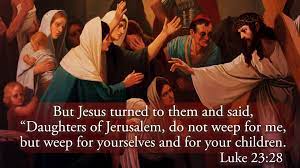
On the way to the cross, Jesus was bleeding badly and suffered so much of the hands of the Roman soldiers. After all those whips and mockery and spit, there was a huge multitude of men and women following him. The woman were mourning for him.
Luke 23:28–29 (ESV)
28 But turning to them Jesus said, “Daughters of Jerusalem, do not weep for me, but weep for yourselves and for your children. 29 For behold, the days are coming when they will say, ‘Blessed are the barren and the wombs that never bore and the breasts that never nursed!’
The pain carried by the loved ones and followers of Christ following Christ to the cross
You can imagine the scene seeing the greatest man on earth who saved you from sickness, demonstrated signs, who did signs and wonders of miracles before you, and spoke most gracious, beautiful words, full of truth and grace, and now, completely drenched in blood in a despicable sight. It’s beyond comprehension! Unbelievable! It’s a sight that evokes deep emotions of outcry, a deep cry of anguish to God. “Why, Lord? What happened?”
I can just imagine the mother of Jesus the human mother on earth, Mary, was weeping and crying all the way to Golgotha, following Jesus, her own precious son. It is in those moments that its almost like darkness descended on earth. It’s like emotionally the world has come to an end as they come to such tragic, unexpected and much beloved son.
At that moment, in the minds of those who believed in Christ, who loved Christ, who has been loved by Christ, and touched by Christ, and taught by Christ, it was a totally devastating moment to walk to Jesus cross, and funeral.
To witness the glorious one, the Son of God, the promised Messiah to end up in such a state, it’s just beyond words, simply unbelievable and it’s totally disappointing & heart breaking.
Tweet
And it is at that moment of time, Jesus turned around and said to the women, “Luke 23:28–29
28 But turning to them Jesus said, “Daughters of Jerusalem, do not weep for me, but weep for yourselves and for your children. 29 For behold, the days are coming when they will say, ‘Blessed are the barren and the wombs that never bore and the breasts that never nursed!’
“blessed are those who are the barren ones, who never breast nursed a baby because the doom day is a judgment coming just going to be so severe that you’re going to cry out of the mountains, fallen spirit cry for yourself, weep for yourselves in which children. 30 Then they will begin to say to the mountains, ‘Fall on us,’ and to the hills, ‘Cover us.’ 31 For if they do these things when the wood is green, what will happen when it is dry?
Do not weep for me, weep for yourselves and your children
In reality it is actually out of this world. The fact that son of God himself would be crucified on the cross drenched in blood, it’s out of this world. And Jesus give a sober warning to the women weeping for him. Do you know you would’ve thought that this is the time to show appreciation and love towards the women who throughout the expression, the emotions, weeping and crying for the one they loved, but Jesus said to them “weep not for me daughters of Jerusalem, weep for yourselves And your children.” This may sound harsh, but it actually carries the absolute truth. What you see now is a death that will be resurrected in three days and they will bring the glory of God.
You’ll see my glory
That’s what Jesus go to tell them essentially don’t weep for him. The world of darkness has no power over him. The prince of darkness has not won. In fact, Satan, the devil will be defeated when he dies on the cross and resurrected from death conquering over death, defeating the devil. So it is great news. Therefore all daughters of Jerusalem, weep not for me, but weep for yourself and the children.
If you do not believe in Christ suffered so much, agonizing and anguish on the cross, you should be weeping for yourselves. If your children don’t appreciate what Christ has done on the cross, in anguish and sufferings for them and for us, they should be weeping for themselves to
Tweet
He changed the world, the entire cosmos, forever and ever
Tweet
It is just simply incredible then, the depth of emotions so profound that came off of the lips of Jesus at such moment, highly emotional, highly charged, highly stated with expectation, and the entire profundity of it, He changed the world, the entire cosmos, forever and ever.
The cross changed everything in this world decidedly. There’s no turning back. He has risen. Hallelujah Jesus has risen from the dead. That’s our only hope for all eternity.
Amen.
God called us to be a kingdom of priests and a holy nation
The power of waiting in the lord as Jesus, waited for his kingdom
God fights to crush Christ’s enemies to be his footstool

Psalm 110 The LORD says to my Lord: “Sit at My right hand Until ”2 The LORD will stretch out Your strong scepter from Zion, saying, “Rule in the midst of Your enemies.”3 Your people will volunteer freely on the day of Your power; In holy splendor, from the womb of the dawn, Your youth are to You as the dew.
David prophesied in Psalm 110 that the Lord says to my Lord “Sit at my right hand until I make your enemies your footstool for your feet.” Now this is truly significant who is the Lord,? And who is my Lord? As it is also been repeated by the Lord Jesus, himself in the gospel, The Lord is God, the Father Yahweh, my Lord is clearly the son of God our Lord Jesus Christ. David called Jesus, my Lord, and the Lord the Father.
I make Your enemies a footstool for Your feet
This is commonly used as one of the proof evidence that Jesus is of the deity, he’s God. The second person of the Triune God. Now what I want to bring up is the theme of the conversation is a spiritual warfare, which is much neglected by the contemporary evangelical and reformed world.
The entire context is the spiritual war between God and the satanic forces. God, the Father spoke to God the Son ” Sit on my right hand, until I make your enemies your footstool it. The word “make” is a warfare word in the context of enemies. What does that mean? That means God is going to crash the forces of darkness, satanic forces enemies of Christ to the point of becoming a footstool for Jesus. It is a metaphorical language, this size Jesus will crush Satan and the forces of darkness completely. When is that happening? It began at the time Jesus rose from the dead, and went back to heaven, and seated on his throne on the right hand side of the father. Now, the process of “until” means it’s ongoing process. Basically God the father is saying “sit here my son on the throne on my right hand side until I crush enemies.”
That is the language used for spiritual warfare. That is the language that the evangelical world has been eerily silent. That’s the kind of language that charismatic Pentecostal prime them selves in, this is an unfortunate scene because it all we talk about is the gospel centered message, the grace of God, and forgetting the huge emphasis of the spiritual warfare is defined by God, the father, that he’s engaging in now, as we speak until all the enemies of Christ will be crushed. the kingdom will never be complete until the enemies of Christ are crushed the kingdom would not become complete just by us preaching the love of God per se.
Jesus on the cross is not just manifesting his profound love, but also for his profound defeating the devil and death.
Tweet
The implications of the spiritual warfare, crushing the enemy of Christ, has huge impact upon the church ecclesiology and eschatology and systematic theology. The definition of spiritual warfare in the words of God the Father to God the Son, “ Sit on my right hand until I make your enemies your footstool” should fire up the church to make that happen. We should immediately put on notice in prayers, worship evangelism to crush the enemies of Christ, which is really the enemies of the church.
We should balance out the reformed theology of gospel, send a messages which is far more appealing to the world of modernity today. Because modernity hates war in any language of confrontation aggression war is not welcomed. However, the Bible says we are now in the spiritual warfare against forces of darkness, principal principalities of darkness, not against flesh and blood, we must combine the gospel centered message on the grace of God in Christ with the God warrior redeemer in Christ Jesus.
The LORD will stretch out Your strong scepter from Zion, saying, “Rule in the midst of Your enemies
Christ will rule in the midst of his enemies. Who is Zion? Zion is the church. God will stretch out Christ strong scepter from the church so that Christ will rule in the midst of his enemies and our enemies. The ruling does not only happen when Christ returns, but it’s an ongoing ruling mow in the midst of spiritual warfare facing our enemies. Who are our enemies? The forces of darkness and principalities of darkness, ruling and raging against the people of God in our society. The forces that devour churches the most today is the issue of sexuality for example that has caused many mainline denomination churches to split up, to the extent even supposedly very strong word based Presbyterian church into PCA and PC USA. And the list goes on :The United Methodist, the Episcopalian, the Reformed churches just to name a few. Our country has never faced such a wrecking ball in our society with our president pushing for transgenderism homosexuality, abortion and the lot. The accountability at the end of the day will be enormous.
The forces that caused Christians to be disheartened, to be sucked into the cultural forces of being catechized by them, like being strong committed Christians it’s out of fashion. Accusing Christianity is standing on the wrong side of history etcetera. Truly the Bible says the devil prowls around like a roaring lion waiting to devour someone.
1 Peter 5 8 Be alert and of sober mind. Your enemy the devil prowls around like a roaring lion looking for someone to devour.
But God has promised to crush his enemies and still continue to have Christ rule in the midst of his enemies. We may not see a lot of ruling in our society looking at our news, but you also see a new movement of outpouring the Spirit of God is happening in Asbury, Kentucky and spreading across the country. We are believing a tremendous move of the Spirit of God will move across our nation the next five years and more to come. Amen.
 Al Ngu sermons & devotion