Changing the World Begins with a Transformed Heart

The fruit of the Spirit can’t be manufactured. Galatians 5 shows us where it grows.

I heard a preacher say something recently that has stayed with me. The United Nations, he said, spends billions of dollars year after year, and the world only grows more chaotic. His diagnosis was simple: there is no fruit of the Spirit. No love. No patience. No self-control. No transformed hearts.

He is right. I want to say that clearly before I say anything else.

Picture a world thick with patience. Neighbors who are gentle with one another. Leaders who are not self-seeking. Rivals who choose kindness over revenge. The fruit of the Spirit really is the answer to the depravity and chaos we live in.

But that answer leaves the real question hanging in the air. The multimillion-dollar question is not what we need. It is how we get there.

The Right Answer, the Missing Power

Here is the danger. If we simply tell people that love, joy, and peace are the goal, and then send them off to try harder, we have turned the fruit of the Spirit into a self-improvement project. Lean in. Do your best. Be a little kinder this week than last.

It will never work.

Paul does not call these things the fruit of effort. He calls them the fruit of the Spirit. They grow out of a life that God himself is working in. This is where Reformed theology shines, because it refuses to flatter us. It says plainly: you cannot do this. But Christ, by his Spirit, can do it in you.

Paul knew the end of his own strength. “Wretched man that I am! Who will deliver me from this body of death? Thanks be to God through Jesus Christ our Lord!” (Romans 7:24–25). And a few lines later: “For the law of the Spirit of life has set you free in Christ Jesus from the law of sin and death” (Romans 8:2).

Set free. Not by trying. By being empowered.

So how exactly does the Holy Spirit do it? Galatians 5 tells us.

Walk by the Spirit

The famous list of the fruit sits in verse 22, but you have to read the whole chapter to understand it. The key is verse 16:

“But I say, walk by the Spirit, and you will not gratify the desires of the flesh. For the desires of the flesh are against the Spirit, and the desires of the Spirit are against the flesh, for these are opposed to each other, to keep you from doing the things you want to do.” (Galatians 5:16–17)

The ESV Study Bible puts it in a sentence I keep coming back to: “The only way to conquer the flesh is to yield to the Spirit.” The notes go on to explain that “walk by the Spirit” carries two ideas at once: direction and empowerment. We make our decisions according to the Spirit’s guidance, and we act in the power the Spirit supplies. And in Scripture, to “walk” describes not a single step but the pattern of a whole life.

Direction and power. We need both.

First, conviction. We have to be persuaded that the desires of the flesh are actually wrong, and only the Holy Spirit can do that in a human heart. Second, strength. Once we know something is wrong, where do we find the power to say no when the temptation arrives? That power, too, comes from the Spirit.

This is what walking by the Spirit means. Our will is not bypassed. It is persuaded and transformed by the Spirit through the Scriptures, until it becomes available to God.

Why You Cannot Out-Muscle the Flesh

Notice what Paul does not say. He does not say, “Fight the flesh, and you will produce the Spirit.” He says, “Walk by the Spirit, and you will not gratify the flesh.”

That order matters. When we try to fight the desires of the flesh with the strength of the flesh, we have already joined the side we are fighting. Fallen human nature drifts toward its own desires automatically. Flesh cannot defeat flesh. Only the desires of the Spirit can stand against the desires of the flesh, because, as verse 17 says, these are opposed to each other.

This is why preaching that exposes the immorality of the world and calls people to bear good fruit, though it is correct, so often leaves them stranded. It hands them the truth without the grace. And grace is not only God’s kind disposition toward us. It is God’s own power in Christ Jesus, the grace that, as Paul tells Titus, trains us to renounce what is wrong and to live what is right (Titus 2:11–12).

Our Default Setting

Paul names the flesh with uncomfortable specificity:

“Now the works of the flesh are evident: sexual immorality, impurity, sensuality, idolatry, sorcery, enmity, strife, jealousy, fits of anger, rivalries, dissensions, divisions, envy, drunkenness, orgies, and things like these. I warn you, as I warned you before, that those who do such things will not inherit the kingdom of God.” (Galatians 5:19–21)

“The desires of the flesh” are not just bodily cravings. They are the whole range of ordinary desires of our fallen nature, from sensuality to rivalry, from idolatry to envy. These are our default settings. Left alone, they keep showing up and popping out.

The only way to weaken them, starve them, and finally put them to death is to walk by the Spirit.

The Spirit Goes on the Attack

Then Paul turns:

“But the fruit of the Spirit is love, joy, peace, patience, kindness, goodness, faithfulness, gentleness, self-control; against such things there is no law.” (Galatians 5:22–23)

The ESV Study Bible makes an observation here that I love. The Spirit does not fight sin only on defense. He also goes on offense, growing in Christians the very marks of godly character that we see in Jesus throughout the Gospels.

This is spiritual warfare. We are not merely bracing ourselves for the next assault from the enemy or from our own hearts. We are not meant to live in retreat. The Spirit advances, and he advances by making us more like Christ.

Look at what he produces. Love comes first, because it is the greatest, and because it most clearly reflects the character of God (1 Corinthians 13). Joy follows close behind: when we rejoice in God’s salvation, it shows our affections are resting in the right place (John 15:11). Peace is what grows when sinners are reconciled to God and are no longer his enemies, so that we can approach him with confidence and freedom (Romans 5:1–2; Hebrews 4:16). Patience means we have surrendered our own timetable, and our own ideas about how the world ought to run, to God’s plan. Kindness is goodness, generosity, and sympathy toward others, and it too mirrors God himself, whose kindness leads us to repentance (Romans 2:4). Goodness, faithfulness, gentleness, and self-control complete the portrait. Put them together and you get a face. It is the face of Jesus.

Do you want that fruit in your life? I hope so, because nothing matters more. The gifts of the Spirit and the fruit of the Spirit belong together, and I thank God for both. But you could cast out demons every day, lay hands on the sick every day, and lead people to Christ every day, and if this fruit is missing, Paul says you are a noisy gong. “If I have not love, I am nothing” (1 Corinthians 13:2).

Keeping in Step

Paul brings the chapter to a point in verse 25: “If we live by the Spirit, let us also keep in step with the Spirit.”

Life comes first. Then the walk. Jesus told Nicodemus, “Truly, truly, I say to you, unless one is born of water and the Spirit, he cannot enter the kingdom of God. That which is born of the flesh is flesh, and that which is born of the Spirit is spirit” (John 3:5–6).

Flesh can only ever give birth to flesh. The Spirit who gave us new birth is the same Spirit we now keep pace with, step by step, day by day. From beginning to end, it is supernatural.

Where the Fruit Begins

So we can never tell people to produce the fruit of the Spirit by gritting their teeth and pressing in harder. It is fruit. It grows from walking by the Spirit, letting him direct our lives and empower our choices.

What does that look like on an ordinary day? Let me give you a picture of how I try to walk by the Spirit.

For me, it begins early in the morning, before anything else. The phone stays face down. The inbox stays closed. Before the day can make its demands, I sit with the Lord who loved me and gave himself for me, and we talk. Not in a stiff, scripted way, but in honest, organic conversation, the way you talk with someone you love.

I do this because Jesus did it. “And rising very early in the morning, while it was still dark, he departed and went out to a desolate place, and there he prayed” (Mark 1:35). If the Son of God began his days in the Father’s presence before the crowds found him, how much more do I need to?

This is not legalism. It is following Christ. And I have been deeply empowered by it. Half an hour or more, first thing, sets the pace for the rest of the day.

In that time, I place the calling of God and the work in front of me into his hands. I acknowledge again Christ’s calling on my life. Often I pray something very simple: O Lord, set me apart for the work you have called me to do.

And I confess, every morning, that I cannot do any of it in my own strength. Paul gave me the words for that long ago: “I have been crucified with Christ. It is no longer I who live, but Christ who lives in me. And the life I now live in the flesh I live by faith in the Son of God, who loved me and gave himself for me” (Galatians 2:20). When I pray that verse back to God, something shifts. I feel his power and his nearness.

I also pray through the Lord’s Prayer, slowly, making it my own. Our Father in heaven, hallowed be your name. Your kingdom come, your will be done, on earth as it is in heaven. I pray it over my wife and my kids, over my family, over the Bible study group in my office, over the people I love, over this city, and over our nation. His kingdom, his will, here, in these lives.

I have been stirred lately by what God is doing among young people in New York. Church of the City New York has seen thousands of Gen Z men and women come into its life, and they have set up hour-long lunchtime prayer gatherings every weekday, even inside places like Goldman Sachs and other major Manhattan firms. Prayer in the towers of finance. That is something.

It prompted me. This coming week, I am starting a thirty-minute prayer time with the Bible study group in my own office.

Set Apart

I say all this to make one point clear. Walking by the Spirit is not only asking God to make me more patient, more kind, more gentle, though those prayers matter deeply. It is also yielding to his call.

In Antioch, as the church was worshiping and fasting, “the Holy Spirit said, ‘Set apart for me Barnabas and Saul for the work to which I have called them'” (Acts 13:2). To be set apart is to be dedicated. It is sanctification: a life handed over to God for his purposes. And a life set apart is exactly the soil where the fruit of the Spirit grows.

Notice, too, that the Spirit spoke. The church in Antioch heard the Holy Spirit’s direction in a gathering of worship, and that is the gifts of the Spirit at work. This is why I believe the fruit of the Spirit and the gifts of the Spirit, prophecy included, go hand in hand. The fruit shapes who we are. The gifts equip what we are sent to do. A Spirit-filled life needs both.

To Change the World

The preacher was right. The world will not be fixed by billions of dollars. To change the world, we must first be changed, from the inside out, until the fruit of the Spirit begins to show in our love, our patience, our self-control.

But the fruit of the Spirit on its own is not the whole story. The same Spirit who grows fruit in us also gives gifts to us, power for the mission he has set us apart to do. That is where I want to go next time.

For now, it starts somewhere small. A dark morning. A quiet room. A person on their knees, saying, Lord, I cannot do this. Set me apart. Christ, live in me.

Then they stand up and take the first step.

Scripture quotations are from the ESV® Bible (The Holy Bible, English Standard Version®), © 2001 by Crossway. Used by permission. All rights reserved.
The Christ Who Understands

Dear friends,

Thank you to everyone who joined today’s fourth session of our Christ-Centered—Knowing Christ • Living in Christ • Experiencing Christ series. I appreciated your presence, thoughtful sharing, and willingness to explore God’s Word together.

Today’s message, “The Christ Who Understands” (Hebrews 4:14–16), brought us three wonderful encouragements:

Hold firmly to our faith: Jesus, our great High Priest, has entered heaven and represents us before the Father.
Bring our weaknesses to Him: Jesus experienced suffering and temptation, yet remained without sin. He understands our struggles, and we can come to Him honestly.
Approach God’s throne of grace: We do not have to wait until we have everything together. Through Christ, we are invited to receive mercy and find grace to help us in our time of need.
What an encouragement to know that the One who reigns in heaven also understands our struggles here on earth!

You can watch today’s teaching here:
The Christ Who Understands—Teaching Video⁠Attachment.png

Singing “Great Is Thy Faithfulness” together was another special part of our gathering. It blessed my heart, and I appreciated hearing how it encouraged others too. We hope to sing together again at our Tuesday prayer meeting and Thursday Bible exposition.

Next Thursday, October 8, we will continue with Session 5: “The Christ Who Humbled Himself for Us” (Philippians 2:5–8). We will explore why the eternal Son of God took the form of a servant and humbled Himself even to death on a cross. What does this reveal about His love for us—and how might knowing Him reshape the way we live and treat one another? I hope you will join us.

Our new Tuesday prayer meeting begins October 6 at 12:30 p.m. We will share a short passage from the Psalms and pray for one another’s needs. You are welcome to come, whether you would like to share a request or simply join us in prayer.

Thank you for helping us grow into a community that learns, sings, and prays together.

Warmly,
Al

Christ in All the Scriptures

Dear friends,

Thank you to everyone who joined yesterday’s Bible exposition. We had nine people participating—five remotely through Teams and four in the conference room. I am grateful for each of you and for the thoughtful attention, questions, and conversation.

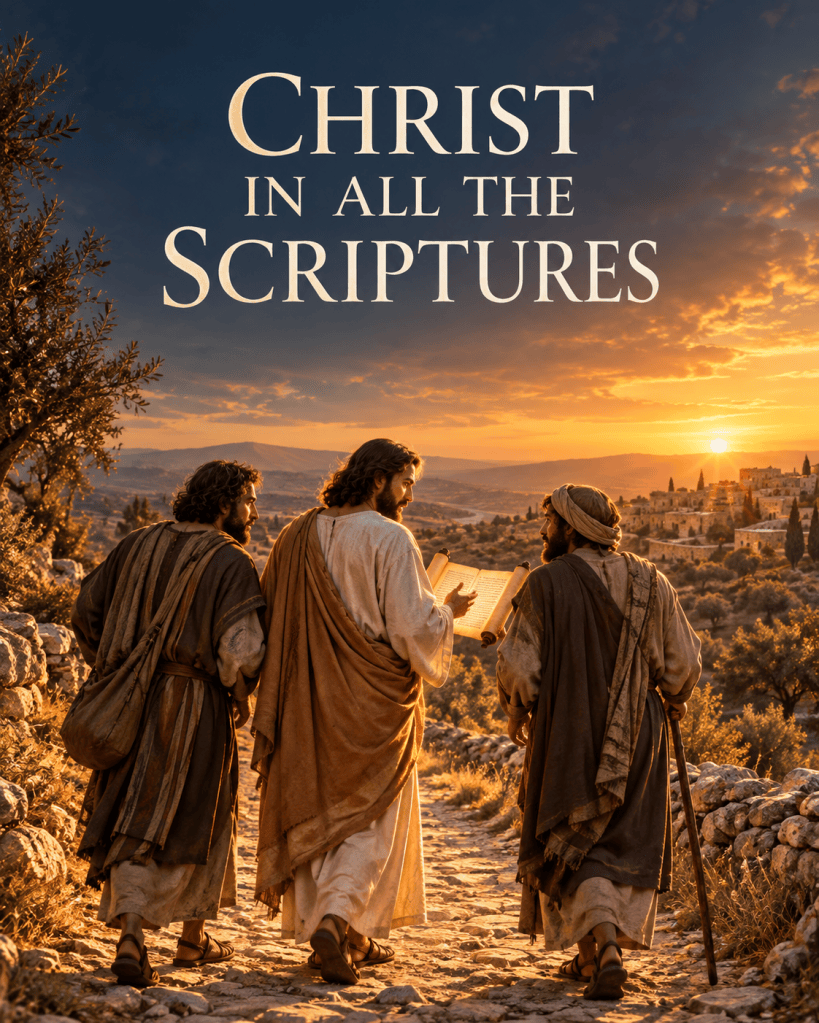
In Session 3, “Christ in All the Scriptures,” we explored Luke 24:13–35 and the encounter between Jesus and the two disciples on the road to Emmaus. They knew the events surrounding Jesus’ death and had even heard the reports about the empty tomb, but they did not yet understand what God was doing. Then Jesus came alongside them and, beginning with Moses and all the Prophets, showed them how the Scriptures ultimately pointed to him.

The Bible is more than a collection of moral teachings or principles telling us to work harder in our own strength. It is the unfolding revelation of God’s redemptive story centered in Jesus Christ—who he is, why he had to suffer, and how his death and resurrection accomplished the salvation we could never accomplish for ourselves. The cross was not an interruption of God’s plan; it was the fulfillment of God’s plan. My prayer is that we will not merely know more information about the Bible, but that we will encounter the living Christ through the Scriptures and experience our hearts coming alive to him.

If you missed the session or would like to hear it again, you can watch it here:

Watch “Christ in All the Scriptures” on YouTube⁠

Next Thursday, we will continue our CHRIST-CENTERED: Knowing Christ • Living in Christ • Experiencing Christ series with Session 4:

The Christ Who Understands — Hebrews 4:14–16

Many people believe that God is distant from their struggles or disappointed by their weaknesses. But Hebrews presents Jesus as our great High Priest who has entered heaven for us and who understands human weakness from the inside. He was tempted as we are, yet without sin. Because of Christ, we do not have to hide from God, pretend to be stronger than we are, or carry our burdens alone.

Hebrews gives us this remarkable invitation: “Let us then with confidence draw near to the throne of grace, that we may receive mercy and find grace to help in time of need.” Christ does not merely know about our suffering from a distance. He entered our humanity, experienced temptation and suffering, and now welcomes us to come honestly and confidently before God.

How would your relationship with God change if you truly believed that Christ understands what you are facing? What if your weakness were not a reason to run away from God, but the very reason to draw nearer to his throne of grace?

I hope you will join us next Thursday as we consider the Christ who understands us, represents us before the Father, and gives mercy and grace precisely when we need them most. I will be praying for each of you throughout the week.

Grace and peace,
Al

911 Memorial-

Al Ngu.  September 11, 2026

Good morning.

This morning, we gather in a solemn moment to remember September 11 and all that this day represents for our city, our nation, and for so many families whose lives were forever changed. We remember with gratitude those who gave their lives, including Dick Morgan and the many men and women who served in the aftermath of that terrible day. We honor their courage and sacrifice, and we give thanks for those who continued to serve, even when the immediate crisis had passed and the consequences continued for years afterward.

But this morning, I want us not only to remember what happened, but to consider where we can find hope in the face of suffering and loss. Because when we stand in a place of remembrance like this, one question inevitably comes to us: Where do we turn when life is broken? Where do we find strength when we experience things that we cannot explain? And where can we find hope when the wounds of the past continue to affect the present?

The Bible does not give us a shallow answer to those questions. Scripture does not tell us to ignore suffering or simply move beyond it. In fact, one of the most remarkable things about the Bible is that it gives us permission to grieve. The book of Lamentations was written in the midst of tremendous devastation. Jeremiah looked honestly at suffering, loss, and destruction. Yet, right in the middle of his grief, he says, “But this I call to mind, and therefore I have hope: The steadfast love of the LORD never ceases; his mercies never come to an end; they are new every morning; great is your faithfulness.”

“This I call to mind, and therefore I have hope.” What a beautiful word for a morning like this. We remember, but our remembrance does not have to end in despair. We can acknowledge the darkness without believing that darkness has the final word. We can grieve what has been lost while still believing that God is faithful. His mercies are new every morning. His faithfulness has not ended.

And Psalm 46 gives us another beautiful promise: “God is our refuge and strength, a very present help in trouble.” It doesn’t say that God’s people will never experience trouble. It says that when trouble comes, God is present. He is our refuge and our strength. And the Psalm goes on to say, “God is in the midst of her; she shall not be moved.”

That is a message that New York City needs to hear—not only on September 11, but every day. We have experienced tremendous suffering, but we have also witnessed extraordinary courage, compassion, and service. We have seen people run toward danger to save others. We have seen people serve their neighbors, care for strangers, and continue to carry burdens that many of us will never fully understand. We give thanks for that legacy of service, and we pray that it will continue in the generations ahead.

But ultimately, our hope is not in our own strength. Our hope is in God.

And for those of us who believe in Jesus Christ, that hope becomes even more personal.

Because Christianity does not tell us that God watches suffering from a distance. The Christian faith tells us that God came into our suffering.

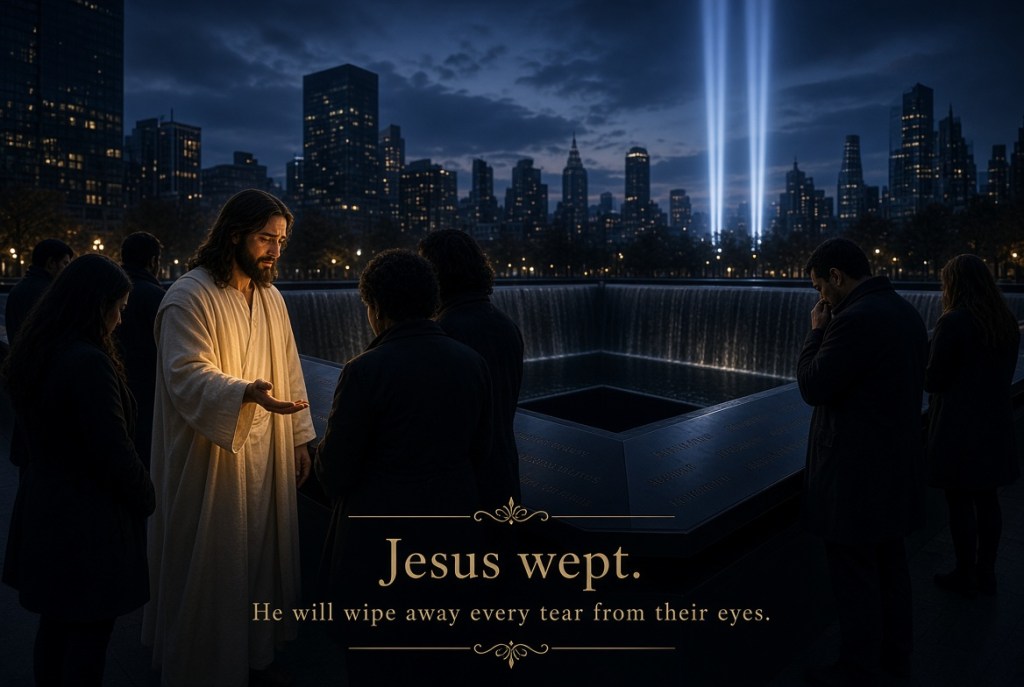
Jesus Himself wept.

When Jesus stood before the tomb of His friend Lazarus, He knew that He was about to raise Lazarus from the dead. He knew what He was going to do. And yet, when He saw Mary weeping and those around her grieving, the Bible simply says, “Jesus wept.”

That tells us something profound about the heart of God. Jesus does not stand far away from human grief. He enters into it. He knows what it means to lose someone. He knows what it means to weep. He knows what it means to experience suffering.

And Jesus did not merely witness suffering. He Himself experienced betrayal, violence, rejection, and death. He went to the cross. He entered into the deepest darkness that human beings can experience.

But death was not the final word.

Jesus Christ rose again.

And that is the heart of Christian hope. Our hope is not simply that things will eventually get better. Our hope is that Jesus Christ has conquered sin and death, and because He lives, death does not have the final word.

That is why the Christian can grieve and still have hope. We don’t have to choose between remembering and hoping. We can remember those we have lost, we can acknowledge the pain that remains, and at the same time we can look toward a future that is held by God.

And the Bible gives us a beautiful picture of that future at the very end of Revelation. It says that God “will wipe away every tear from their eyes, and death shall be no more, neither shall there be mourning, nor crying, nor pain anymore.”

Think about that promise: God Himself will wipe away every tear.

The tears that have been shed in New York. The tears of families who lost loved ones. The tears of those who served and carried the consequences afterward. The tears that perhaps are still shed privately, years later. God sees them. God knows them. And Scripture tells us that there is coming a day when He will wipe away every tear, when death will be no more, when mourning and pain will finally come to an end.

That is our hope.

So this morning, we remember with gratitude. We honor with respect. We grieve with those who grieve. And we look forward with hope—not because we have forgotten the darkness, but because we believe the darkness will not have the final word.

There is a future for New York City. There is a future for our families and for the generations that will come after us. And ultimately, there is a future in the hands of a faithful God who has not forsaken us.

So as we leave this place today, may we carry with us not only the memory of those we honor, but also the hope that comes from knowing that God is our refuge and strength, that His mercies are new every morning, and that in Jesus Christ, death is not the end.

Jesus wept. Jesus suffered. Jesus died. But Jesus rose again.

And because He lives, there is hope.

May God comfort those who still grieve, strengthen those who continue to serve, bless the city of New York, and lead us into the future with courage, compassion, and hope.

Thank you.

New York 911 Memorial

Good morning.

This morning, we gather in a solemn moment to remember September 11 and all that this day represents for our city, our nation, and for so many families whose lives were forever changed. We remember with gratitude those who gave their lives, including Dick Morgan and the many men and women who served in the aftermath of that terrible day. We honor their courage and sacrifice, and we give thanks for those who continued to serve, even when the immediate crisis had passed and the consequences continued for years afterward.

But this morning, I want us not only to remember what happened, but to consider where we can find hope in the face of suffering and loss. Because when we stand in a place of remembrance like this, one question inevitably comes to us: Where do we turn when life is broken? Where do we find strength when we experience things that we cannot explain? And where can we find hope when the wounds of the past continue to affect the present?

The Bible does not give us a shallow answer to those questions. Scripture does not tell us to ignore suffering or simply move beyond it. In fact, one of the most remarkable things about the Bible is that it gives us permission to grieve. The book of Lamentations was written in the midst of tremendous devastation. Jeremiah looked honestly at suffering, loss, and destruction. Yet, right in the middle of his grief, he says, “But this I call to mind, and therefore I have hope: The steadfast love of the LORD never ceases; his mercies never come to an end; they are new every morning; great is your faithfulness.”

“This I call to mind, and therefore I have hope.” What a beautiful word for a morning like this. We remember, but our remembrance does not have to end in despair. We can acknowledge the darkness without believing that darkness has the final word. We can grieve what has been lost while still believing that God is faithful. His mercies are new every morning. His faithfulness has not ended.

And Psalm 46 gives us another beautiful promise: “God is our refuge and strength, a very present help in trouble.” It doesn’t say that God’s people will never experience trouble. It says that when trouble comes, God is present. He is our refuge and our strength. And the Psalm goes on to say, “God is in the midst of her; she shall not be moved.”

That is a message that New York City needs to hear—not only on September 11, but every day. We have experienced tremendous suffering, but we have also witnessed extraordinary courage, compassion, and service. We have seen people run toward danger to save others. We have seen people serve their neighbors, care for strangers, and continue to carry burdens that many of us will never fully understand. We give thanks for that legacy of service, and we pray that it will continue in the generations ahead.

But ultimately, our hope is not in our own strength. Our hope is in God.

And for those of us who believe in Jesus Christ, that hope becomes even more personal.

Because Christianity does not tell us that God watches suffering from a distance. The Christian faith tells us that God came into our suffering.

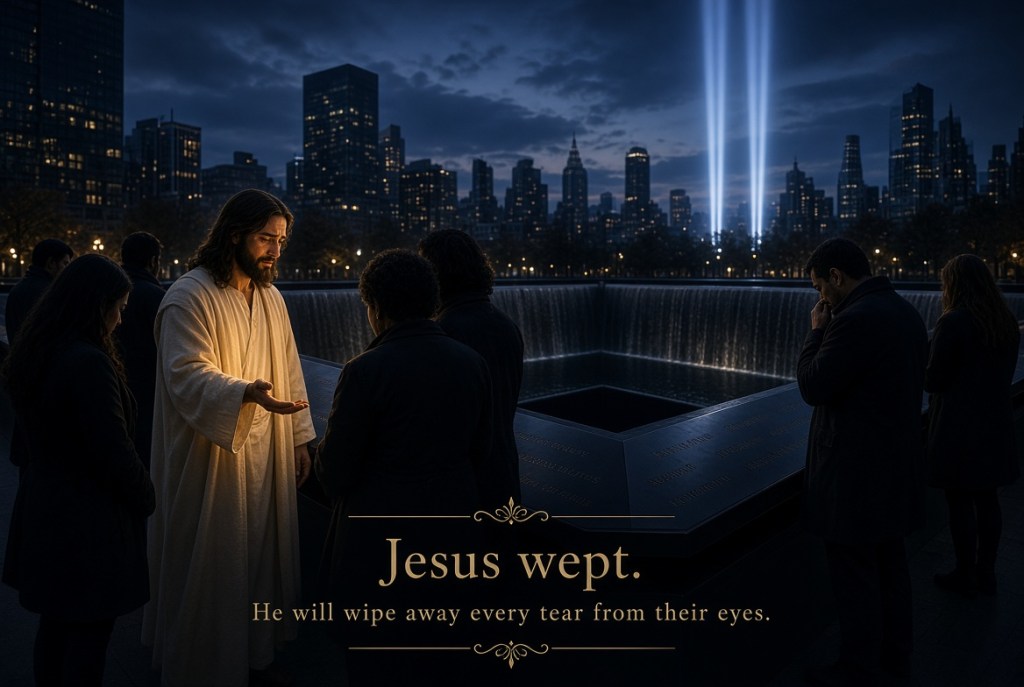
Jesus Himself wept.

When Jesus stood before the tomb of His friend Lazarus, He knew that He was about to raise Lazarus from the dead. He knew what He was going to do. And yet, when He saw Mary weeping and those around her grieving, the Bible simply says, “Jesus wept.”

That tells us something profound about the heart of God. Jesus does not stand far away from human grief. He enters into it. He knows what it means to lose someone. He knows what it means to weep. He knows what it means to experience suffering.

And Jesus did not merely witness suffering. He Himself experienced betrayal, violence, rejection, and death. He went to the cross. He entered into the deepest darkness that human beings can experience.

But death was not the final word.

Jesus Christ rose again.

And that is the heart of Christian hope. Our hope is not simply that things will eventually get better. Our hope is that Jesus Christ has conquered sin and death, and because He lives, death does not have the final word.

That is why the Christian can grieve and still have hope. We don’t have to choose between remembering and hoping. We can remember those we have lost, we can acknowledge the pain that remains, and at the same time we can look toward a future that is held by God.

And the Bible gives us a beautiful picture of that future at the very end of Revelation. It says that God “will wipe away every tear from their eyes, and death shall be no more, neither shall there be mourning, nor crying, nor pain anymore.”

Think about that promise: God Himself will wipe away every tear.

The tears that have been shed in New York. The tears of families who lost loved ones. The tears of those who served and carried the consequences afterward. The tears that perhaps are still shed privately, years later. God sees them. God knows them. And Scripture tells us that there is coming a day when He will wipe away every tear, when death will be no more, when mourning and pain will finally come to an end.

That is our hope.

So this morning, we remember with gratitude. We honor with respect. We grieve with those who grieve. And we look forward with hope—not because we have forgotten the darkness, but because we believe the darkness will not have the final word.

There is a future for New York City. There is a future for our families and for the generations that will come after us. And ultimately, there is a future in the hands of a faithful God who has not forsaken us.

So as we leave this place today, may we carry with us not only the memory of those we honor, but also the hope that comes from knowing that God is our refuge and strength, that His mercies are new every morning, and that in Jesus Christ, death is not the end.

Jesus wept. Jesus suffered. Jesus died. But Jesus rose again.

And because He lives, there is hope.

May God comfort those who still grieve, strengthen those who continue to serve, bless the city of New York, and lead us into the future with courage, compassion, and hope.

Thank you.

Is My Cause Is Hidden from the Lord?

On Isaiah 40, and the God who does not grow tired of us

Signature: KxDCgHeBJwve8ybS34M3DJKkWFJ+e6EG+kfpKqDVKSYuR8gcDO5KN7q3bagyM8yOuxzyjcdZPErNoaKN4I9q7ZPlsmG7P8OqrnWwMJhlPfbu0QE29jUI1eF0A/qxiL3IzV/MQVqOuc9hAkMvX6oHUObzD4XHis/ekEuXUinWmlBRM6jCJ3cKwFsIJY9CXm02wBAHHK79vlxazoyHJe0fLBulFEP71gsVk8ipzRRNs2QJQf+HWfTRNYmvfxXlshSfTZmXxU+6/YvykAq3irRCE8/CfI+E3yOKrtlj8fIp6bYYs2SgBkH2NKqZv2QJNB9OsZBKhC+xcLjVwg0aW0jK+3PWSfbezS3VDRXR41duVy9Z1e8QA0dJp7hWonZHAsf1vxZyQn7CMBelcv+zDrz35HwEkyYqiY2qEIDTvthlbP6IQZq45CSiyQU4VYSGuncR6oozpkszFzTHBZvdtcSjhCyGG6C2/MD1CLo/9qQF0ji/A+mzAN/V4OP1SKNOpKKK2uC8vSVe6jjb7sBju8CY2n5Qr8JbYENwcYspI/O8gqEK7iqB3SAcM/30BvFK+UIp0T2OGqVOVfeDnTxl1YBeJn8iVIUhk1nbwxy7rMMQ54xXBmR694Jit5lQGYAdfOCa7xR0Q/kQ+Ynor6hdfjPpoKSvSvCAAnn8FMoHH17QSXZwAW0KxhixxPmwu0Ly7V8ap4DuNV3oLa+WRiqwgrXWm/QTDl0EIHc72m0uLbweKwYZKA2P+fnTETNmuShAsgmrgqh3E4NUVFefwxzDVZdryF9EbVIxRHrbXIm6I9FMxZMKSheXNL/j1YmRQ+M+fxF2C9v8vEUXL0woIteKkXHY9Nq7EwBrDzN3F5N68Cd0qyEke/d1m7kPQykIBagIXn/2W7Wcoxd5firDV/HdZMa9vAR/oeMx3fAfPdeoLeDKTPg7c115yqtE00WvpfmPeA9Ye6L087tejSoD3fkQod48TTFNP9DEF49XNZz14ty1KiQ=

You know the silence I mean.

You have prayed the same prayer so many nights that the words have worn smooth, like a coin handled too long. You have asked, and asked, and the ceiling has not moved. Months of it. Maybe years. And somewhere underneath the prayer a quieter sentence starts to form, one you would never say out loud in church: He isn’t listening. My case has been set aside.

That is where Isaiah 40 begins. Not in triumph. In exile.

Israel is far from home. Babylon has taken the temple treasures, taken the sons, taken the future. Isaiah had seen it coming a chapter earlier and said it plainly — the days are coming when everything in your house will be carried off, and nothing will be left. It happened. And now the people sit in a foreign city, under foreign gods, and the God who had called them mine has, as far as they can feel, gone quiet.

I want to stay on Babylon for a second, because Babylon was never only a place.

In Scripture, Babylon becomes shorthand for everything in the world that is impressive to the eye and set against God underneath. Gleaming on the outside. Rotten at the root. And here is the part that makes my heart go small: you can be carried into Babylon without ever noticing the journey. You can take on its values, its doctrines, its whole way of wanting things, and call it home. I look at the world I live in — I look at this country I love — and I see how much of it is exactly that. Confident. Beautiful. Quietly opposed to God. And most of the people inside it have no idea they’ve been taken.

So this is who the word of comfort comes to. Not the strong. The captured. The tired.

Comfort, comfort my people, says your God. Speak tenderly to Jerusalem.

Notice that He still says my people. After the exile. After the failure. Still mine.

And then Isaiah does something strange. To a people who feel forgotten, he preaches the sheer size of God. Who measured the oceans in the cup of his hand? Who has ever taught the Lord anything, shown Him a better way? The nations are one drop hanging off a bucket. Dust on a scale. He sits above the circle of the earth, and from up there we look like grasshoppers — all of us, the whole restless swarm of us. He brings out the stars one by one and calls each of the billions by name, and not one of them goes missing.

You would think that would only make a small, tired person feel smaller.

But watch where Isaiah is going. Right after the stars — right after establishing that God forgets nothing, not one distant burning thing in all that dark — he turns and looks straight at the exhausted heart and says back to it exactly what it has been whispering:

Why do you say, O Jacob, and speak, O Israel, “My way is hidden from the Lord, and my right is disregarded by my God”?

There it is. The real thing. Not does God exist — the exiles believed He existed. The wound is quieter than that, and closer to the bone. My case, mine specifically, has been overlooked. He is real, and He is powerful, and He is not paying attention to me.

And I love that God does not scold the doubt. He answers it.

Have you not known? Have you not heard? The Lord is the everlasting God, the Creator of the ends of the earth. He does not faint or grow weary.

Read that slowly if you are tired tonight. He does not grow weary. The One who has been waiting with you does not get drowsy on the late shift. He does not lose the thread of your prayer somewhere around month eight. And his understanding is unsearchable — which means that if the answer is taking longer than you can bear, it is not because He forgot. It is because He is working at a depth you cannot see the bottom of.

Then comes the promise, and it is not the promise I would have written.

He gives power to the faint, and to him who has no might he increases strength. Even youths shall faint and be weary, and young men shall fall exhausted; but they who wait for the Lord shall renew their strength. They shall mount up with wings like eagles; they shall run and not be weary; they shall walk and not faint.

Not the strong will win. The strong fall down. The young burn out. The promise is for the ones who have run all the way out of themselves and are still, somehow, waiting. The NIV says those who hope in the Lord — and it turns out hoping and waiting are the same verb, the same act, the same stubborn refusal to stop looking up.

Here is the whole thing, as plainly as I can say it. I don’t think most Christians doubt that God is mighty. We’ll sing that all day long. He hangs the stars and calls them by name — fine, we believe it. What we doubt, at two in the morning, is whether that God will bother to help us. This situation. This prayer. The one we’ve held up so long our arms have gone numb.

That is the exact doubt God reaches for in verse 27. And His answer is not you were wrong to hurt. His answer is: I am not hidden. I am not disregarding you. Wait.

So tonight, wait.

But hear the tense of the promise, because everything turns on it.

They who wait for the Lord shall renew their strength; they shall mount up with wings like eagles; they shall run and not be weary; they shall walk and not faint.

Shall. Will. Later. The soaring is in the future, and the future can be years away — years of kneeling, years of the same worn prayer. The renewed strength is a promise still out ahead of you.

And yet look back at where the chapter opened, because that is the present tense. Comfort, comfort my people. Speak tenderly to Jerusalem. Tell her that her hard service is completed, that her sin is paid for. Not will be. Is. Already. The exiles were still sitting in Babylon when God announced that their warfare was over. You may still be on your knees when He says the hard part of your waiting is finished. The soaring is coming. The comfort has already started.

That is how grace works while you wait. He gives power to the faint, and strength to the one who has none left — not by lifting the weakness off you, but by quietly rebuilding you underneath it, for a day you cannot yet see.

And that day comes. There is no image in all of Scripture more liberating for someone who has knelt so long their knees have gone numb than this one. Not crawling. Not limping. Not merely surviving. An eagle — thousands of feet up, wings open, riding the very wind that used to knock you flat. The God who never grows weary does not just get you back on your feet. He gives you the sky.

So keep waiting. The kneeling is not the last scene. Out ahead of you, above Babylon and the grasshoppers and the numbered stars, something with wide wings is riding the high wind — weightless, unhurried, unafraid. Not long ago it was face-down on the floor, praying a prayer that seemed to land nowhere. That is you, later. Wait for it.

The Veil Over the Heart

What 2 Corinthians 3 Actually Says About Freedom, Hardened Hearts, and the Crisis of Our Generation

Al Ngu

Part One of Three

I. A Sermon That Troubled Me

Once I sat under a sermon drawn from 2 Corinthians 3:17 — “Now the Lord is the Spirit, and where the Spirit of the Lord is, there is freedom” — connected to Galatians 5:1: “For freedom Christ has set us free.” The preacher was earnest. The congregation was moved. And the message ranged across a familiar landscape of contemporary concerns: freedom from depression, from loneliness, from anxiety, from the gravitational pull of self-destructive habits. Real struggles. Real pain. And a real text.

But something did not sit right with me, and it took some time to name what it was. The sermon was not wrong to speak of freedom. The text does speak of freedom. But it had imported a meaning of freedom that the passage itself does not supply — and in doing so, it had bypassed the specific and more searching freedom that Paul actually has in mind. The freedom in 2 Corinthians 3:17 is not, in its first and controlling sense, freedom from depression or loneliness. It is freedom from something far more foundational, far more spiritually catastrophic, and far more precisely addressed by the new covenant: freedom from a hardened heart.

To miss this is not a minor exegetical slip. It changes the entire trajectory of what the gospel is being asked to do. A gospel that offers relief from circumstantial suffering without addressing the hardened heart that underlies it is a gospel that cannot sustain what it promises. It gives people something to feel without giving them something to become. And that, I will argue, is not the freedom the Spirit of God brings.

My burden in this article is pastoral and urgent. I am thinking specifically of people I know and love — young people and older ones alike — who once confessed Christ and now have walked away. Some have drifted quietly. Others have reconstructed a faith on their own terms, keeping a version of Jesus that never costs them anything. Others have deconstructed publicly and openly. I want to understand what is happening to them theologically. What does Scripture call this? Where does it come from? And is there any genuine hope for the heart that has gone to stone?

The answer begins in 2 Corinthians 3. And it is more searching, more specific, and more hopeful than most sermons on this text have led us to believe.

II. What the Passage Actually Says: The Veil and the Hardened Heart

Paul’s argument in 2 Corinthians 3 begins with Moses descending from Sinai with the glory of God radiating from his face — a glory so intense that Israel could not bear to look at him, and he was compelled to veil his face (Exodus 34:29–35). Paul’s interpretive move is audacious: he takes this familiar story and reinterprets the veil not merely as a physical covering over Moses’ face, but as a symbol of something that persists into his own present day.

“But their minds were hardened,” he writes in verse 14, “for to this day, when they read the old covenant, that same veil remains unlifted.” And then, more devastatingly: “Even to this day when Moses is read, a veil lies over their hearts” (verse 15). The veil, in Paul’s rereading, is not over Moses’ face. It is over the heart of the reader.

And what does this veil produce? He names it in verse 14: hardness. The Greek word is pōrō — to petrify, to turn to stone, to make callous. The law of Moses, read without Christ and without the Spirit of the new covenant, does not soften the heart toward God. It petrifies it. Not because the law is defective — Paul insists elsewhere that the law is holy and righteous and good (Romans 7:12). But because the law comes to a faculty that is broken. It commands what the unrenewed heart cannot do, and the result is not reformation but calcification. The heart that cannot obey grows harder in its inability. The veil thickens.

This is the specific bondage that verse 17 addresses. “Where the Spirit of the Lord is, there is freedom.” Freedom from what? Freedom from this. Freedom from the veil over the heart. Freedom from the petrified, stone-cold, unresponsive inner life that hears the Word of God and remains unmoved — not because it lacks information, but because the very faculty of reception has been shut down. This is the deepest slavery a human being can experience — not the slavery of circumstance, but the slavery of a will turned to stone. And it is from this slavery, specifically and precisely, that the Spirit of the new covenant sets us free.

The old covenant could diagnose this condition. It could not cure it. But the prophets had already heard God announce that he intended something more. Jeremiah heard it: “I will put my law within them, and I will write it on their hearts” (Jeremiah 31:33). Ezekiel heard it in even more visceral terms: “I will remove the heart of stone from your flesh and give you a heart of flesh. And I will put my Spirit within you, and cause you to walk in my statutes” (Ezekiel 36:26–27). The promise is not merely forensic. It is surgical. God reaches into the chest and replaces the stone with something that can beat, feel, and respond.

And in Luke 4:18, Jesus stands in the synagogue at Nazareth and announces that this promise has arrived in him: “The Spirit of the Lord is upon me, because he has anointed me to proclaim liberty to the captives.” The liberty he proclaims is precisely this liberty — not first the liberation of the prisoner from his cell, but the liberation of the captive heart from its own petrification. This is what the new covenant brings. This is what the cross purchased. And this is why freedom in 2 Corinthians 3:17 is such a weighty and specific word.

III. What Hardness Looks Like in Our Generation

The hardening of the heart is not a first-century Jewish problem. It is a perennial human condition, and it takes recognizable forms in every generation. In ours, it presents most acutely in three overlapping patterns.

The first is simple drift. A person who once read Scripture regularly, prayed with some intentionality, and gathered with the body of Christ begins to withdraw — slowly, almost imperceptibly. Nothing dramatic has happened. The Bible is read less frequently. Prayer becomes occasional and then absent. Worship becomes something attended rather than something inhabited. The heart has simply been starved of the beholding that keeps it soft, and it has begun, by degrees, to harden. This is the quiet pastoral emergency that rarely makes headlines but accounts for the majority of spiritual casualties in any congregation.

The second is the backsliding pattern — a moral failure or a season of deliberate sin that, rather than driving a person to repentance, drives them to theological reconstruction. Because the heart cannot simultaneously pursue sin and submit to the God who forbids it, it begins to quietly renegotiate its theology. Passages that were once received as authoritative begin to feel culturally conditioned or misinterpreted. The Jesus who commands becomes the Jesus who affirms. The cross that demands death to self becomes a symbol of self-actualization. This is not intellectual honesty. It is the hardened heart generating the theology that the hardened heart requires.

The third is the deconstruction movement in its more ideologically driven form. Here the hardening presents as sophistication. The person does not abandon religion — they refine it. They read widely, cite scholars, express compassion for the marginalized, and position themselves as having grown beyond the naive faith of their upbringing. But the Scripture passages they select, the interpretations they favor, and the Jesus they construct have one consistent feature: they never demand anything the reconstructed heart is unwilling to give.

Paul had a name for all three patterns. He called it the veil remaining over the heart. The person may be reading the text — perhaps reading it seriously and at great length — but the veil is there. The glory of Christ in the Word does not penetrate. The text is processed but not received. The words are analyzed but not inhabited. And the result, in every case, is a heart that grows progressively harder toward the actual Christ of the actual Scripture.

This is one of the most urgent fronts of spiritual warfare in our age. Not because the attacks are new, but because the cultural conditions have made them uniquely pervasive and unusually difficult to name. When the hardening presents as enlightenment, when petrification wears the face of intellectual maturity, it is very hard to call it what it is. But we must.

IV. The Mechanism of Transformation: Beholding the Glory of Christ

How does the Spirit soften what has been hardened? This is the question the passage moves toward answering. And Paul answers it in the verse immediately following his declaration of freedom — 2 Corinthians 3:18:

“And we all, with unveiled face, beholding the glory of the Lord, are being transformed into the same image from one degree of glory to another. For this comes from the Lord who is the Spirit.”

This verse contains the mechanism. Let us work through it carefully.

The key verb is katoptrizomenoi — beholding as in a mirror. It is a rare word, appearing nowhere else in the New Testament, derived from the Greek word for mirror. It carries a double sense: gazing into a reflective surface and, in that gazing, reflecting back what you see. The ESV renders it “beholding”; the NIV renders it “contemplating.” Both are right, and the tension between them is theologically productive: the believer gazes upon the glory of Christ, and in gazing, begins to mirror it. Beholding comes first. Reflecting follows as its necessary consequence.

The verb is in the present tense — indicating continuous, ongoing action. Transformation is not the result of a single powerful encounter, one mountaintop experience, one revival night. It is the cumulative fruit of sustained, habitual, returning attention to the glory of Christ. You become what you consistently behold.

The word translated “are being transformed” is metamorphoumetha — from the same root as our English word metamorphosis, and the same word used for Jesus’ Transfiguration on the mountain in Matthew 17:2. Paul is not describing a gradual self-improvement program. He is describing a structural remaking of the person, as radical as a caterpillar becoming a butterfly. And it is a passive verb. You are not transforming yourself. You are being transformed — by the Spirit, acting upon you, using the beholding as the instrument through which he does his work. The believer contributes the gaze. The Spirit produces the change.

The phrase “from glory to glory” — apo doxes eis doxan — signals progressive, cumulative, unceasing growth. A Semitic expression of intensification, comparable to Psalm 84:7’s “from strength to strength.” And crucially: unlike Moses’ glory, which faded because it was external and borrowed, the glory the Spirit produces in the new covenant believer increases. Its source is not a temporary encounter but the permanent indwelling of the Spirit of Christ himself.

What does beholding actually look like in practice? Paul himself answers this in the next chapter: the glory of God is seen “in the face of Jesus Christ” (2 Corinthians 4:6), mediated through the gospel — which is the Scripture. Jesus is the Word made flesh (John 1:14). When you gaze into the written Word, you are gazing into the incarnate Word. They are not two different objects. Scripture is the Spirit-given lens through which the risen Christ becomes visible to the unveiled heart.

And so the three great instruments of beholding are these. First, the daily meditation of the Holy Scripture — not the casual reading of a verse for emotional reassurance, but the sustained, submissive, returning immersion in the whole counsel of God. Psalm 1 describes the blessed man as one who meditates on the law day and night, and the Hebrew word for meditate is hagah — to mutter, to murmur, to turn a thing over repeatedly in the mind the way a cow works its cud. The text is not consumed and moved past. It is inhabited. And in that inhabiting, the glory of Christ embedded in every page begins to do its work upon the heart.

Second, prayer — which is not merely the recitation of requests but an increasingly intimate conversation with the living person of Christ. If Scripture is gazing at Christ, prayer is speaking to him. The beholding becomes a relationship. And in that sustained relational encounter, the Spirit works the same transforming alchemy: you become, gradually and sometimes imperceptibly, more like the one you spend the most time with.

Third, worship — private and communal. In worship, the beholding becomes embodied and affective. The heart does not merely observe the glory of Christ; it responds to it, is moved by it, is broken open by it. The “we all” of verse 18 is a plural. Transformation is not merely an individual project. The community of worshippers, gathered around Word and sacrament and prayer, creates conditions in which the Spirit can ignite in a congregation what may be only a flicker in an individual.

And here is the upgrade the new covenant brings over everything that came before: under the old covenant, these same practices — reading the law, prayer, worship — could be performed with a veil over the heart. The Israelites sang the Psalms and heard the Torah and offered the sacrifices, and still the hardness persisted. The glory was there, embedded in the text, but inaccessible — like sunlight behind a thick curtain. Under the new covenant, the Spirit has removed the curtain. The same Scripture now radiates with Christ. The same prayer now reaches the Father through the Son. The same worship is offered in Spirit and in truth. Same practices. Entirely different encounter.

V. Why So Many Are Still Not Free

If the veil has been removed permanently — if the Spirit now dwells within every believer, making the glory of Christ accessible through Scripture, prayer, and worship — why does the church still contain so many people whose hearts appear functionally hard? Why does deconstruction continue? Why does backsliding persist?

The answer is not that the new covenant has failed. The answer is that the removal of the veil is not the same as the sustained direction of the gaze. The door has been opened. But many believers are standing with their backs to it.

Regeneration gives the heart a new capacity to behold. But the flesh, the old nature, remains and wars against the Spirit (Galatians 5:17) — and it does not war alone. What we call distraction is rarely a neutral phenomenon. It is the surface symptom of something more sinister operating beneath it: the active, coordinated work of the enemy whose primary weapon, Paul tells us in 2 Corinthians 4:4, is deception. The god of this age has blinded the minds of unbelievers — and his strategy against believers is the same, only subtler. He does not need to re-hang the veil that Christ has removed. He simply needs to turn the face away from what the veil’s removal makes possible.

This turning is never a single clean movement. It is a process — overlapping, cumulative, and mutually reinforcing. The demonic works through deception, planting doubts about the goodness of God, the reliability of Scripture, the coherence of faith. The flesh cooperates eagerly, finding in those doubts a permission structure for the desires it has never stopped wanting. The heart, shaped by both, begins to experience a creeping disillusionment — not a sudden collapse of faith but a slow cooling, a gradual withdrawal of trust, a progressive loss of appetite for the things of God. And the carnal mind, which Paul says in Romans 8:7 is hostile to God by nature, provides the rationalization that makes the whole drift feel like growth rather than departure.

These forces do not operate in sequence. They operate simultaneously, each one amplifying the others. The deception makes the flesh bolder. The flesh makes the heart more susceptible to deception. The disillusionment makes both feel reasonable. And woven through all of it is the noise of contemporary life — the curated digital worlds, the endless horizontal stimulation, the thousand small redirections of attention — which are not the cause of the hardening but the medium through which the other forces most effectively do their work. The enemy has never had a more efficient delivery system for spiritual numbness than the one we carry in our pockets.

The result is a heart that is not beholding Christ. And a heart that is not beholding Christ is a heart that is not being transformed. And a heart that is not being transformed is a heart that is becoming harder — not by dramatic apostasy, but by the quiet, daily compounding of a gaze that has been turned away.

This produces a downward spiral: no beholding produces no transformation, which weakens the desire to behold, which produces less transformation, which hardens the heart further. The Christian who once read Scripture with hunger finds the Bible growing dry. Prayer feels like speaking to the ceiling. Worship becomes performance. And at some point, the gap between what the professed faith demands and what the hardened heart can sustain becomes unbearable — and deconstruction presents itself as the intellectually honest exit.

There is also a genuine paradox at work that honest pastoral observation cannot avoid. The hardened heart does not want to read Scripture. But Scripture is what softens the hardened heart. The heart that avoids the Word grows harder. The harder it grows, the less it wants the Word. This is not merely a theoretical spiral. It is the bondage of the will that Paul describes in Romans 7 and that Augustine recognized in himself centuries later: the man who wants to do good cannot. The problem is not information deficit. It is a captivity of the wanting itself.

This paradox raises a question that this article cannot fully answer but refuses to leave hanging: if the hardened heart cannot soften itself, and if the beholding that softens it requires a willingness the hardened heart does not possess — who breaks the cycle? How does anyone get out? And what can those of us who love the deconstructed, the backslidden, and the drifting actually do?

That is the question the second part of this essay takes up. But before we get there, sit for a moment with the weight of what Paul has diagnosed. The veil is real. The hardness is real. The spiral is real. And the people caught in it are not primarily intellectual skeptics who need better arguments. They are people with hearts of stone who need the one thing no human being can give them — and that the new covenant promises God will.

* * *

This is Part One of a two-part essay. Part Two — “Preaching to Dry Bones” — takes up the theological and pastoral response: the doctrine of regeneration, and what those who love the hardened-hearted can actually do.

—

Al Ngu (MDiv) is a pastor and church planter in New York City, where he leads Hearts Burn NYC, a faith community gathering in Union Square Park. He writes at the intersection of biblical theology, pastoral concern, and the life of the Spirit for a generation in crisis.

God is Real –Pruning the Soul for the Calling

This morning I was in my early morning prayer as usual in my 1 hour prayer, although this morning was a little bit short ,but it was profound experience. I’ve been struggling to do things for God, to serve God , to reach a height that I’ve ever seen before to glorify him not to glorify my ministry per se.  Although they always have a linkage between the two.

God promise to make Abraham’s name great

As a matter of fact God spoke to Abraham, “ I will make your name great and I’ll make you to be father of great nations. All nations shall be blessed through you. I will bless you and I will bless those who bless you and curse those who curse you.” This is making Abraham’s name great, not for Abraham’s sake as he is in no way asking for anything of that sort from God, but its really him trying to understand, trying to serve God in his calling in a humble way. But astoundingly God promise to make Abraham’s name great!

In our days it is hard  to imagine that you want to ask God to make your name great and they’ll be self-centered, self-egoistic! But this is not that case, this is actually God wanted to make Abraham’s name great so you might understand that’s how I pursue God for all this longest time of period because I want to proclaim his Name make his name great. 

In the midst of all this, I feel worn out, tired mentally and spiritually because I’m not seeing anything substantial from God in my drive and zeal to plant church for God. I remember there was a tremendous session taught in our movement before on the chapter called the zeal of Paul.  Zealousness is one of the clearest characters in Paul’s life and is displayed as his passion for Christ and he even said, “Woe is me if I don’t preach the gospel.”  So I’m zealous by my own nature and passionate and it seems to be a grinding to the ground.

God blessed me to start a work bible group

In fairness by God’s grace, He has blessed me to start a new group Bible teaching group in my office which is truly remarkable because it has never been done in the existence of out company for the last hundreds of years as far as I know!  All these are very exciting. I started it in August last year and now it’s about 8 to 10 people and it’s about half a year now time flies. I graduated last May and I have determined in my life I want to be somewhat like Paul when he got converted literally after three days of prayer and fasting when he was liberated from his blindness as he was struck by the Lord Jesus, the minute he opened his eyes he started preaching the gospel. And he was so powerfully effective and anointed and it seems doors are opening all over the place for him. I mean he could just literally walk into a synagogue, and they will invite him to preach. I wish modern day synagogues and churches would do that to me as well today, but there is a dream that never will happen. It’s a laughingstock. So I wanted to start quickly. Time flied pass….it was June ,July I was really seeking the Lord for direction what to do Lord I’ve spent seven years very rigorous Master Divinity (MDiv) in NYC and Orlando, and now am totally ready to blast it out for Jesus. And guess what? Nothing. In fact I was able to preach once a month during my two years of seminaries schools the last two years, and after I graduated last year the strangest thing happened, I was not invited to preach in that church in New Jersey anymore. And prior to that I was like preaching three Sundays a month in Long Island as an interim pastor and that was intense because I was studying in school having a 40 hour full time job and I have a family, although empty nested, and in the midst of juggling all this I was really stretched and I did that for one year the Lord has done a beautiful thing in my life. So it is in that context that I hear nothing, I got nothing. In the church that my wife and I attending, I finally put myself forward and asked by the pastor to teach theology class once and now preaching in a quarterly fashion which is really far from my intensity, but very thankful.  And thanks be to God that I am able to teach the word of God bi weekly in my office to a group of 10 people. O Lord may you bless their group the Lord bless the folks who come to my teaching.

The Vision of a Pizza Cutter

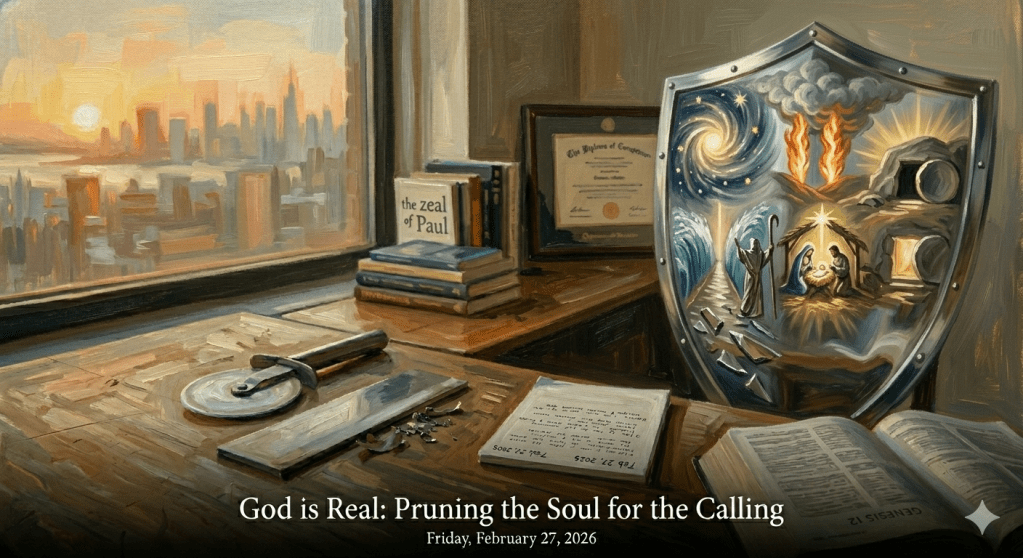
So this morning as I was praying so hard I recognized that I have something I can relate to from the church planters forum I attended with  for.NYC organization. They were telling us that one of the pastors after seven years of pastoring, he felt the internal state of his soul is worn out, it’s not ready to continue to do the intensity of pastoring. That phrase caught my attention about the internal state of your soul. In fact there were like the lead pastor of this organization shared that he had even experienced: his three church plants were blasting away growing well while his marriage was falling apart. But thanks be to God the grace of God he rectified that and his has great marriage ever since. So I thought to myself maybe God is doing something about my internal state of my being during all this period of searching and knocking at the door and with my zeal for God and passion for the ministry of the gospel, and as I was praying suddenly I saw this vision of something like a metal roller cutter like a like a pizza wheel cutter thing and just rolled over the edge of a metal. And this is like the cutter is cutting off the edges of the metal. I immediately understood and dawned on me that this is God telling me, “You are right, I’m doing something in your internal state and I’m cutting off the rough edges in your life.”

God is real

That means the world to me at that moment and I said, “Lord thank you now I know God is real.”  When I say God is real, I mean I always know that God is real, what it means God is real at that moment to me because God can be very silent even though you know he’s there. I’m feeling so much better and I do think that God cares very much how we feel inside our hearts but it takes a while for God to communicate that because it is precisely through this process of the moments we experience that God is actually transforming our lives, transforming our state of our inner being so they will be ready for the calling years for us.

Praise to God!

The Search for the Transcendent: Gen Z and the Return to Orthodoxy

In the landscape of the 21st century, a quiet but profound revolution is taking place. For decades, the prevailing sociological narrative suggested that as societies modernized, they would inevitably secularize—leaving religion behind as a relic of a bygone era. However, recent data from both the United States and the United Kingdom has upended this expectation. A striking trend has emerged: Gen Z men are retaining or adopting Christian identity at rates equal to, or even higher than, their female peers.

This is not merely a statistical anomaly; it is a spiritual homecoming. Many young men today report feeling culturally dislocated, marginalized, or even villainized by progressive secular discourse regarding masculinity. In an era defined by “fluidity”—where identity, gender, and morality are treated as ever-shifting social constructs—young men are finding themselves adrift. In response, they are gravitating toward the ancient, the “thick,” and the traditional. Traditional forms of Christianity, particularly Catholicism and Eastern Orthodoxy, offer a narrative of responsibility, sacrifice, and hierarchy that provides a defined role for men seeking solid ground.

The Crisis of Masculinity and the Divine Design

The modern challenge to masculinity, driven by aggressive progressive cultural forces, has created a deep-seated confusion regarding gender roles. Over the last decade, the cultural “circuitry” of society has been rewired. By attempting to dismantle the traditional understanding of what it means to be a man or a woman, secular society has inadvertently created a “void in the soul” for a generation of men.

When we speak of masculinity today, it is often through the lens of “toxicity.” Young men are told that their natural inclinations toward strength, leadership, and protection are inherently problematic. This has led to a state of cultural dislocation. After years of feeling like they have no place in the modern narrative, Gen Z men are reacting against the chaos. They are finding that the “freedom” promised by secularism feels more like a vacuum.

From a secular sociological perspective, many scholars overlook the fundamental reality of the human condition: the Imago Dei—the image of God—and the “common grace” implanted in the human soul. There is a fundamental tension that occurs when human design is distorted. Much like a high-performance vehicle—if you begin short-circuiting the electrical design or putting the wrong fuel in the tank, the car will sputter, stall, and eventually break down.

Similarly, the human soul becomes restless, tired, and worn out when it operates outside of God’s design. This is the heart of the Gen Z cry. They are tired of the “short-circuiting” of their nature. It is in this state of exhaustion that the invitation of Christ becomes a lifeline:

“Come to me, all you who are weary and burdened, and I will give you rest. Take my yoke upon you and learn from me… for my yoke is easy and my burden is light.” (Matthew 11:28-30)

The Biblical Foundation of Identity

To understand why Gen Z men are returning to the Church, we must look at the foundational architecture of identity found in the Book of Genesis. The Bible establishes that gender is not a social performance, but a divine distinction.

“So God created mankind in his own image, in the image of God he created them; male and female he created them.” (Genesis 1:27)

Crucially, God breathed His life specifically into them—an act not extended to the animals or the plants. This “breath of life” confirms that only humanity is created in the image of God. This truth stretches far beyond the Garden of Eden; it provides the very definition of male and female in this world.

“Then the Lord God formed a man from the dust of the ground and breathed into his nostrils the breath of life… Then the Lord God made a woman from the rib he had taken out of the man, and he brought her to the man.” (Genesis 2:7, 22)

When society pushes a “social construct” agenda to redefine these roles, it leads to the spiritual and social decay described in the first chapter of Romans. Paul describes a society that exchanged the truth of God for a lie and worshiped the creature rather than the Creator. The result was a “giving over” to confusion and disorder.

“They exchanged the truth about God for a lie, and worshiped and served created things rather than the Creator… Because of this, God gave them over to shameful lusts. Even their women exchanged natural sexual relations for unnatural ones. In the same way the men also abandoned natural relations with women and were inflamed with lust for one another.” (Romans 1:25-27)

Yet, it is precisely because of this darkness that the light of the Transcendent is becoming so attractive again. In a world of “liquid modernity,” only the Transcendent offers the certainty and serenity that the human heart craves.

From Judgment to Grace: The Path to Restoration

While the diagnostic portion of the Bible warns of the consequences of turning away from God’s design, the Scriptures do not leave us in the pit of despair. The transition from Romans 1 to Romans 3 is one of the most powerful movements in all of theology.

Paul moves from the judgment of God to the grace of God. He acknowledges that while all have fallen short and experienced the “short-circuiting” of their nature, the grace of God provides a pathway for joy, forgiveness, and total restoration.

“This righteousness is given through faith in Jesus Christ to all who believe. There is no difference… for all have sinned and fall short of the glory of God, and all are justified freely by his grace through the redemption that came by Christ Jesus.” (Romans 3:22-24)

This is the message that Gen Z men are finally hearing. They are realizing that they do not have to be “self-made” men; they can be “God-made” men. Despite the “giving over” to disorder that we see in the culture, the grace of God is working a quiet miracle. The time has come for Gen Z to experience this restoration. They are seeking a framework that is not social, but spiritual; not temporary, but eternal.

The Role of Modern Intellectuals: Re-enchanting the Bible

We cannot discuss this trend without acknowledging the role of public intellectuals, most notably Jordan Peterson. Peterson has played a pivotal role in “re-enchanting” the Bible for a secular male audience that had previously written it off as a book of fairy tales.

By framing biblical narratives as psychological maps for meaning rather than strictly metaphysical claims, Peterson created an “on-ramp” for secular men to enter religious spaces. He spoke to men in a language they understood: the language of competence, responsibility, and voluntary sacrifice. He challenged young men to “stand up straight with your shoulders back”—a call to alertness that mirrors the biblical command:

“Be on your guard; stand firm in the faith; be courageous; be strong.” (1 Corinthians 16:13)

Peterson’s work has paved the way for a religious lifestyle for many who were otherwise lost in the spiritual vacuity of modern life. He helped them realize that the Bible isn’t just a book you read; it’s a reality you inhabit. The keyword here is yearning. There is a profound yearning for meaning in a world that tells young men they are “toxic” or “unnecessary.” By providing a bridge between psychological truth and biblical orthodoxy, these intellectual movements are navigating young men back toward the timeless wisdom of the Scriptures.

Conclusion: The Return to the Ancient Path

The rise of “Digital Orthodoxy” and the return to traditional liturgical worship among Gen Z men is a sign that the secular experiment has failed to satisfy the human soul. The aesthetic of antiquity, the rigor of discipline, and the clarity of the biblical narrative are far more appealing to a young man than the hollow promises of a fluid culture.

The “human vehicle” is being brought back to the Manufacturer. The confusion of gender roles and the “man-made” problems of the last decade are being met with the ancient “God-made” solutions. It is absolutely comforting to know that the time has come for the Gen Z man to react to the void and reach for something solid.

They are moving from the chaos of Romans 1 into the grace of Romans 3. They are finding that in the hierarchy of God, there is freedom; in the responsibility of the Cross, there is strength; and in the image of God, there is a true identity that no social construct can ever take away.

The time has come for Gen Z. Praise the Lord.

Demons Know What Many Christians Forget: The Terrifying Reality of “The Time”

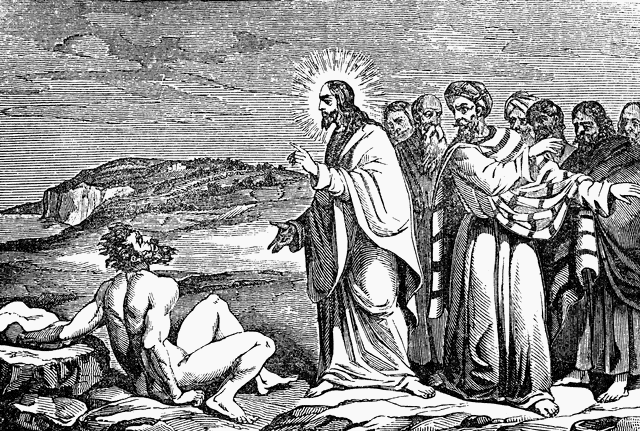
When Jesus and His disciples crossed the stormy Sea of Galilee—after He had rebuked the winds and waves with a word of authority—they stepped ashore in the region of the Gadarenes (or Gergesenes, as some manuscripts read). Immediately, two demon-possessed men came rushing from the tombs toward Him. These men were so fierce and uncontrollable that no traveler dared pass that way anymore. Yet in the presence of Jesus, the demons inside them could not remain silent. They cried out in terror: “What have you to do with us, O Son of God? Have you come here to torment us before the time?” (Matthew 8:29, ESV).

This dramatic confrontation reveals truths that cut to the heart of spiritual reality. First, these demonic beings—ancient, rebellious spirits—instantly recognize and confess Jesus’ divine identity as the **Son of God**. This is the same title Peter proclaimed in faith (Matthew 16:16), the same one the Father declared at Jesus’ baptism (Matthew 3:17), yet it is a truth billions of people in our modern world actively deny, dismiss, or ignore. The demons know what many refuse to accept.

“Have you come here to torment us **before the time**?”

But the second part of their cry is even more unsettling: “Have you come here to torment us **before the time**?” They are not confused or uncertain about the future. They possess clear, terrifying knowledge of an appointed “time”—the final eschatological judgment day when Satan and all his angels will be thrown into the lake of fire and sulfur, tormented “day and night forever and ever” (Revelation 20:10). Jesus Himself describes this as “the eternal fire prepared for the devil and his angels” (Matthew 25:41), a place of unquenchable fire and undying worms (Mark 9:48). In the parallel accounts in Mark 5 and Luke 8, the demons beg Jesus not to send them into the abyss—a temporary place of restraint and suffering before the final sentence falls. Their desperate plea shows they fully expect torment; they simply dread facing it prematurely.

This moment makes the supernatural uncomfortably real. Hell is not a medieval scare tactic, a psychological symbol, or a cultural holdover from less enlightened times. It is a literal, eternal destination for those who persist in rebellion against God. The demons’ fear underscores that spiritual forces operate with full awareness of cosmic justice. They tremble at what awaits them, even though the appointed time may still be centuries or millennia away.

Tragically, many contemporary Christians have largely tuned out this same reality.

We live in an era bombarded by distractions: endless scrolling on social media, the pursuit of financial security, entertainment that numbs the soul, and a prevailing cultural narrative that insists a truly loving God could never allow eternal punishment. The result is a mental compartmentalization—judgment feels distant, abstract, or even incompatible with the compassionate Father revealed in Scripture. Many churches contribute to this by focusing almost exclusively on themes of grace, healing, community, and personal fulfillment (which are all biblical and essential), while rarely addressing demons, spiritual warfare, the wrath of God, or the vivid warnings Jesus gave about hell more often than He spoke of heaven.

A divine wake-up call: the end times are not merely future prophecy; they are a present spiritual reality that must shape our daily priorities, decisions, and mission

This selective preaching is not harmless. If fallen angels—who have rebelled against God for far longer than humanity has existed—shudder at the certainty of coming torment, how much more should redeemed believers, who possess the complete revelation of God’s Word and the indwelling Holy Spirit, live with holy urgency? The Gadarenes encounter is a divine wake-up call: the end times are not merely future prophecy; they are a present spiritual reality that must shape our daily priorities, decisions, and mission.

The personal and communal implications are profound and life-transforming. A genuine, heart-level awareness of eternal judgment would radically alter how we live as followers of Christ. Evangelism would cease to be an occasional activity reserved for special events or mission trips; it would become the natural overflow of our lives—sharing the gospel boldly, relationally, and relentlessly every single day. We would stop wasting energy on petty doctrinal arguments that divide rather than unite, on chasing material gain that rusts and fades, or on conforming to cultural wickedness that dulls our spiritual senses. Instead, we would lift our eyes to the eternal horizon and invest in what truly lasts.

Pause and consider the emotional weight: What if the people we love most—our children, our spouse, our closest friends, our coworkers, our neighbors—are on a path toward eternal separation from God? The image is heartbreaking, almost unbearable. Yet it is precisely this kind of piercing grief that should stir us out of complacency and into fervent action. Love that is truly Christlike does not remain silent in the face of danger; it warns, pleads, and pursues.

“Write the vision; make it plain on tablets, so he may run who reads it.

The prophet Habakkuk received a similar divine mandate in a time of impending judgment: “Write the vision; make it plain on tablets, so he may run who reads it. For still the vision awaits its appointed time; it hastens to the end—it will not lie. If it seems slow, wait for it; it will surely come; it will not delay” (Habakkuk 2:2–3, ESV). This vision included both the certainty of judgment on sin and the promise of God’s ultimate justice and restoration. When the message is proclaimed clearly and faithfully—without dilution or apology—it produces action. “Run” is not a suggestion; it is an imperative verb calling for urgent, purposeful movement.

Yet so many believers today remain spiritually sedentary, passively waiting rather than actively running. The reason is clear: the church has too often watered down the full counsel of God, choosing “winsome” politeness over the confrontational boldness Jesus modeled. He did not hesitate to call out hypocrisy, warn of judgment, or speak of Gehenna’s fire in ways that offended religious leaders and casual hearers alike. We must recover that same courage.

The terrified confession of the demons in the Gadarenes lays bare the unseen battle raging beneath the surface of ordinary life.

This must change—now. The terrified confession of the demons in the Gadarenes lays bare the unseen battle raging beneath the surface of ordinary life. Judgment is real. The appointed time draws nearer every day. And the gospel of Jesus Christ remains the only rescue from the wrath to come.

Let us therefore reclaim the whole truth of Scripture: a love so deep it willingly bore the cross to save sinners from deserved wrath; grace so powerful it transforms rebels into saints; and an urgency so compelling it drives us to proclaim Christ boldly, urgently, and unapologetically while there is still time.

May we write—and live—this vision plainly today. Let it awaken hearts, ignite passion, and send us running toward eternity, reaching the lost before the time arrives. The demons know the stakes. It is time for the church to remember, to repent of our slumber, and to respond with the fervor the gospel demands.