Good morning.
This morning, we gather in a solemn moment to remember September 11 and all that this day represents for our city, our nation, and for so many families whose lives were forever changed. We remember with gratitude those who gave their lives, including Dick Morgan and the many men and women who served in the aftermath of that terrible day. We honor their courage and sacrifice, and we give thanks for those who continued to serve, even when the immediate crisis had passed and the consequences continued for years afterward.
But this morning, I want us not only to remember what happened, but to consider where we can find hope in the face of suffering and loss. Because when we stand in a place of remembrance like this, one question inevitably comes to us: Where do we turn when life is broken? Where do we find strength when we experience things that we cannot explain? And where can we find hope when the wounds of the past continue to affect the present?
The Bible does not give us a shallow answer to those questions. Scripture does not tell us to ignore suffering or simply move beyond it. In fact, one of the most remarkable things about the Bible is that it gives us permission to grieve. The book of Lamentations was written in the midst of tremendous devastation. Jeremiah looked honestly at suffering, loss, and destruction. Yet, right in the middle of his grief, he says, “But this I call to mind, and therefore I have hope: The steadfast love of the LORD never ceases; his mercies never come to an end; they are new every morning; great is your faithfulness.”
“This I call to mind, and therefore I have hope.” What a beautiful word for a morning like this. We remember, but our remembrance does not have to end in despair. We can acknowledge the darkness without believing that darkness has the final word. We can grieve what has been lost while still believing that God is faithful. His mercies are new every morning. His faithfulness has not ended.
And Psalm 46 gives us another beautiful promise: “God is our refuge and strength, a very present help in trouble.” It doesn’t say that God’s people will never experience trouble. It says that when trouble comes, God is present. He is our refuge and our strength. And the Psalm goes on to say, “God is in the midst of her; she shall not be moved.”
That is a message that New York City needs to hear—not only on September 11, but every day. We have experienced tremendous suffering, but we have also witnessed extraordinary courage, compassion, and service. We have seen people run toward danger to save others. We have seen people serve their neighbors, care for strangers, and continue to carry burdens that many of us will never fully understand. We give thanks for that legacy of service, and we pray that it will continue in the generations ahead.
But ultimately, our hope is not in our own strength. Our hope is in God.
And for those of us who believe in Jesus Christ, that hope becomes even more personal.
Because Christianity does not tell us that God watches suffering from a distance. The Christian faith tells us that God came into our suffering.
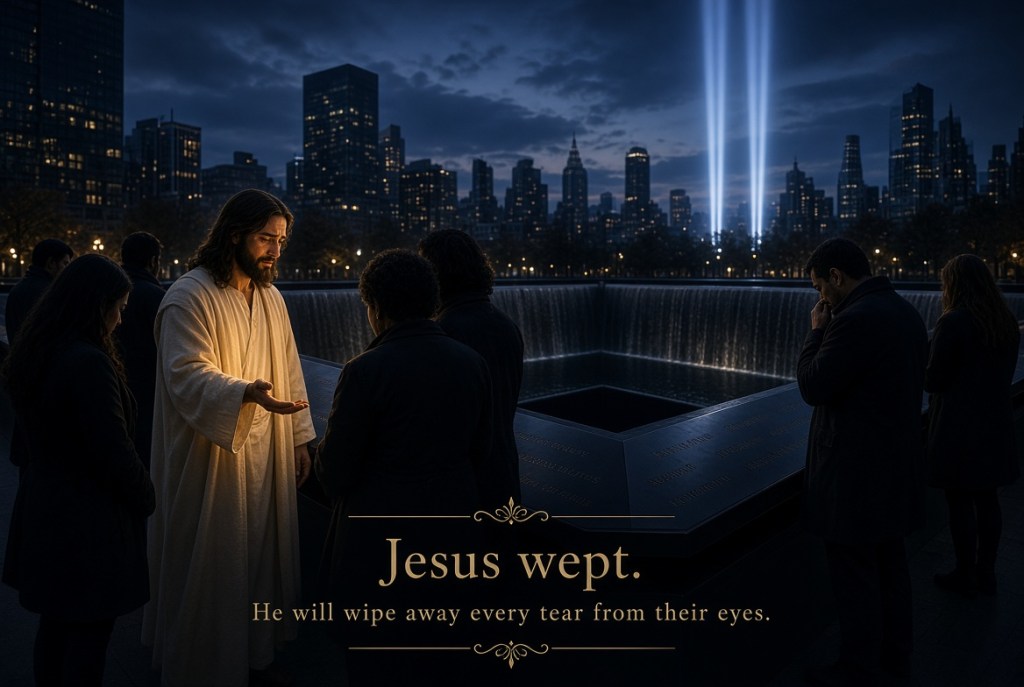
Jesus Himself wept.
When Jesus stood before the tomb of His friend Lazarus, He knew that He was about to raise Lazarus from the dead. He knew what He was going to do. And yet, when He saw Mary weeping and those around her grieving, the Bible simply says, “Jesus wept.”
That tells us something profound about the heart of God. Jesus does not stand far away from human grief. He enters into it. He knows what it means to lose someone. He knows what it means to weep. He knows what it means to experience suffering.
And Jesus did not merely witness suffering. He Himself experienced betrayal, violence, rejection, and death. He went to the cross. He entered into the deepest darkness that human beings can experience.
But death was not the final word.
Jesus Christ rose again.
And that is the heart of Christian hope. Our hope is not simply that things will eventually get better. Our hope is that Jesus Christ has conquered sin and death, and because He lives, death does not have the final word.
That is why the Christian can grieve and still have hope. We don’t have to choose between remembering and hoping. We can remember those we have lost, we can acknowledge the pain that remains, and at the same time we can look toward a future that is held by God.
And the Bible gives us a beautiful picture of that future at the very end of Revelation. It says that God “will wipe away every tear from their eyes, and death shall be no more, neither shall there be mourning, nor crying, nor pain anymore.”
Think about that promise: God Himself will wipe away every tear.
The tears that have been shed in New York. The tears of families who lost loved ones. The tears of those who served and carried the consequences afterward. The tears that perhaps are still shed privately, years later. God sees them. God knows them. And Scripture tells us that there is coming a day when He will wipe away every tear, when death will be no more, when mourning and pain will finally come to an end.
That is our hope.
So this morning, we remember with gratitude. We honor with respect. We grieve with those who grieve. And we look forward with hope—not because we have forgotten the darkness, but because we believe the darkness will not have the final word.
There is a future for New York City. There is a future for our families and for the generations that will come after us. And ultimately, there is a future in the hands of a faithful God who has not forsaken us.
So as we leave this place today, may we carry with us not only the memory of those we honor, but also the hope that comes from knowing that God is our refuge and strength, that His mercies are new every morning, and that in Jesus Christ, death is not the end.
Jesus wept. Jesus suffered. Jesus died. But Jesus rose again.
And because He lives, there is hope.
May God comfort those who still grieve, strengthen those who continue to serve, bless the city of New York, and lead us into the future with courage, compassion, and hope.
Thank you.

