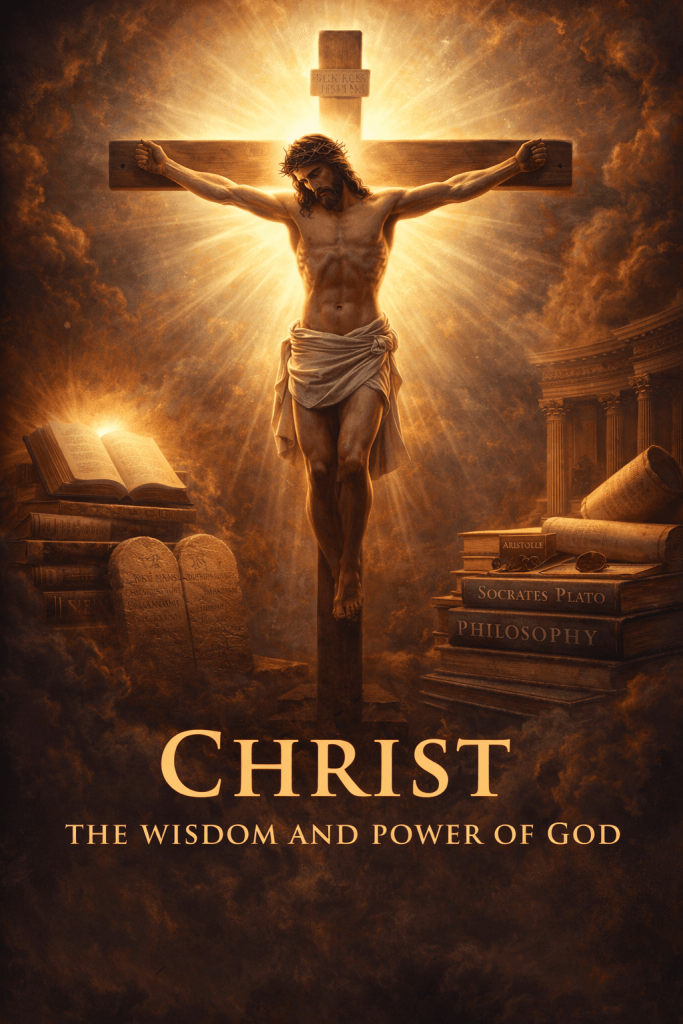
In an age dominated by self-promotion, ideological echo chambers, and relentless pursuit of human acclaim, the apostle Paul’s words in 1 Corinthians 1 cut through the noise with startling clarity. “For Christ did not send me to baptize but to preach the gospel, and not with words of eloquent wisdom, lest the cross of Christ be emptied of its power” (1 Cor. 1:17, ESV). Paul, a highly educated Pharisee turned apostle, deliberately eschews rhetorical flair and sophisticated argumentation—not because wisdom is unworthy, but because reliance on it risks diluting the gospel’s inherent power. The cross, in its apparent foolishness and weakness, stands as God’s ultimate demonstration of wisdom and might.
Craig L. Blomberg, in his commentary on 1 Corinthians, insightfully notes that verses 18–2:5 expand on this theme: “Genuine, full-orbed Christianity stands opposed to the fundamental values of a fallen, sinful world but provides the necessary antidote to the self-centered factionalism of the Corinthians.” This factionalism—divisions along lines of favorite leaders (“I follow Paul,” “I follow Apollos”)—mirrors the prideful rivalries Paul confronts. Extending this to our day, we see similar fractures not only in society but within the church: ministers vying for platforms, influencers building personal empires, and believers splintered by cultural wars. Self-centeredness breeds misery, as it isolates us from the communal joy found in Christ alone. Mortifying this ego-driven mindset is essential to our sanctification; a life orbiting the self is ultimately empty, while one centered on the cross brings true fulfillment.
Paul’s humility is striking. As a renowned apostle addressing a divided church, he could have asserted authority through impressive oratory. Instead, he declares that eloquent wisdom would empty the cross of its power. There is profound poise here: the cross needs no human embellishment. No preacher, no matter how gifted, can claim credit for its efficacy. Glory belongs solely to God, ensuring unity as all boast only in Christ. This culminates in verse 18: “For the word of the cross is folly to those who are perishing, but to us who are being saved it is the power of God.”
Paul bolsters his argument in verse 19, quoting Isaiah 29:14: “I will destroy the wisdom of the wise, and the discernment of the discerning I will thwart.” Blomberg explains this as scriptural support for Paul’s thesis, where God judges superficial religion by upending human pride. The Hebrew term translated “thwart” or “frustrate” implies rejecting, ignoring, or invalidating worldly discernment. This is no petty divine sabotage but a merciful intervention. Worldly wisdom, crafty and seductive, suppresses truth and fuels rebellion (Rom. 1:18–32). By confounding it, God clears the way for revelation—true wisdom that begins with the fear of the Lord (Prov. 1:7; 9:10).
To the ancient world, the gospel was scandalous. Greeks sought philosophical sophistication; Jews demanded miraculous signs. A crucified Messiah—a suffering God, a criminal executed on a Roman cross—seemed absurd and weak. Yet Paul proclaims that human wisdom, in rejecting God, invites divine judgment: salvation through a cursed death appears foolish, confirming humanity’s blindness.
For “those who are called, both Jews and Greeks, Christ the power of God and the wisdom of God” (v. 24). This calling is the Spirit’s work, convicting and illuminating hearts to see the cross as transformative. As Blomberg observes, the Spirit touches lives across ethnic divides, revealing Christ’s death as God’s profound wisdom (reconciling sinners through atonement) and power (conquering sin and death via resurrection).
This message resonates powerfully today. Our world, like Corinth’s, idolizes human wisdom: expertise, credentials, viral rhetoric. Elite institutions embody this “wisdom of the wise.” Recent reports highlight stark ideological imbalances in American higher education. At Yale University, the Buckley Institute’s 2025 Faculty Political Diversity Report analyzed 1,666 faculty members across undergraduate departments, law, and management schools. Findings reveal over 82% registered as Democrats or primarily supporting them, with Republicans comprising just over 2%—a 36:1 ratio. Notably, 27 of 43 undergraduate departments have zero Republican faculty. Similar patterns persist at peer institutions: Harvard’s Faculty of Arts and Sciences surveys show around 63–70% identifying as liberal in recent years, with conservatives often under 5%. Princeton and Columbia exhibit comparable left-leaning skews, contributing to a national trend where liberal faculty outnumber conservatives significantly in humanities and social sciences.
This entrenchment of secular worldviews in academia echoes Paul’s “wisdom of this age”—philosophies that marginalize biblical truth and promote self-autonomy. Generations are shaped by ideas dismissing the cross as folly, prioritizing human speculation over divine revelation. No wonder Christianity has retreated from many campuses; naive approaches—relying solely on emotional appeals or spiritual experiences—fall short against sophisticated intellectual challenges.
Yet Paul’s words compel engagement, not withdrawal. God intends to “destroy the wisdom of the wise” precisely through the gospel’s proclamation. Christians must confront worldly intellect with redeemed minds: robust apologetics, deep theological literacy, and confident articulation of Christ’s superiority (Col. 2:8). The book of Proverbs reminds us wisdom starts with fearing God; only then can we dismantle crafty ideologies.
Encouragingly, signs of vitality persist. Campus ministries thrive amid secular dominance. Organizations like Cru, InterVarsity, and Reformed University Fellowship report growth, with bold preaching, worship, and evangelism drawing students. Catholic Newman Centers and evangelical groups provide communities where faith flourishes. Recent revivals—as at Asbury—highlight Gen Z’s hunger for authentic spirituality. Christian universities see enrollment surges as students seek meaning and connection in faith-based environments.
Despite imbalances, God’s promise endures: He thwarts human discernment to exalt Christ. The cross remains the antidote to factionalism, pride, and emptiness—both in Corinth and today.
Paul’s approach models faithful ministry: preach Christ crucified plainly, trusting the Spirit’s power. No eloquent additives needed; the message itself transforms. In churches plagued by celebrity pastors and in societies fractured by ideology, this humbles us all. No one steals glory from the cross—not Paul, not modern influencers.
As we navigate intellectual battles and cultural shifts, let us embrace the “foolishness” of the gospel. To the called, Christ is wisdom and power, satisfying the soul’s deepest longings. May we proclaim Him unadorned, uniting believers and confounding the wise, until He returns.
 Al Ngu sermons & devotion