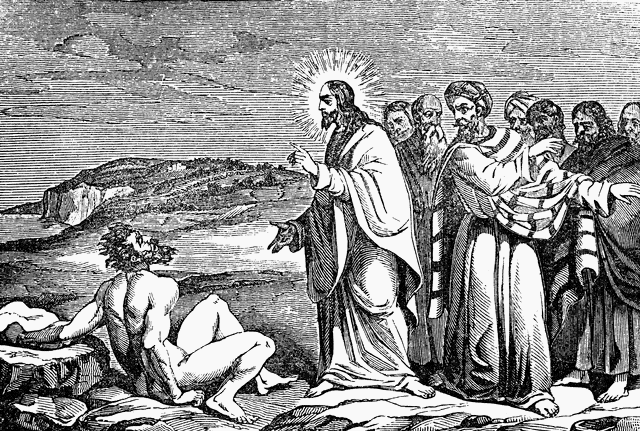
When Jesus and His disciples crossed the stormy Sea of Galilee—after He had rebuked the winds and waves with a word of authority—they stepped ashore in the region of the Gadarenes (or Gergesenes, as some manuscripts read). Immediately, two demon-possessed men came rushing from the tombs toward Him. These men were so fierce and uncontrollable that no traveler dared pass that way anymore. Yet in the presence of Jesus, the demons inside them could not remain silent. They cried out in terror: “What have you to do with us, O Son of God? Have you come here to torment us before the time?” (Matthew 8:29, ESV).
This dramatic confrontation reveals truths that cut to the heart of spiritual reality. First, these demonic beings—ancient, rebellious spirits—instantly recognize and confess Jesus’ divine identity as the **Son of God**. This is the same title Peter proclaimed in faith (Matthew 16:16), the same one the Father declared at Jesus’ baptism (Matthew 3:17), yet it is a truth billions of people in our modern world actively deny, dismiss, or ignore. The demons know what many refuse to accept.
“Have you come here to torment us **before the time**?”
But the second part of their cry is even more unsettling: “Have you come here to torment us **before the time**?” They are not confused or uncertain about the future. They possess clear, terrifying knowledge of an appointed “time”—the final eschatological judgment day when Satan and all his angels will be thrown into the lake of fire and sulfur, tormented “day and night forever and ever” (Revelation 20:10). Jesus Himself describes this as “the eternal fire prepared for the devil and his angels” (Matthew 25:41), a place of unquenchable fire and undying worms (Mark 9:48). In the parallel accounts in Mark 5 and Luke 8, the demons beg Jesus not to send them into the abyss—a temporary place of restraint and suffering before the final sentence falls. Their desperate plea shows they fully expect torment; they simply dread facing it prematurely.
This moment makes the supernatural uncomfortably real. Hell is not a medieval scare tactic, a psychological symbol, or a cultural holdover from less enlightened times. It is a literal, eternal destination for those who persist in rebellion against God. The demons’ fear underscores that spiritual forces operate with full awareness of cosmic justice. They tremble at what awaits them, even though the appointed time may still be centuries or millennia away.
Tragically, many contemporary Christians have largely tuned out this same reality.
We live in an era bombarded by distractions: endless scrolling on social media, the pursuit of financial security, entertainment that numbs the soul, and a prevailing cultural narrative that insists a truly loving God could never allow eternal punishment. The result is a mental compartmentalization—judgment feels distant, abstract, or even incompatible with the compassionate Father revealed in Scripture. Many churches contribute to this by focusing almost exclusively on themes of grace, healing, community, and personal fulfillment (which are all biblical and essential), while rarely addressing demons, spiritual warfare, the wrath of God, or the vivid warnings Jesus gave about hell more often than He spoke of heaven.
A divine wake-up call: the end times are not merely future prophecy; they are a present spiritual reality that must shape our daily priorities, decisions, and mission
This selective preaching is not harmless. If fallen angels—who have rebelled against God for far longer than humanity has existed—shudder at the certainty of coming torment, how much more should redeemed believers, who possess the complete revelation of God’s Word and the indwelling Holy Spirit, live with holy urgency? The Gadarenes encounter is a divine wake-up call: the end times are not merely future prophecy; they are a present spiritual reality that must shape our daily priorities, decisions, and mission.
The personal and communal implications are profound and life-transforming. A genuine, heart-level awareness of eternal judgment would radically alter how we live as followers of Christ. Evangelism would cease to be an occasional activity reserved for special events or mission trips; it would become the natural overflow of our lives—sharing the gospel boldly, relationally, and relentlessly every single day. We would stop wasting energy on petty doctrinal arguments that divide rather than unite, on chasing material gain that rusts and fades, or on conforming to cultural wickedness that dulls our spiritual senses. Instead, we would lift our eyes to the eternal horizon and invest in what truly lasts.
Pause and consider the emotional weight: What if the people we love most—our children, our spouse, our closest friends, our coworkers, our neighbors—are on a path toward eternal separation from God? The image is heartbreaking, almost unbearable. Yet it is precisely this kind of piercing grief that should stir us out of complacency and into fervent action. Love that is truly Christlike does not remain silent in the face of danger; it warns, pleads, and pursues.
“Write the vision; make it plain on tablets, so he may run who reads it.
The prophet Habakkuk received a similar divine mandate in a time of impending judgment: “Write the vision; make it plain on tablets, so he may run who reads it. For still the vision awaits its appointed time; it hastens to the end—it will not lie. If it seems slow, wait for it; it will surely come; it will not delay” (Habakkuk 2:2–3, ESV). This vision included both the certainty of judgment on sin and the promise of God’s ultimate justice and restoration. When the message is proclaimed clearly and faithfully—without dilution or apology—it produces action. “Run” is not a suggestion; it is an imperative verb calling for urgent, purposeful movement.
Yet so many believers today remain spiritually sedentary, passively waiting rather than actively running. The reason is clear: the church has too often watered down the full counsel of God, choosing “winsome” politeness over the confrontational boldness Jesus modeled. He did not hesitate to call out hypocrisy, warn of judgment, or speak of Gehenna’s fire in ways that offended religious leaders and casual hearers alike. We must recover that same courage.
The terrified confession of the demons in the Gadarenes lays bare the unseen battle raging beneath the surface of ordinary life.
This must change—now. The terrified confession of the demons in the Gadarenes lays bare the unseen battle raging beneath the surface of ordinary life. Judgment is real. The appointed time draws nearer every day. And the gospel of Jesus Christ remains the only rescue from the wrath to come.
Let us therefore reclaim the whole truth of Scripture: a love so deep it willingly bore the cross to save sinners from deserved wrath; grace so powerful it transforms rebels into saints; and an urgency so compelling it drives us to proclaim Christ boldly, urgently, and unapologetically while there is still time.
May we write—and live—this vision plainly today. Let it awaken hearts, ignite passion, and send us running toward eternity, reaching the lost before the time arrives. The demons know the stakes. It is time for the church to remember, to repent of our slumber, and to respond with the fervor the gospel demands.
 Al Ngu sermons & devotion