by Al Ngu April 6, 2026
There is a scene I cannot get out of my mind.
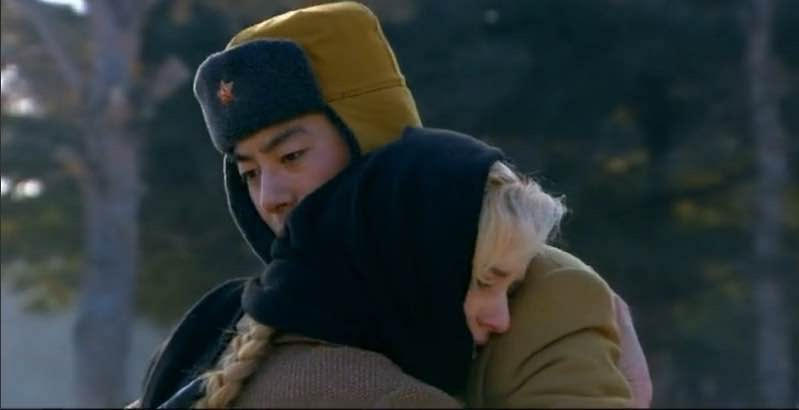
A young Russian woman — I’ll call her Natasha — stands on the bank of the Amur River in the dead of a northern winter. The temperature is subfreezing. The river is vast. On the other side, China. She is waving. She has been waving across this river for weeks, and somehow it has become their language — the two of them on opposite banks, separated by the water and the politics and the soldiers, communicating in the only way they can: color, motion, presence. You wave, I wave back. I am here. You are there. The river is between us but we are not gone.
And then one day she comes to the bank and waves.
And the other side is silent.
He had been taken. Chinese soldiers had come for him — a young man in love with a Russian woman, waving across a militarized border during the Sino-Soviet split, which in the eyes of the state made him exactly one thing: a spy. He disappeared. No warning, no explanation, no goodbye. Just gone. And Natasha stood there on the Russian bank in the subfreezing cold, waving at nothing, tears pouring down her face, waiting.
She was pregnant with his child.
I watched this on a documentary. I don’t know with certainty whether every detail happened exactly this way — it may be dramatized, reconstructed, the way all memory and film and love stories are. But what I know is that it is true in the way that the most important things are true: it names something real about the human condition, about what love costs, about what silence does to a person who is waiting.
What followed was more than twenty years of silence.
Not five years. Not ten. Twenty years. Two decades in which Natasha did not know if he was alive or dead, imprisoned or freed, if he ever thought of her, if he had been broken into forgetting her. Two decades in which she raised a child who had never met his father. Two decades of going to a river bank, I imagine, and looking across at a country that had swallowed the person she loved and refused to give him back.
How does love survive that?
I’m asking seriously. I don’t have a clean answer. But I think that question is one of the most important questions a human being can sit with.
The border in question is the Amur River — called the Heilongjiang, the Black Dragon River, in Chinese. For over a thousand miles it runs as the contested frontier between China and the Soviet Union, and by the 1960s that frontier had become one of the most militarized stretches of land on earth. What had been a fraternal communist alliance had collapsed into mutual suspicion and ideological warfare. The Soviet Union massed sixteen divisions, over a thousand aircraft, and more than a hundred medium-range missiles along that border. China mobilized its own forces in response. Both governments were contemplating the unthinkable. Ordinary people who lived along that river found themselves suddenly stranded at the edge of a potential nuclear confrontation between two superpowers.
Into that, two young people fell in love.
They met somehow — the way people meet, in the ordinary porousness of border life before the clampdown fully came. Something kindled. They found ways to be near each other. And when the border hardened and the armies came and physical crossing became impossible, they improvised the only communion they could: they stood on their respective banks in the northern cold and they waved. Whole conversations conducted in color and gesture across a width of freezing water. Weeks of this. Something tender and absurd and completely serious, the way love always is when it refuses to accept the terms that the world is offering.
And then he was taken.
And the river went silent.
I need to say something about silence. Not the comfortable silence of a peaceful room, but the silence that answers you when you have called out to someone you love and they do not respond. That silence is its own kind of violence. It does something to a person. It raises questions that cannot be answered and therefore cannot be put down: Are you there? Did something happen? Did I do something? Do you still exist? The not-knowing is, in some ways, worse than the worst news, because at least the worst news is a fact you can grieve. Silence is a wound that stays open because nothing has come to close it.
Natasha waited through that silence for more than twenty years. I keep turning that number over. Twenty years is not an abstraction — it is a specific length of time that I can feel. Twenty years ago from today, I was in a completely different chapter of my life. Twenty years from now, if God grants it, I will be a different person in a different season. Twenty years is long enough for a child to be born and grow up. Long enough for certainty to erode, for memory to blur at the edges, for the world to insist — gently, persistently, reasonably — that it is time to move on. To stop standing at the river. To accept that some stories end badly and this is one of them.
She did not move on.
I don’t fully understand how. I suspect she didn’t fully understand how either. Love at that depth is not really a decision you make every morning — it is more like a fact about you that you keep discovering, even when you wish you could undiscover it. She loved him. The river did not answer. She loved him anyway.
Here is where I have to be honest about why this story hit me the way it did — and it is not because my situation resembles hers in any external sense. I have a wife I adore. God has been remarkably kind to me in marriage, and I do not take that for granted for a single day. The love story I am living is not a love story of anguish.
But there is another love in my life. A calling. A conviction that God has placed on me to build something in this city — a faith community for a generation that has largely written the Church off, that carries wounds from institutions that failed them, that hungers for meaning but flinches at the word “church.” I moved to New York. I planted a flag. I stood in Union Square with a folding table and a gospel and an open hand.
And ministry, I am learning, has its seasons of silence.
Not always dramatic silence. Not soldiers and borders and disappearances. But the quiet that settles when the response is small, when the crowd doesn’t come, when you have poured yourself into something and the river doesn’t wave back. The silence of faithfulness without visible fruit. The silence of calling without confirmation. The silence that makes a reasonable person ask: are you sure this is what you’re supposed to be doing? Shouldn’t something have happened by now?
I watched Natasha wave across the frozen river at nothing, and I felt the question form inside me in a different register — not about human love, but about divine love. About the love between a soul and God.
Can you love God through twenty years of silence?
This is, it turns out, not a new question. The Psalms are full of it. My God, my God, why have you forsaken me? That is not a statement of unbelief — it is a cry from someone who believed so hard they went looking for God and found an empty bank. The prophets knew it. Elijah, fresh off the fire of Mount Carmel, collapsed under a juniper tree and told God he was done. Job argued his case to a heaven that seemed to be ignoring him for chapters upon chapters. The saints across the centuries have named it — the dark night of the soul, the long season when prayer feels like waving at a river that doesn’t wave back.
What strikes me about every one of these figures is that they did not resolve the silence by pretending it wasn’t there. They named it. They raged against it. They sat in it. And somehow — not always with explanation, not always with a tidy resolution — they came out the other side still in love with the God who had seemed, for a season, to go quiet.
The resurrection of Jesus is the ultimate answer to this question, but it is an answer that arrives after three days of the most absolute silence imaginable. The disciples on Holy Saturday did not know a resurrection was coming. They knew a tomb. They knew silence. They knew that the one they had staked everything on was gone, and the river wasn’t waving back. The road to Emmaus is a story of two people walking away from Jerusalem in that silence — and the miracle is not just that Jesus appears, but that he walks with them in the direction they are already going, in their grief, in their confusion, in their having-already-given-up. The love came to them. The love did not wait for them to get their hope back before it showed up.
But I want to sit a moment longer in the silence before I get to the resurrection, because I think we move too quickly past the Saturday. The question Natasha poses from the bank of the Amur River is the Saturday question: can love hold on when it has no evidence to hold on to? Not when the miracle comes. Not when the answer arrives. Not when he finally reappears after twenty years and she finds out he was alive and he was faithful and the love was real. But in the middle years, the frozen years, the years of waving at nothing — can love endure that?
I believe the answer is yes. But I want to be honest that it is not a comfortable yes. It is a costly one.
What I am trying to build in this city is small right now. The first gathering was modest. The obstacles are real. There are moments when I stand at the metaphorical bank and wave and wonder if anything is there.
And I think what I am learning — what Natasha’s story is teaching me, what the Psalms are teaching me, what the whole long tradition of faithful waiting is teaching me — is that love is not validated by its results. It is validated by its staying power. The measure of love is not what it produces in the seasons of abundance but what it does with the silence. Does it keep showing up? Does it keep waving? Does it believe, against all visible evidence, that the other side of the river is not empty — that there is a presence there that has not forgotten, has not abandoned, is still oriented toward you even in the years when you cannot see a sign of it?
Natasha stood on that bank and waved for twenty years because she believed — maybe consciously, maybe just in her bones — that the man on the other side was real, and that he had loved her, and that love of that quality does not simply dissolve because the state makes it inconvenient. She staked her life on the reality of what she had known before the silence came.
That is what faith looks like. Not the triumphant faith of answered prayers and visible miracles — though those are real and I have known them. But the quiet, exhausting, unreasonable faith of someone who keeps showing up at the river because they cannot bring themselves to believe that the love they once knew is gone.
The river didn’t answer Natasha for twenty years. But she was right to keep waving. He was there.
I believe God is there too. I believe the silence is not absence. But I want to go further than that — because the story of Natasha and the young man across the river, as devastating and beautiful as it is, is not the deepest love story there is. It is a shadow of one. And I think we need to feel the full weight of the shadow before we can begin to grasp the glory of what casts it.
Think about what made their love extraordinary. He loved her across an impossible divide. She loved him through twenty years of silence. Neither of them quit, even when every force in the world said to quit. We watch that and we are undone, because we recognize instinctively that this is what love is supposed to look like — stubborn, costly, unreasonable, surviving everything the world throws at it.
Now consider Jesus on the cross.
Natasha loved a man who loved her back. Christ loved people who were killing him. Natasha waved across a frozen river at someone who was desperate to wave back. Jesus stretched out his arms on a cross toward people who put him there, who mocked him while he bled, who had abandoned him when it cost something to stay. Natasha endured twenty years of silence not knowing if she was still loved. Jesus cried out “My God, my God, why have you forsaken me?” — absorbing into himself the full, crushing silence of divine abandonment, so that the people who deserved that silence would never have to hear it.
And then, from the cross, while the nails were still in his hands, while the crowd was still jeering, while the blood was still running — he opened his mouth and said: “Father, forgive them, for they know not what they do.”
I have read that line hundreds of times. I have preached near it. But watching Natasha wave at an empty riverbank, tears streaming down her face in the subfreezing cold, something in that line finally broke open for me in a new way. Because this is not the love of someone waving across a river at the person they adore. This is the love of someone being murdered by the people he is forgiving in real time. This is love with no reasonable basis whatsoever — love that is not a response to being loved, but love that initiates, that absorbs hostility, that refuses to become what it is being treated as. This is love that does not wait for the silence to end before it speaks. It speaks into the worst silence, from the worst place, at the worst moment, and what it says is: I forgive you. I am still for you. You do not know what you are doing, but I do, and I am choosing this.
No human love has ever done that. Not Natasha’s. Not anyone’s. The love between that Russian woman and that young Chinese man across the Black Dragon River is one of the most moving things I have ever encountered on a screen. But it is, in the end, two finite people loving each other across a frozen river. What happened on Calvary is the infinite loving the finite across the ultimate divide — not despite hostility, but through it, for it, willingly, eyes open, arms wide.
That is the love I want to know. Not just know about — know, the way you know a person, the way Natasha knew the man she waved to, the way she knew his presence well enough to feel the agony of his absence across twenty years of silence. I want to know the love of Christ with that kind of depth and that kind of personal, irreducible certainty. And I want that knowing to be so real in me, so alive in my bones, that when I stand in this city and open my mouth, something transcendent comes out — not my eloquence, not my theology, not my best argument, but the overflow of a love I have actually experienced.
That is what I want to proclaim to the people of New York. Not a doctrine. Not a program. Not an institution. The love that said Father, forgive them while bleeding. The love that is more stubborn than twenty years of silence, more willing than any human devotion, more costly than anything Natasha ever paid — and offered freely, without condition, to people who were not waving back.
If that love is real — and I believe with everything I have that it is — then there is no one in this city too wounded, too cynical, too far gone, too long silent to receive it. I want to know it so deeply that when I speak of it, something in the listener recognizes it as true before I have finished the sentence. Because somewhere inside every human being, I think, is a Natasha standing at a frozen river, waving into silence, hoping against hope that love is still on the other side.
It is. And it is greater than she imagined.
That is worth proclaiming. Even in the cold. Even when the other bank looks empty. Even when it has been a very long time.
Al Ngu is the founding pastor of Hearts Burn NYC, a faith community in New York City.
 Al Ngu sermons & devotion