On Natasha, public love, and what God has been waving at us all along.
Al Ngu
The truck was already moving.
Borechka stood in the back with the other soldiers, headed toward the front lines, carrying whatever a young man carries when he knows the next weeks could be his last. The night before had ended badly. Natasha had come to him in the dark, afraid and wanting closeness, and he had pulled away. Not because he didn’t love her — she knew he did. He just couldn’t say it. Couldn’t cross whatever line lived inside him between feeling and declaring.
So she had gone back to her room. She told him she wouldn’t see him off.
She lied.
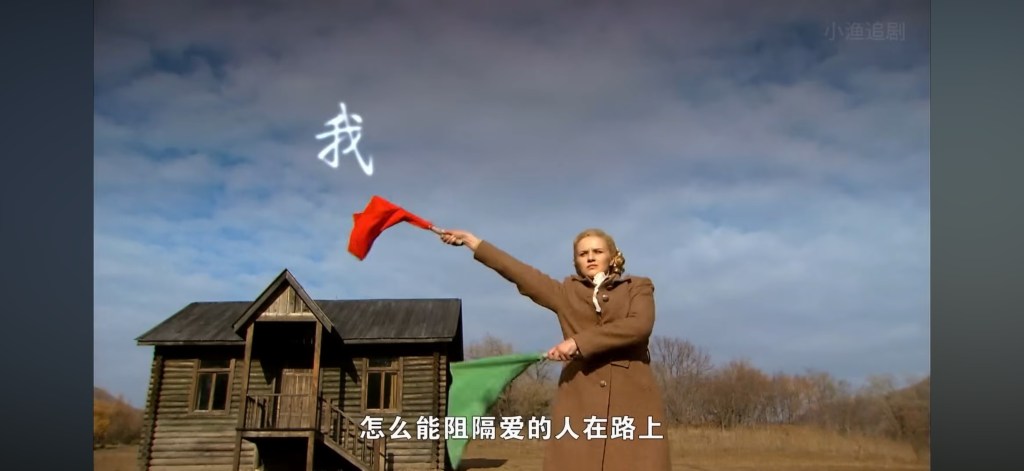
Because when the convoy rolled past the edge of the field, there she was. Standing alone. Holding two flags. Waving them in wide arcs with everything she had, spelling out in the open air what he had refused to say in the dark of a quiet room:
I love you, Borechka.
Three trucks full of soldiers saw it. They started hollering — hey, someone’s got a girl — and Borechka looked, and for a moment I think the whole world stopped. Then something broke open in him. He grabbed two flags of his own and started waving back. Not whispering. Not hinting. Waving. In front of everyone.
Natasha. I love you too.
She saw it. Her tears came down. She waved: I will wait for you.
He waved back: I promise I will return.
I was somewhere around episode twenty when this happened. I had followed these two people through all their hesitations, all their silences, all the cultural weight Borechka carried that kept him from doing the simple human thing of saying I love you to someone who needed to hear it. And then this. In a field. With flags. In front of an audience he never asked for.
I wept. I’m not ashamed to say it. I wept because it was beautiful, and because it was true, and because something in me recognized what I was watching.
The Man Who Couldn’t Say It
The Chinese man struggling to say what he felt — I understand that. Culture buries things. Propriety builds walls. Coming from a Chinese background myself, I recognize it. There is a silence that is taught, absorbed into the bones before you are old enough to question it. Expression of the heart, especially love, especially to a woman, especially in public — it stays locked inside. Not because the feeling isn’t there. Because the door has been sealed by something heavier than individual will.
So why would a woman fall for a man like that? A man who never once said I love you, who showed signs of affection — you could gather enough from his eyes, his presence, the way he stayed — but who would not cross the line into declaration?
I genuinely don’t know. I think love sometimes moves on a frequency that bypasses the rational mind entirely. Natasha saw something in Borechka that the silence couldn’t hide. She believed in what she felt more than she was discouraged by what he wouldn’t say. And then she went to a field with two flags and said it first.
That is what I want to stay with for a moment. Not his silence. Her courage.
She didn’t wait for him to become brave. She became brave herself and made space for him to follow. She took the risk of humiliation — of waving her heart across a field at a man who had already refused to meet her in the dark — and somehow that risk unlocked him. He grabbed two flags and stood up in front of every soldier in that convoy and he said it.
Love does that. It doesn’t just feel. It acts. And when it acts publicly, when it plants a flag in open ground and says this is what I believe, it invites others into their own courage.
I keep thinking about that field. I keep thinking about what it cost her to stand there.
What Gen Z Is Actually Crying Out For
There is something I keep noticing in Union Square on the mornings I stand there with my Bible.
The young people pass — Gen Z, mostly, twenties, some younger — and if you watch their faces long enough you stop seeing the phones and the headphones and the carefully constructed indifference. What you see underneath is something older and more urgent than any generational label.
They are looking for someone to love them.
Not romantically, necessarily. Or not only. But deeply. Unconditionally. Without the fine print. They want to belong somewhere that won’t eventually let them go. They want to be known and not discarded. This is true of Millennials too. It is true, at the core, of every generation that has ever lived — the longing for love and identity and belonging runs through all of us. But something about this moment feels more exposed, more raw. The cultural scaffolding that used to hold these longings at a manageable distance has come down. What’s left is the need itself, blinking in the open, enormous and unanswered.
This horizontal longing — what the Greeks called phileo, the love between persons — is real and it matters. Community, friendship, being seen: these things are not trivial. God wired us for them.
But I want to go deeper than the horizontal. Because at the very core of human longing — beneath the desire for belonging, beneath the hunger for intimacy, beneath even the need to love and be loved by another person — there is something that human love, however beautiful, cannot finally satisfy.
There is a shape of longing in us that is the exact shape of God.
The Love That Goes Public
Here is the thing about Christianity that I find myself returning to again and again:
The gospel is not a private transaction.
God did not slip a note under the door. He did not whisper something in the dark and then pull back in the morning. He went public. He went so public that two thousand years later we are still talking about it, still writing about it, still trying to comprehend the scale of the declaration.
For God so loved the world.
The cross is a flag in a field. It is the most exposed, most humiliating, most costly public declaration in all of human history. It is God standing in front of every soldier in every convoy that has ever passed, with both arms stretched wide — not waving flags, but nailed there, which is more extreme than flags, which is the most extreme gesture of love this universe has ever witnessed. Somebody preached once that the image of Christ on the cross, arms spread wide, bleeding, is the most potent visual declaration that has ever existed. Arms open as if to say: this is how much. This far. This wide. This costly.
I love you.
Not to a category. Not to humanity in the abstract. To you. To the Gen Z kid scrolling at midnight who doesn’t know if anyone sees them. To the one who has been told they don’t belong. To the one who is performing belonging so well that no one knows they’re dying inside. To the Millennial grinding through exhaustion, not sure what they’re building toward or whether it matters. To every human heart that has ever wanted to be loved the way Natasha wanted to be loved — fully, publicly, without reservation.
That love was declared before any of us arrived. The cross was planted in the ground before you knew you needed it.
The Width and Height and Depth
Paul prays in Ephesians for something that sounds almost impossible — that we would be able to comprehend the width and length and height and depth of the love of Christ. He doesn’t pray that we would understand the doctrine. He prays for supernatural capacity, because what God feels toward us exceeds the natural bandwidth of a human heart. You need the Spirit of wisdom and revelation even to begin to register it. It is that large.
I read that prayer and I feel something in me ache. Because most days I live as though the love of God is a theological category rather than a living force. I know it the way I know the boiling point of water — accurately, usefully, and at a certain remove.
But Natasha didn’t just know Borechka loved her. She was captivated by it. So captivated that she grabbed two flags and ran to a field.
When I was young and falling in love with the woman who became my wife, I drove two hours each way to see her on weekends. Two hours there. Roses. Two hours back. I did not experience this as a burden. I barely noticed it. Love recalibrates the cost of everything. What looks like sacrifice from the outside looks like obvious necessity from the inside.
Of course I drove four hours. I love her.
That is what the cross looks like from inside the love of God. Not reluctant sacrifice. Not divine duty performed with gritted teeth. Of course I went. I love you.
Augustine said it: our heart is restless until it rests in you. He didn’t say our theology is restless. He said our heart. Because the longing that drives us toward God is not an intellectual problem to solve. It is a love story we are already in the middle of, whether we know it or not.
The Lover and the Beloved
There is a book in the Bible that has always made cautious readers nervous. Song of Solomon — this ancient love poem full of perfume and longing and bodies and desire — sits in the middle of the Hebrew scriptures like a burning coal. The beloved longs for her lover with a hunger that is almost unbearable to read. She wakes up in the night reaching for him. She searches the city for him. She is undone by his absence and restored by his presence.
Christian interpreters from Origen to Bernard of Clairvaux read that and said: this is us. This is the longing of every human soul for the one who made it, the one it was made for. The man as lover is God. The beloved, the woman, is the church. You see how far God has gone in the public expression of his affection. He didn’t just write a theology of love. He wrote a poem about longing.
The Bible says Christ is the bridegroom and the church is the bride. We are waiting for his return. The parable of the ten virgins is about exactly this — the bride community watching, waiting, keeping their lamps lit for the one who is coming back.
Natasha waited for Borechka in silence for years. Decades. Not knowing if he was dead or imprisoned or simply gone. I wrote in an earlier essay about the particular cruelty of that silence — how not knowing is in some ways harder than loss, because grief without a clear object has nowhere to land. She hung on not because she had evidence but because she believed in the love. The love she had seen with her own eyes, felt in her own chest, received in those waving flags in that open field.
She trusted the declaration.
I think about the Christians I know who are white-knuckling their faith through silence — through prayers that seem to hit the ceiling, through years of waiting for something to break. And I want to say: you are not crazy for hanging on. You are Natasha in the years of not knowing. And the man in the truck waved. He waved in the most unmistakable way possible. He promised he would return.
He will return.
But more than that: he loves you now. In the silence. In the waiting. In the years when you don’t feel it tangibly. His love is not a human love that fluctuates with mood and circumstance. It is higher than that, stranger than that, more reliable than anything you have felt from another person.
What Happens When Love Actually Lands
Here is what I have found to be true: when you actually encounter the love of Christ — not just hear about it but encounter it — you cannot sit still anymore.
Something breaks open. The same way something broke open in Borechka when he saw Natasha in that field waving her flags. All the cultural silence, the restraint, the careful management of exposure — it couldn’t hold against what he saw. He grabbed two flags and stood up in front of every soldier in that convoy and he said it.
That is what the love of Christ does when it actually lands on you. It makes you restless. Not restless in the anxious way, but restless in the Natasha way — restless with something you cannot keep to yourself. It makes you want to go out and tell people. Not as a duty performed without conviction, not as language detached from experience, but as someone who has been found by something real and cannot keep quiet about it.
Paul didn’t pray merely that the Ephesians would have good doctrine about love. He prayed that they would be filled — flooded — with the Spirit of wisdom and revelation, so that they could know. Know it the way Natasha knew it in that field. Know it the way I knew it driving four hours with roses. Know it in the body, in the chest, in the parts of you that are beyond argument.
That knowing transforms. We need not more cultural accommodation or religious performance or superficial familiarity with God. We need an explosion of his love hitting us — invading us — the width and height and depth of it breaking through the crust of our routine and landing somewhere real.
Because love like that overcomes every barrier. Cultural barriers. Spiritual barriers. The silence of years. The fear of public exposure. The weight of not knowing. It overcame all of it for Natasha. It overcame all of it on the cross.
Come and Stand in the Field
In Union Square Park, I stand in front of strangers and I talk about Jesus. I think sometimes about what that looks like from the outside — a man in a park with a Bible, which is maybe the least fashionable thing possible in lower Manhattan. And I feel something of what Natasha must have felt in that field. The exposure of it. The risk of looking ridiculous.
But she grabbed the flags anyway.
Because the alternative — staying in her room, preserving her dignity, letting the trucks roll past without a word — was unbearable. She loved him too much to play it safe.
I love him too much to play it safe.
And so I stand in the park. And I wave.
He loves you. I have seen the declaration. It is public and permanent and it has not been revoked. It was made on a cross with nailed hands and it has been echoing across two thousand years of human history, reaching into every generation’s longing, answering the cry underneath the cry. The Gen Z young person scrolling at midnight, looking for someone to finally see them — he sees them. The Millennial carrying exhaustion like a second skin, wondering if any of this means anything — it means everything. The person from any generation who has ever wanted to be loved the way Natasha wanted to be loved: fully, publicly, without reservation.
You are the beloved. He is the bridegroom. The declaration has already been made.
I’m starting a community in Union Square Park called Hearts Burn NYC. We gather in the open — Gen Z, Millennials, people who have walked away from faith and people who have never touched it, people who are lonely, people who are searching, people who don’t yet have language for what they’re looking for. We stand in the same kind of field where the flags would have been waving if this were that story.
I believe we are in that story.
I believe God is still in the field, arms wide, spelling out the same message he spelled out on the cross.
I love you. I will return. Wait for me.
Come and stand in the field with us.
More is coming. I’m not done waving.
— Al Ngu
Hearts Burn NYC | Union Square Park | heartsburnnyc.com

