Modernism criticism of the real Jesus & historical Jesus

What is it & why do we need to understand it

Modern Criticism of 19th century basically centered in Germany the Gospel has, in my understanding, perpetuated the modern critical interpretation by the liberalism thinkers of today. Some of the tangible effects today are like liberal Christians love the kindness and compassion of Christ but reject his resurrection and virgin birth and even the historicity of Christ!

Most average church goer Christian would probably respond so what? It hardly affects my life. But the reality is, it has affected millions of people especially the millennial generation with this being taught in colleges, being the liberalism colored lens. If we want to reach out to the educated mass today, we must understand better the liberalism Modern Criticism of the Gospel.

This is very problematic because essentially, they the liberals refuse to back down from being called a Christian, while rejecting the miraculous and the virgin birth f Christ and the resurrection of Christ, because they are amazed with the person Jesus Christ, and loving his virtuous deed and teachings, like the sermon on the Mount, the good Samaritan, stop being judgmental, feeding the poor, kind and compassionate, indeed Jesus is a par excellence moral character to them, but alas, nothing divine. And why? Because in their mind, this doesn’t fit into or congenial to their scientific minds and worldview! So they actually dissected the gospel and divided as they wish to try to “fit” into the science driven worldview.

A famous liberalism thinker scholar in Germany called Rudolf Bultmann in the 19th century has impacted much modern liberalism. Robert Strimple wrote:             While he actually summarized the theology of the New Testament that is set in that mythical cosmological framework:

            The aeon is held in bondage by Satan, sin, and death and hastens to its end. That end will come very  soon, and will take…a cosmic catastrophe. The Judge will come from heaven, the dead will rise…”In the fullness of time, God sent forth his Son, a pre-existent divine Being, who appears on earth as a  man. He dies the death of a sinner on the cross and makes atonement for the sins of men…. The risen           Christ is exalted to the right hand of God in heaven and made “Lord” and “King”. He will come  again on the clouds of heaven to complete the work of redemption, and the resurrection and judgment of  men will follow.”[1]

This all fit into the biblical gospel very well, and we rejoice. But no! But Bultmannn insisted, it is impossible for any modern person to receive in such a message: “Man’s knowledge and master of their world have advanced to such an extent through science and technology that it is no longer possible for anyone seriously to hold the New testament view of the world-in fact there is no one who does. [2]

What catches my attention is this line: “The mythical eschatology is untenable for the simple reason that the Parousia of Christ never took place as the New Testament expected. History did not come to an end,…it will continue to run its course.” This is a wrong exegesis statement from Bultmann and it has such huge significance, because that is the breaking point for him to turn away from true Christianity sadly. For a brilliant mind to land in such dark philosophical thinking, is very grieving as he and a lot of other liberalism scholars impacted the books and syllabus we read in colleges today and for the past centuries. Why blame it on the return of Christ (parousia) not happened yet? And that caused Bultmannn to conclude the mystical eschatology as untenable?? That means the supernatural miraculous, and the final judgment. So sad. Maybe he should have exegete the timing of the parousia, like a day is a thousand years to the Lord, and a 1000 years like a day.

He tried so hard to reconcile the mythical side of the bible to the reality of science of his days. He even tried to call to delete the mythological (supernatural for us) in the New Testament as “husk”, so that the “kernel” of truth might remain (as Harnack had suggested)? But he said that one couldn’t delete the husk because the truth (kernel) is actually embedded in the so-called husk. Therefor his conclusion is not to delete the mythological elements of the NT, but to transform that kerygma into the conceptual framework with which modern people operate. You see the attempts of these philosophers go deep. In my view these folks have just put science onto a pedestal that’s idolatry. Ironically, science can’t explain conclusively the black hole and tons of stuff including the evolution in our 21st century, let alone their 19th century.

So Bultmannn went ahead and reconstructed the whole Gospels, calling it to decontextlaization and recontextualization. Bultmannn teaches that we must understand the Gospel mythology, not cosmologically but anthropologically, or more specifically, existentially.

Christian’s response

The biggest problem is the definition of human nature, Being. Their problem can be summarized in Boltzmann’s question: “Must we understand it as the cross of Jesus as a figure of past history? Must we go back to the Jesus of history?”

Strimple writes: Christ’s death and resurrection saved all who believed in him because Jesus is God’s Son, whom he appointed as heir of all things, and through whom God made the universe. The Son is the radiance of God’s glory and the exact representation of his being, sustaining all things by his powerful word” (Heb 1:2-3) This is the one whom the angels worship (1:6) and who is addressed as “God” (1:8), but “who was made a little lower than the angels…so that by the grace of God he might taste death for everyone, “ and who “ is not ashamed to call” those whom he makes holy “brothers” and who “shared in their humanity”. (2:9,11,14) In other words, the significance of his work is grounded in the significance of this person as the God-man. [3]

The question that confronts us today is that whether we are willing to understand ourselves as one crucified and risen with Christ.


[1] Strimple, Robert   The Modern Search for the Real Jesus    P&R Publishing 1995, New Jersey  p120

[2] ditto

[3] ditto
Theistic Evolution

John Piper has a very good teaching on this very important subject albeit very challenging as we pit Bible Vs science ie. evolution as necessitated by the argument from our scientific driven society that was started in the Enlightenment age in the 19th century. A lot of Christians are not even bothered about this subject, and ask why? Pastors rarely touched on it too, but the liberals including the liberal Christians and scholars have a swinging time knocking down our creation narrative, and replacing it with evolution with books and talks. To me, this is very troubling and disturbing, and definitely needs to be examined and taught well so our folks in churches will respond well to the outside world, especially with our kids in schools facing evolution syllabus and books.

Tim Keller in a talk in TGC that scientists had concluded humans cannot be all from a single set of parents, ie Adam & Eve genetically. They are supposed to be from a group of homosapiens in the sub-Sahara desert in Africa. Now my question is, genetically where do these group of “early fathers” in Africa come from? The early group of humans in Africa can’t be direct creation from God or evolution from Garden of Eden?

Piper has taught that theoretically it is possible that God used evolution to create the mankind and animals called Theistic Evolution. Exegetically, you can’t reconcile that to the death of one man, brought death to the one man, etc. To believe in the historical Adam, it’s impossible to believe in Theistic Evolution. Hermeneutically, with the historical Adam & Eve, and that God breathed into the first man’s nostrils to give him life, this doesn’t compute with the billions of years to develop mankind. Looking at the spider coming out of the pond, with its ability to make web for its offspring, the question is such intricacy & complexity ability, where do they come from? Theistic evolution is a no go.


Just because Galileo made a mistake claiming from the bible that the earth is flat, does not mean science has triumphed over the bible. I would say Galileo made an exegetical mistake. Sola Scriptura.

Pentecostalism is an antidote to the Desupernaturalism of Christ or Gospel historical Criticism

Al Ngu, New York                                          June 23, 2019

The historical criticism or gospel criticism started in the mid eighteenth century started by philosophers like Immanuel Kant and his cohort propelled the teaching that all supernatural acts and deeds of Christ are to be removed from the Bible because if you can’t explain it by rationalism and science, it cannot be true. They purported that the present must explain the past. If you don’t see it in present days, it couldn’t have happened in the past. 
I feel like these scholars need a plague of Egypt to wake them up. First of all, the entire Christianity anchors upon the supernatural works of Jesus. To take away the supernatural, you might as well join a Boy Scout or Red Cross or Soup Kitchen. 

There is a real sense of frustration among the Pentecostals that evangelicals would even spend time to deal with those what we call as unbelief. Those folks pushing denial of the miracles of Christ simply are not Christians. In the scholastic world we are engaging their minds because we will have to answer the atheist worlds challenge about the identity of Christianity . The reason now I know is as follow:

            Robert Strimple wrote: The so-called quest of the historical Jesus has seemed to grip the imagination of modern men and women the way it has. The modern, post-Enlightenment readers of the Gospels have not been willing to accept and follow the supernatural Jesus presented there. They found that the religious role for Jesus as written is uncongenial to their naturalistic mind-   set, and yet they find it hard to cut off all religious relationship with Jesus. Therefore they seek to find one, compatible with their unbiblical worldview.[1]

I find this astonishing that they rejected the miraculous Jesus which is the core of the very divine being of the Son of God incarnated into this world, and yet wanted to cling on to the same Jesus in some way and fashion. They really wanted their naturalistic mind to triumph over the super naturalistic legend Jesus. You see the naturalistic doesn’t go well with supernatural. That’s precisely the point. They wanted to convert or relabel Jesus to be naturalistic. Like the modern liberals wanted to relabel marriage, sexuality and the power is in the tongue they said. This is the potent weapon of the devil, from the Pentecostal background, my perception of this, is nothing less than spiritual warfare. It is nothing short of the highest warfare in the intellect. You see casting out demons may be dramatic & spooky & compelling, but that’s nothing compares with the relabeling of Jesus, the Son of God, by way of their intellect & writing books. That is far more powerful and darker as it affects a generation and more!

Interestingly this unbelief of the supernatural of Christ in some ways echo’s or mirrors the unbelief of the reformed teaching that embraces the cessationist view which is the supernatural gifts of speaking in tongues, prophecy, healing etc. have all ceased because they were to be used in the apostolic time only. Essentially the gospel criticism group merely extends the cessation backward to Jesus himself, claiming that the miracles of Christ never happened on the first place. 

And to argue against them in stuff like the historical Adam and Eve, we could just invite them to a Pentecostal meeting where supernatural healings happen, where prophecy happens, and where the palpable presence of the transcendent God is felt. The experiential aspect of the supernatural trumps any theological debate in a way that theology teaching has not known. This is what is called living my theology. You get what you believe. What one learns in the mind and what one learns in the heart and senses is vastly different and the latter is more compelling. Having said that, however, the supernatural can only go so far and indeed the teaching of the kingdom and the gospel must go for the long haul like how Jesus did it himself. Like how Paul and Peter did it in the epistles. The teaching of the kingdom of God and the gospel respectively.


[1] Robert Strimple   The Modern Search for the Real Jesus   p 10-11 P&R Publishing, Phillipsburg, NJ

My reflection on History I from Seminary

I think going through Ancient and Medieval church History has impacted my life in a way that is unprecedented. I love the ancient church history the most, going through the lives of Augustine, Justin Martyr, Irenaeus, Aquinas, the Councils creed like Nicene creed, Ephesians Creed, Chaldecan’s creed, etc. and how they were martyred for the Name of Christ in early churches are just too powerful and inspiring to me. It’s a real eye opener for me to see all the work and thinking on theology that has gone in in the early church because of necessity like false teachings Arianism, Gnosticism, the dual nature of the divinity/humanity of Christ, the trinity of the Godhead which are all so fundamental to our faith that we have taken for granted. I for one, have not plodded deep into Trinity, the homoousia and the homoiousia, the same or similar substance between Christ and the Father has just blown me away. I confess that I have always believed in Trinity but never known such intricacy thereof. I love the fact that Augustine said we need a God-Man to save the human race, as human savior must be a savior, and yet we can’t find a perfect human on earth to save us. But God came up with an amazing idea that is He sends his own Son Jesus Christ to incarnate into our human world by taking up the dual nature of God-Man, which is simply the most amazing mysterious breakthrough of human history. For the creator of the universe to step into our universe to walk and cry and laugh with us and teach us the gospel and the Father, is beyond any words can describe. Only Jesus is qualified to take up this task to redeem mankind, by living a perfect life we should have lived, and offering up his life as a sacrifice, substitution, for us, is the biggest act of love we have known. I am so thankful for Christ to step into our world to reveal who God is and his affection for us is transforming. Without Christ incarnated into this world, I would have been so lost trying to figure out the God of the OT and any relevance for our modern days. I have always been thankful for that, but after this semester, I am more pumped and closer to my savior who incarnated in my world and saved me. I am so thankful.

Looking at the martyrdom of the early bishops like Justin the Martyr, and the really powerful woman Perpetua and Felicitas is such a daunting challenge and inspiration to me of the extent they sacrificed for the Name of Jesus. I am humbled and grateful.

Looking at the monasteries that sprung up and produced almost all the most formidable thinkers, theologians in the early church is a phenomenal success that I have not known before. They asceticism, and their pursuit of God is really something inspiring and stirring in the material comfort world in our 21st century New York city. What a contrast. I have learnt that material comfort actually brought down the downfall of the monasteries, and indeed a big lesson to be learnt. I love that they chant the psalms –whole book like once a week or so. This has impressed in my heart too that I want to be a more psalm filled Christian and also an awe towards tradition and the council I never had before. I greatly respect the early fathers of their theological understanding when every time they met in a council they voted for the biblical doctrines, kicked out and exiled the false teachers. Such one accord is amazing and such intellectual power of Augustine, Aquinas, Anselm, etc. is truly inspiring. I am thankful for this semester on the early church especially.

Prophecy & Tongues

I am reading Perspectives on Pentecost by Dr. Richard Gaffin as part of my seminary class. I want to dispute numerous points on this subject: and the list will grow I am sure, as I am in my busy schedule on reading more books needed by this month.

Pg 77- 1 Cor 14: 14, 32 v2-“the one who speaks in a tongue….speaks mysteries by the Spirit.” “Because the anthropological spirit is excluded in verse 14 and 32, the reference here is likewise is likely not to the human spirit, but, as is more likely on other grounds anyway, the Holy Spirit.”

v14 For if I pray in a tongue, my spirit prays but my mind is unfruitful.—my spirit here is My spirit. Not the Holy Spirit.

32 The spirits of prophets are subject to the control of prophets.—-spirits” here is the prophets spirits. NOT Holy Spirit.

This is clear.

Charismatics friends should read the last paragraph. “It’s true that charismatics belief in the Holy Spirit as a powerfully present reality, not just a doctrine, protest against intellectualism in theology and formation in the worship and  life of the church, intense prayer and praise, stress in cultivating relationships among believers, and a more intimate fellowship within the church.”-R Gaffin. Through my last decades in charismatics church I can say the protest against intellectualism is true and it’s real sad and even grieving in itself to the Spirit and we lost so much heritage in the truth that the spiritual fathers have carried before us like Augustine, Luther. I will write more in my blog. Lots of teachings I disagree with Gaffin, but this strikes at me as a real awakening call. #pentecost #charismatics More to come……

Why didn’t God help the early church under Roman persecution but he did with Israel in Egypt?

By Al Ngu, New York                                                                                                                September 23, 2018

I want to pull a parallel between the sufferings and persecutions of the Jewish nation Israel during the time of Moses and the early (ancient) church in Jerusalem.

Israel’s Slavery in Egypt

To be real, the sufferings of Israel was predestined by God to have the children of Abraham to suffer in exile in a foreign nation as God told Abraham in a vision as He established a covenant with Abraham in a semi trance when the fire of God passed over the sacrifices. (Gen 15:12-16) [1]

And sure enough 3 million Jews suffered intensely in Egypt and they cried out to God, and God, in his timing, sent a deliverer/prophet, Moses to their rescue. And that culminated in the greatest miracle in the human civilization ever, the great Red Sea was parted as God sent a mighty east wind that blew all night for the 3 millions Jews to cross on dry sea bed, only to close it as Egyptian army chased them into the sea bed. Israel was delivered and Mariam led the women of Israel as they danced before the Lord and sang “The Lord mighty: The chariots of Egypt were thrown into the sea. Now, quick forward history to the church, what about the persecutions & sufferings of the church of Jesus Christ, the Son of God?

The Early Church Martyrdom

Since the resurrection of Christ at about 33 AD, the apostle Peter, James & John took over the reign of the church and led the church to some phenomenal growth both numerically and qualitatively. The most important part was the spirit of the early church was so strong and the foundation laid by especially Paul is phenomenal. The book of Acts exploded with the arrival of the Pentecost when 3000 men were converted in a single event after 300 men were filled and baptized in the Holy Spirit and spoke in tongues. The church took off and tightly knitted communities were formed only to be the envy of the world, for they so loved one another, and shared all with everyone else. No one was in lack. The Lord was in their midst.

But under the Roman emperor of that time, both our greatest apostle, Paul, was martyred, and also Peter crucified, and John, James beheaded. There was a huge price to pay for Christ. Then came the ancient church forefathers who were powerful in their theology and loving the Lord and church, but were all martyred. Those included Justin Martyr, Irenaeus, Ignatius, and a woman of mighty faith and intellect, Perpetua who was fed to the beast, as a nursing mother. The stories couldn’t be more dark and heart breaking as we plow through those years, as I read my seminary book-The Story of Christianity ’ by Justo Gonzalez.

To summarize right from the get go, Christians faced severe persecutions of the kind that modern churches in our 21st century has not seen or heard at all. Let me just spring to the final & worst persecution of the church. The Caesar of Roman Empire called Galerius started the final and worst persecution. Christians were labeled as rebels as they refused to join the Roman military. Galerius, in fear of the Christians refusing to join the army, and hence may even pull out of army in time of war, started pushing them to deny their faith. In 303 AD, he finally convinced the Augustus (Emperor) of the Roman Empire, Diocletian, to issue a new edict against Christians. He ordered that all Christian buildings and books to be destroyed, and as many Christians who refused to turn over their sacred writings (Bible), they were tortured and condemned to death. Throughout the empire houses where Christian met and sacred writings were being sent to the torch, and overzealous officials put Christians to death. There were resistance from Christians (rightfully) and caused disturbances in some areas, and Emperor Diocletian became convinced that Christians were conspiring against him. He reacted and has all the church leaders arrested and later all Christians must offer sacrifice to the gods. Thus was unleashed the most cruel of all the persecutions that the ancient church had to endure. Many Christians were encouraged to abandon their faith. (Does this sound similar in some ways in America today in a subtler one?) The rest were tortured with refined cruelty, and eventually killed in a variety of ways. A number of them took the sacred books and fled to Persia across the border. [2]

How did God intervene?

That’s my thesis of this reflection. In Moses time, God heard the cries of Israel, and sent Moses. People of Israel bowed when they heard Yahweh heard and responded. Exodus 3: The Lord said,I have indeed seen the misery of my people in Egypt. I have heard them crying out because of their slave drivers, and I am concerned about their suffering….. And now the cry of the Israelites has reached me, and I have seen the way the Egyptians are oppressing them. 10 So now, go. I am sending you to Pharaoh to bring my people the Israelites out of Egypt.” That response changed the entire trajectory of Israel and brought in the most thunderous awesome divine act of God, next to the crucifixion of Christ & resurrection. There is a visible and expressive tangible response from God and Israel were able to worship Him and bow down. To be truthful, I didn’t see any martyrdom of the Jewish population at that time, but only intense hardship in their labor to collect straw for the making of bricks.

The whole approach of God towards his people changed from the OT (Old Testament) to the NT (New Testament)

In the NT, the church is God’s people, the spiritual Israel. And when the ancient church in 300 AD went through the most terrifying martyrdom, the church cried out to the Lord Jesus and God the Father, Yahweh, God didn’t send a ‘Moses’ per se. God’s way seems to be more like “be strong and build up your inner man and that God may be glorified”. That’s why I believe Christians have a much higher calling and hence harder one compared to the OT’s Israel when all they needed to do was to obey and it will be well. The choice of the OT is simple and straightforward, but the NT people of God, the church, has a much harder route in following God and loving Him.

Many were called to martyrdom in the early ancient church, and God seemed to be quiet

But when you hear from the lips of these martyrs, something break loose in your spirit as you know God is so real in their hearts and spirits. Justin martyr (the first bishop after apostle Peter/John) asked the church in Rome not to stop his journey to Rome to be martyred so as to give glory to our Lord. Perpetua [3] (Readings in Christian Theologian-Michael Reeves), a nursing mother, wrote in her Passion of Perpetua that she was ready to be sacrificed for the glory of God and she was fed to the beast. As all these atrocious murderous acts were condemning Christians, God finally tangibly acted. In 311 AD, God intervened in a quiet way, the emperor of Rome, Galerius became ill with painful disease and perhaps convinced by the Christians who said this was a punishment from God, grudgingly decided to change his policy, and in April 30, 311, Galerius proclaimed…to allow Christians once again to gather in their assemblies, as long as they do not interfere with public order. ……And in our tolerance, Christians will be required to pray to their god for us, for the public good, for themselves, so that the state may enjoy prosperity and they may live in peace. [4] Galerius died five days later. The Roman Empire was divided among Licenses, Maximinus Daia, Constantine and Manutius.

Then came the emergence of the savior of the Christendom of that time as Constantine began to emerge. Constantine was the emperor of the Western Roman Empire including Western Europe and the UK, where Galerius was the emperor of the eastern Roman Empire covering Israel and Jerusalem. Constantine, when least expected, gathered his armies in Gaul, crossed the Alps and marched on Rome, Maxiencius capital. Constantine conquered Rome. According to Christian chroniclers who knew Constantine, on the eve of the battle he had a revelation. Lactantius says that it was in a dream Constantine received the command to place a Christian symbol on the shields of his soldiers. The other chronicler, Eusebius, says that in the vision appeared in the sky, with the words “in this you shall conquer”. The symbol looked like the superimposition of the Greek letters chi and rho. Since these are the two letters f the name, “Christ”, this labarum could well have been a Christian symbol. At the end of 313 CE, after the edict of Milan, the persecutions ended.

Conclusion

God intervened and cursed the evil emperor and sent an emperor who would be converted to Christianity and brought the greatest expansion of the gospel in the early ancient foundations of the church. But that’s only after the martyrdom of a lot of Christians in most cruel way. I believe God’s work in this NT time is different from that of OT, and obviously the Son of God, Jesus Christ, our Savior and Lord, came into the world and lit the whole world for a new baptism of fire with the final consummation on the death on the cross and his glorious resurrection. Our Lord was martyred himself too. This calls for a wisdom and heart preparation as we face persecutions in our 21st century.

————————————————————————————————————————————

[1] 12 As the sun was setting, Abram fell into a deep sleep, and a thick and dreadful darkness came over him. 13 Then the Lord said to him, “Know for certain that for four hundred years your descendants will be strangers in a country not their own and that they will be enslaved and mistreated there. 14 But I will punish the nation they serve as slaves, and afterward they will come out with great possessions. 15 You, however, will go to your ancestors in peace and be buried at a good old age. 16 In the fourth generation your descendants will come back here, for the sin of the Amorites has not yet reached its full measure.”

[2] Gonzalez, Justo   The Story of Christianity Pg 121

[3] Kerr, Hugh Readings in Christian Thought   Pg 24-28

[4] Gonzalez, Justo   The Story of Christianity  Pg 124

The Apostolic Fathers & their Martyrdom

I have been reading the History of Christianity by Gonzalez, Theologians You Should Know by Michael Reeves, and Readings in Christian Thoughts by Hugh Kerr as part of my Seminary course. I have been shocked and rudely awakened by such stark reality of persecutions and courage and conviction with faith for the early Apostolic Fathers to stand up against death and even being fed to the beasts under the 1st and 2nd century brutal regime of the Roman Empires. For refusing to renounce Jesus and hence to worship Caesar, Christians were beheaded, thrown to be devoured by the beasts, Christian leaders were all condemned to death. Peter was crucified upside down, Paul was beheaded, so was John. Then after the first tier Apostles, came the 2nd tier Apostolic Fathers (we call them), like Ignatius, Traneous, Justin Martyr, Polycarp, and even a young woman, Perpetua, all stood tall, and strong and affirmed commitment to the one God Jesus Christ and His Father, and hence were all killed and condemned.

I have heard of the persecutions and even martyrdom of men and women of faith in the early church, but this is my first time going deep, up close, reading the actual stories themselves in my books. Facing the reality of death face to face in such unnatural, frightful, condemning way, really spooked me to and think what went through the minds of these forefathers? Ignatius begged his church in Rome to let him be martyred for the glory of Christ and be more like Christ. Perpetua turned down 3 times the begging from her father to renounce Christ for the sake of her new born baby, and her father and family. She wrote a powerful letter called Perpetua Passion which described all the incidents leading to the final death. That’s even for a woman of faith, not the top apostolic leaders. What a woman of strong faith and conviction, the Lord bless her.
My mind goes what made them to be so strong? Justin Martyr fought against heresy that sought to dilute and change the content of orthodoxy like what we face with numerous heretic teachings to day among some churches. Why did they so willingly die for Christ? When we Christians today struggle to even keep our faith strong and intact, and indeed sadly, many young millennials have drifted away from the orthodoxy and purity of our faith and doctrines. The pertinent ones are like in the name of social justice, homosexuality, that have sadly torn the churches apart. We need more Justin Martyrs, Ignatius, Ignarous, who defended the orthodoxy of the Canon, the Word, so mightily with strong intellectual might and faith in Christ. We need the passion of Christ flowing through our lives.
Surely the ultimate sacrifice of these martres of the early church put us in 21st century christians to shame as we are bothered with little, in comparison, trials. May God arise and Jesus mightily shines in our lives, books, sermons, and teachings. Amen.

Is it God/Christ or Gospel who breaks down barriers in our life?


God’s holy calling

5/19/2018  Saturday

Today I read: 1 Tim 2 9 who saved us and called us to a holy calling, not because of our works but because of his own purpose and grace, which he gave us in Christ Jesus before the ages began, 10 and which now has been manifested through the appearing of our Savior Christ Jesus,

This means that God saved & called Timothy to a holy calling because of God’s own purpose and grace which God gave in Christ Jesus before the ages began!

The most important words here are “God’s Purpose” and “”God’s Grace” before the ages began. This is incredible because first of all my calling is holy. It’s not for self gratification, honor. It’s not about the need to preach, the need to be loved and honored by our congregation, buts it about the holiness of God. It’s interesting to see that the call of God upon our lives (the servants of God like pastors etc.) is labelled holy. It’s not called mercy calling, not righteous calling, not compassionate calling or even love calling, though all good and great on their own, it’s not about them. It’s described as holy calling. Why? Because God is holy. In numerous times, God says “because the Lord your God is holy”. He said that repeatedly. He never called himself otherwise by one word, as far as I remember. Therefore beware that our calling is holy. It’s on sacred ground. Not some worldly ground, not some intellectual debate or emotional swing ground. Its holy, and sacred.

Secondly, it’s God’s purpose. His plans for you specifically. For me. Tailored made just for me, just for you. It is not a general call, but a specific call. Not something God just wings it. Remember the purpose was created before the foundation of the world. It really humbles me, makes me trembles. How can anyone argue against predestination? I love to be reformed. Before the world was started or the whole universe for that matter, because God uses the word “ages”. However that means exactly. Need Greek! 🙂 So stop wandering around wondering what to do. I have been wondering and despaired with church plant, but this really encouraged me, he has a purpose, and not a cliche word a purpose, but its a purpose specifically for me before the ages! That should hit a home run.

Thirdly, it’s God’s grace. Oh, how I live this word. The grace of God that brought me through. It’s the grace of God that He showered his love upon me and called me “son”. It’s the grace of God when Jesus my Lord was crucified on the cross and bled for me. So God called me because of his grace. There is no way I could have been a pastor and honored to have planted 2 successful churches, and that’s by his grace. Nothing of me, except he uses me with what He has endowed me with. And that’s the case with all the famed pastors and preaches too, no exception. It’s not something I have worked at and earned, but its something he gave to me though I don’t deserve it.

Amen


An evening with Tim & Kathy Keller-NYC April 2018

4/3/18 Tuesday Evening with the Kellers April 3, 2018 7-9 pm

IMG_20180403_211655.jpgA 20,000 people church (The Village Church) in Dallas’ pastor, Ps Matt Chandler said there is only one Tim Keller…and our Greek Prof Paul Jeong said, not everyone is a Tim Keller, don’t aim and compare with him, you will be disappointed.  And wow, yes, we the 3rd Cohort RTS students got invited to spend an evening in his apartment. It was an amazing evening with Tim & Kathy Keller in their apartment in Roosevelt Island, a prime nice area, with us the 3rd Cohort students from RTS-NYC. For a guy like me who has preached from his sermons, used his books for teaching and sharing, and  the fact that he is such a famous preacher/pastor/writer, it makes it real special to get invited to spend an evening with these great pillars of the evangelical world in America today. Tim Keller is such a well known and respected writer/thinker/preacher/pastor for American evangelical world, his graciousness and humility and learnedness are very appealing. He wrote “The Reason for God” which was published and became the New York Times Best Seller #1. He is also the pastor of a 5,000 people church in Manhattan, Redeemer, and the Chairman of City to City in helping and training church planters like us all over New York, and the world too. He teaches us Intro to Pastoral/Theology, and also “Christianity in the Secular Age” with Prof jame sHunter. I personally enjoyed very much his class on calvinism, Reformed Theology, it was so good, and we asked so many questions! When asked what’s his greatest pride in his work? He said that that his kids love him, and the church loves him. Wow, not the best seller books,  nor the strong Manhattan church that draws pastors from all over the world to investigate his success but just the personal part of that! He is living out what CS Lewis said as the biggest desire of mankind that is to be loved and to love. Amen! And we heard that he called his 39 years old son every Sunday night and go through the book “Knowing God” by JI Packer blew me away. I can only envy him on that! We heard that Tim used to take each son out for dinner one on one once a week or something, to communicate and talk with them. OMG, I wish I had learnt this 15 years ago! I would have a different family now!

IMG_20180403_212105.jpg

Doreen & I standing in front of this shelf of books of Tim Keller which are neatly catalogued. Amazing the number of good books that he has read. I get regular update of kindle books that he recommends in twitter, and I am barely 10% through. LOL.


IMG_20180403_223034_883.jpgOur fellow students from 3rd Cohort had been a blast, we dived in and studied hard.And Tim told us that the professors like us as we are motivated to put our learning into our ministry. He said they usually teach the undergraduates or the PhD students who don’t seem to have a minis

FB_IMG_1522811948641.jpgtry right on, unlike us. And the professors feel we are more hungry and wanting to put into practice and that makes them excited. (And of course, this is New York city!!–this is me 🙂 )
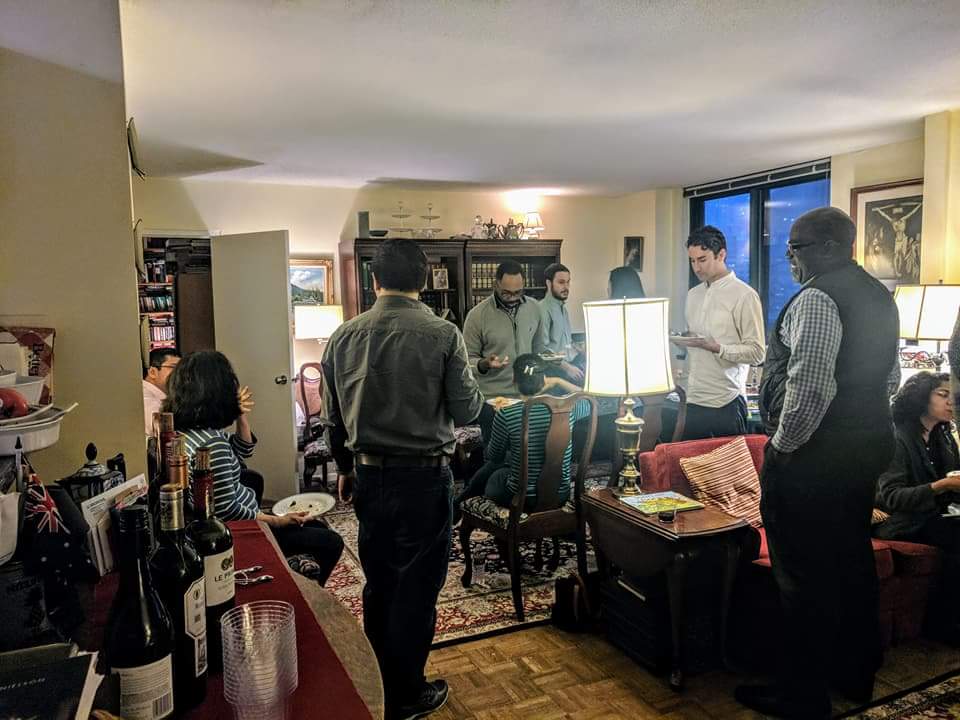
 

Here is Kathy Keller with the cohort students that evening. Such a transparent and strong firm character who supports Tim in the ministry. A lovely godly woman. She co-writes books with Tim.FB_IMG_1522812024096.jpg